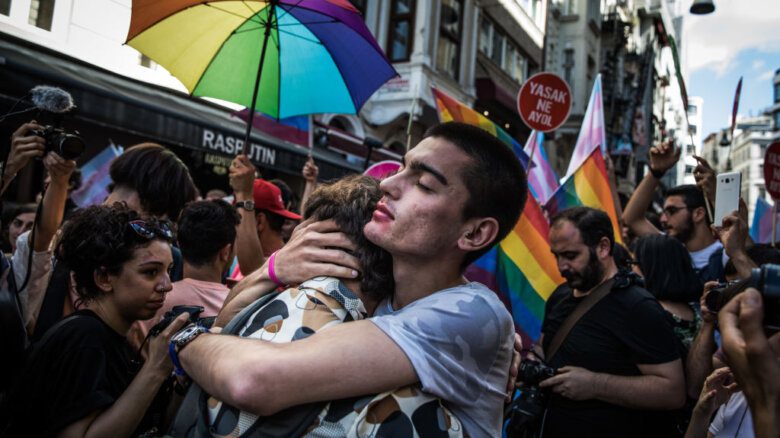
One of the first bills the federal government introduced in the fall sitting of Parliament was a new piece of hate crime legislation that, among other things, will criminalize the display of certain hate symbols. Among some of the voices that I spoke to about this bill for a separate piece that I wrote for National Magazine, there was some cautious optimism that the government was responding to the rise in antisemitism and other hate across the country, which includes hate against the queer and trans communities, but there was also skepticism, and for good reason. In many respects, this bill is going to have little more than symbolic value, but could also be used to over-police already marginalized groups, including the queer and trans communities.
The bill has four constituent components—it creates two new offences around obstruction and intimidation with relations to religious institutions or cultural meeting spaces, which could also include LGBTQ2+ spaces such as community centres, or potentially bars or clubs. It creates a stand-alone crime of hate that is to be layered on top of existing offences rather than treating hate as an aggravating factor with existing offences as the existing hate crime legislation does, and in the doing so, codifies the existing Supreme Court of Canada definition of hate. Finally, it creates an offence around the wilful promotion of hate using symbols such as, per the bill “the Nazi Hakenkreuz, also known as the Nazi swastika, or the Nazi double Sig-Rune, also known as the SS bolts” or signs associated with listed terrorist entities. In addition, it removes the need for Crown prosecutors to get the approval of a provincial attorney general in order to proceed with a hate crime charge.
While there had been calls for more so-called “bubble legislation,” which prohibits protests within a certain radius of prescribed areas (abortion clinics is one example in Ontario), this bill is not that. Those powers don’t belong to the federal government but rather the provinces and municipalities. Nevertheless, the offences around obstruction and intimidation have a component when it comes to defined religious or cultural spaces, which has confused certain media commenters.
While on the face of it, this bill looks like a promising development from the government, and like they’re responding to calls to tackle the rise in hate, particularly from the Jewish community, it nevertheless winds up being a bit of a case of the politician’s syllogism—something must be done; this is something, therefore we must do this. By that, I mean that we already have existing hate crime legislation, and that these new offences add very little to it (and in some cases, could actually make it harder to prosecute hate, according to the analysis of one of the lawyers I spoke to). The real problem has always been enforcement—it requires police to enforce these laws, and to press charges for hate-motivated offences, which they are reluctant to do in so many cases. Creating new offences and tinkering with the Criminal Code does not change this fact, which is why this bill tends to be fairly symbolic overall.
@xtramagazine Pierre Poilievre and the Conservative Party of Canada are going after DEI initiatives in what they’re calling a quest to restore “meritocracy.” The Conservative Party of Canada has launched an online petition calling on Mark Carney’s Liberal government to end its diversity, equity and inclusion initiatives. It specifically calls out bureaucratic funding, research funding and “ideology” at post-secondary institutions. The petition was boosted by Conservative leader Pierre Poilievre on social media, writing “End DEI. Restore the merit principle.” And while this is unlikely to tangibly change anything, all of this political blustering still matters and is worth paying attention to as another example of Poilievre and the Conservatives looking south of the border to get their policy ideas. We break down what you need to know 🌈🇨🇦 #canada #lgbtqnews #politics #pierrepoilievre #cdnpoli ♬ original sound – Xtra Magazine
A number of civil society groups are starting to call for the government to rethink this bill because of the very real possibility that it could inadvertently criminalize legitimate protests. The Canadian Civil Liberties Association and 36 other groups have signed a joint letter calling on the government to either withdraw or amend the bill because of these concerns. The letter lists the broad and vague definition of the intimidation offence as being a vulnerability that can be used to suppress constitutionally protected speech and protest, and says that this could theoretically applied to striking workers protesting outside of their own institutions, though to my mind, this critique misses the language in the bill around the wilful promotion of hatred being part of the offence.
The letter also raises concerns about the display of certain terror symbols, pointing to a lack of transparency or avenues of appeal when it comes to the process of adding organizations to the Listed Terrorist Entities. This is not a frivolous concern—adding groups to the terror list used to be a fairly rigorous technocratic process done by national security agencies, but in recent years, has become a process tainted by politics. Now, it is very much influenced by votes within the House of Commons, or the influence of foreign governments to expand the designation to include criminal cartels, meaning that the definition of what constitutes a terror group no longer has much meaning. Listing the Iranian Revolutionary Guard Corps (IRGC) as a terror entity thanks to political pressure was done in defiance of the very terror listing law because it was supposed to exclude foreign militaries (which the IRGC largely counts as), so you can understand why there is trepidation around what could be included as future hate symbols. This being said, Minister of Justice Sean Fraser did insist that this was not going to include Palestinian flags when this bill was introduced, but that fear has been raised time and again.
The other objection by these groups is that removing the need to get the approval of an attorney general to press hate-related charges removes an institutional check that increases the likelihood of selective enforcement by police, particularly against marginalized communities who are already over-policed and, in certain historical circumstances, have faced police harassment, which includes the queer and trans communities. As well, the stand-alone hate offence could lead to disproportionate sentencing if police biases are at play when they decide which offences get investigated as hate crimes and which ones don’t.
While I do think that the government was trying to come up with some kind of response to the rise in hate, the sad reality is that there is only so much that the federal government can do. So many responses seem to be to tinker with the Criminal Code, which winds up just creating more problems than it solves. This is no exception, but we’re seeing even more of this, particularly around things like the calls for bail reform when the problem is not the law of bail, but the under-resourcing of the courts by provincial governments. Likewise with hate crimes, the problem has always been with the lack of enforcement by local police, and the federal government has very little ability to control that. And once again, we are left with symbolic gestures rather than actual reform that would start with holding those local police to account for their inaction.

 Why you can trust Xtra