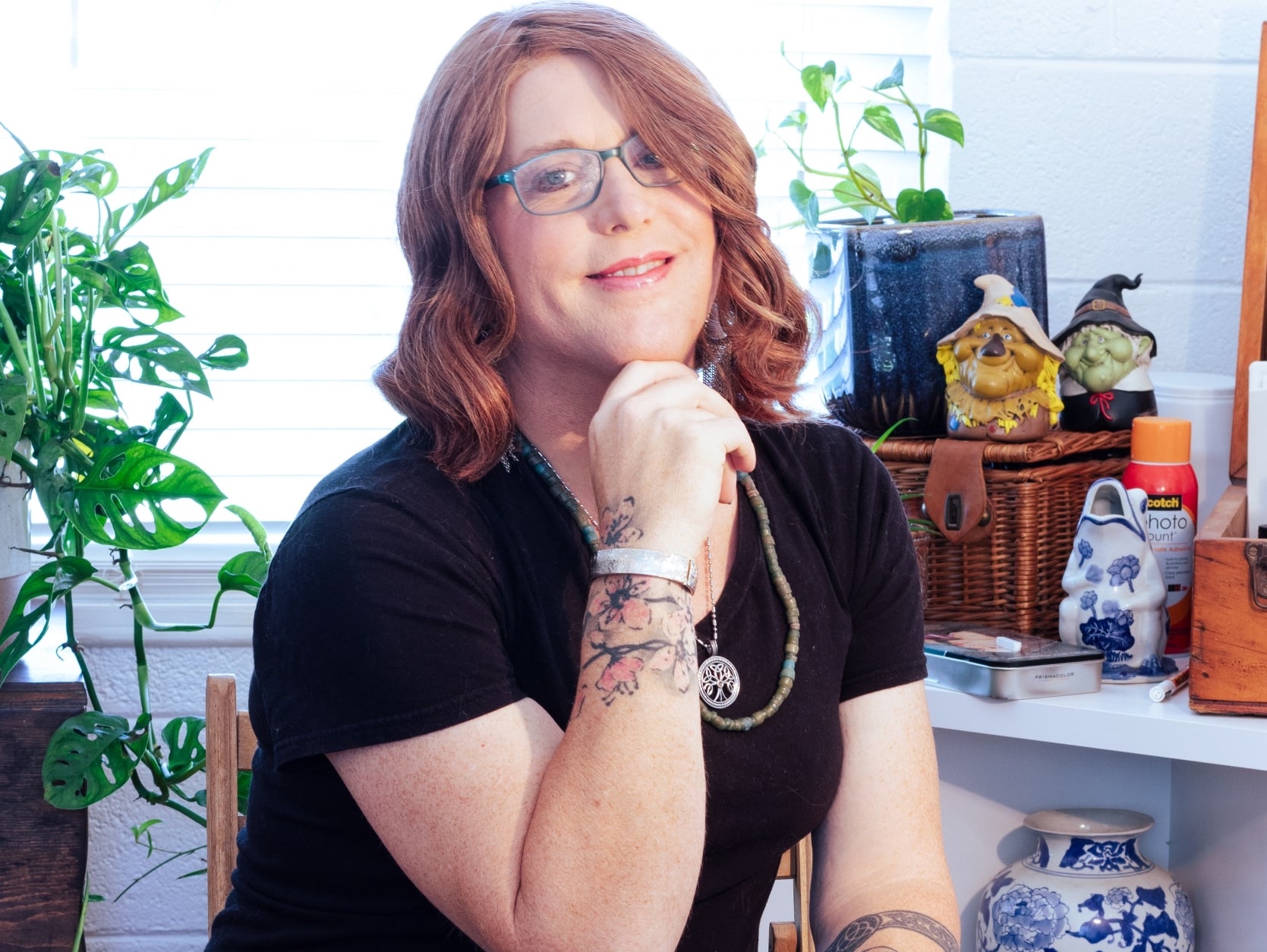
The LGBTQ2S+ advocacy organization Lambda Legal filed suit on Monday in the U.S. District Court for the Northern District of Oklahoma on behalf of three plaintiffs: Rowan Fowler, Allister Hall and a third anonymous party identified under the initials C.R.—all of whom had been denied a gender marker change. Fowler tells Xtra she was “crushed” when she learned in January that her request had been rejected.
“Getting to claim my own name and claim my own identity for the first time was very fulfilling,” she says. “So having that and being able to turn around and change my documents, and then to have the state of Oklahoma tell me, ‘Well, we don’t recognize this and we’re not going to follow through,’ that was rough.”
While birth certificates are typically not needed in daily life as often as other forms of ID, incongruencies can cause problems for trans people, which Fowler says she has experienced firsthand. In the past, she’s faced difficulties in applying for jobs and insurance due to discrepancies in her documents. “There’s an assumption there that we’re siblings or trying to use a relative or parents to try and pull the wool over their eyes, and it just causes all kinds of confusion,” she says.
Lambda Legal alleges that Oklahoma Gov. Kevin Stitt’s November executive order violates trans people’s rights by subjecting them to discrimination and invading their privacy. The order required the State Department of Health to immediately cease amending gender markers on birth certificates and inform the governor’s office of any attempts to overturn the policy in court.
“Possessing accurate identity documents that are consistent with a person’s gender identity—which represents a person’s core internal sense of their own gender—is essential to a person’s basic social, economic, physical, and mental well-being,” Lambda Legal’s suit reads.
Attorneys also point out that accurate identity documents, including birth certificates, are essential for obtaining employment and housing. A 2015 survey from the National Center for Trans Equality (NCTE) found that nearly a third of trans people (32 percent) had experienced discrimination—ranging from verbal harassment to assault—for showing identification that was inconsistent with their physical presentation.
Of survey respondents who had updated their identity documents, very few had updated the name or gender listed on their birth certificate. Just 9 percent had an updated gender marker, the lowest percentage in any category of ID.
“Oklahoma is one of three states that entirely forbid changing the gender marker on one’s birth certificate.”
Respondents to the NCTE survey cited fees associated with changing documents as one of the main reasons for their inconsistent documents, but restrictive and confusing laws also contribute to the situation. Different states have wildly different policies when it comes to requirements for altering names and gender markers on identity documents: California and Maine, for instance, have relatively few requirements, while Montana and Georgia mandate a court order or proof of gender-affirming surgery.
Currently, Oklahoma is one of three states that entirely forbid changing the gender marker on one’s birth certificate, according to the Movement Advancement Project (MAP). West Virginia and Tennessee, the other states that ban gender marker corrections, are also facing legal lawsuits over their policies.
While Oklahoma issued its first birth certificate with an “X” gender marker in October, the option is not yet available to the general public. The November executive order was in part a response to that decision, which stemmed from a legal settlement with a non-binary Oregon resident who was born in Oklahoma. Gov. Stitt publicly condemned the birth certificate’s issuance, blaming “rogue activists who acted without receiving proper approval or oversight” in an October statement.
“I believe that people are created by God to be male or female,” he added. “Period.”
In the executive order, Stitt urged the Oklahoma legislature to pass legislation asserting that non-binary designations on birth certificates are illegal. State senators subsequently introduced Stitt’s suggested bill in February.
The legislation is just one of several bills seeking to restrict the ability of trans Oklahomans to participate in daily life. According to the advocacy group Freedom For All Americans (FFAA), the state has 11 active anti-LGBTQ2S+ bills, including proposals seeking to restrict gender-affirming care for trans youth and ban trans people from participating on sports teams in alignment with their gender. (The sports bill passed a House committee earlier this month and now heads to the floor for a full vote.)
In the face of increasing legislative attacks on trans Americans, Fowler hopes that her suit can represent some small form of hope for trans youth. “The pain is real, what they’re going through,” she says. “Being able to do just this one little thing for them, even just to ensure that when it is their time, they can at least have their name and their marker correct, that makes me feel really good.”

 Why you can trust Xtra