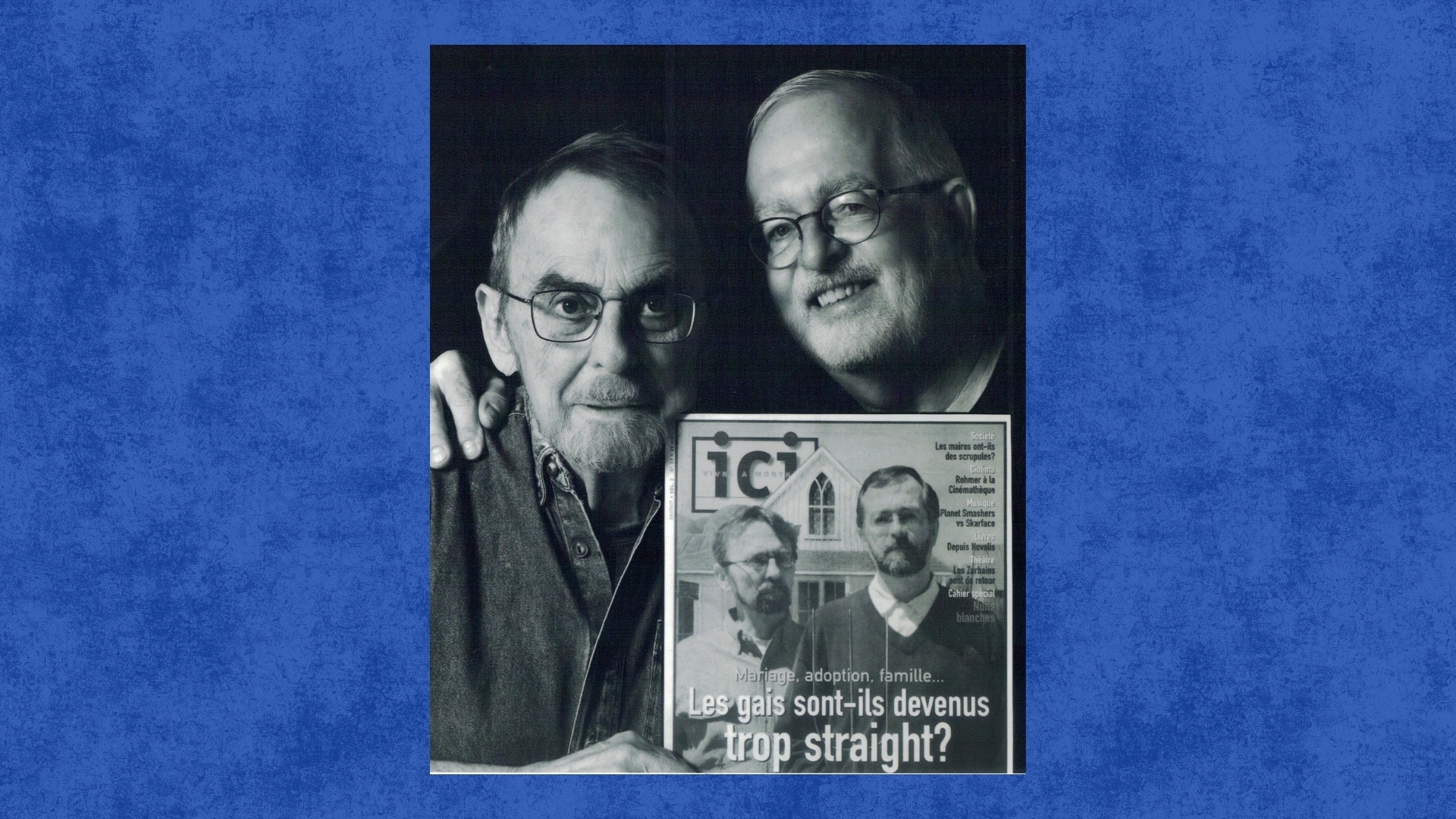
Michael Hendricks passed away on July 18, at the age of 84. He was one of the core members of ACT UP (AIDS Coalition to Unleash Power) Montréal, which was founded in 1989. He went on to be part of a crucial group of LGBTQ2S+ activists (including Roger LeClerc, Douglas Buckley-Couvrette, Claudine Metcalfe and Elizabeth Neve) who met with police regularly during the late ’90s and early 2000s, when Montreal was experiencing a wave of homophobic violence. He and his partner, René Leboeuf, fought to have their marriage legally recognized, and were the first couple to receive that recognition in Quebec in 2004, after years of court battles.
Writing an obituary for Michael is a very complicated thing to do. While interviewing him extensively in the ’90s about his activism, we became friends. He has left such an indelible mark on Quebec’s queer evolution that it’s hard to imagine the milieu without his angry and passionate presence.
Hendricks received MAiD on July 18 after several years of declining health.
“Emphysema [a chronic lung disease] is one of the things that is killing me,” he told me during an interview days before his death.
Last October, one of Montreal’s most renowned theatres, the Théâtre Jean-Duceppe, staged Corps fantômes, a play that recounted the very rocky years of queer existence in Montreal, from 1990 to 1995. I attended and was incredibly impressed with the detailed re-creation of this period. It brought back a jarring flood of memories; this was when I had first become acquainted with Michael and his ACT UP work, interviewing him extensively for articles I wrote for the now-defunct weekly Montreal Mirror and for Xtra, about the frayed relations between Montreal police and the queer community.
I had questions about the veracity of some parts of the play. So I emailed Hendricks to investigate. In particular, the play’s depiction of one 1990 protest at a downtown police station that I myself had attended had included a description of a police officer armed with a rifle on a nearby rooftop. I didn’t recall that, nor had I ever heard anyone describe it.
Hendricks said it was true. We marvelled at the play’s significant attention to key moments in that terrible time—of both the burgeoning AIDS epidemic and intensified violence against men who had sex with men. The creators of the show had interviewed Hendricks and Leboeuf at length and had clearly done their homework.
It was then that Hendricks told me that his health was declining and that he was intending to arrange for MAiD. He and René invited me over for lunch at their home. I suggested we meet again so that I could talk to them about their life together and about Hendricks’s life of activism. They graciously agreed.
What followed were several meetings, mapped out over a couple of months, during which the three of us discussed key events, traumatic moments and their meanings today. Michael was grappling with multiple health issues and was hooked up to an oxygen tank. But his mind was as sharp as ever and his wit was intact.
“The early years were really boring,” he said of childhood and early adulthood in New Jersey and Maryland. “Living among heterosexuals was awful. They’re nice people and everything, but do you really want to spend your entire life around them? It was difficult to realize there was something else.” (While studying at Johns Hopkins University, Michael would get to know a young Divine, John Waters’s legendary cross-dressing muse. “This was before he was Divine. He was skinny and a hairdresser and I knew him as Glenn Milstead. He was very funny.”)
While Michael spent some time in gay bars as a young man, he didn’t feel a sense of queer identity, nor did he think about related activism. “Nothing about activism interested me terribly. I wanted to get laid, like most young men of my generation. We were hoping for sex. I was sure I was heterosexual. I thought I must be! I thought it must be some aberration, these homosexual thoughts. I went for therapy as everyone did back then. We all thought being homosexual was an awful trap. Constant rejection, hating yourself, the empty lives. People didn’t see a way out.” His early struggles to accept himself included a suicide attempt.
After enrolling in various university programs, Hendricks completed a course in computer programming, becoming valuable on the job market at the time. He moved to Manhattan and then, while visiting Montreal, learned that his mother had received a draft notice for him to serve in Vietnam. He chose to stay in Montreal and started a new life while dodging the draft.
Hendricks worked at the National Film Board of Canada for years as a researcher and producer, and realized he wanted to expand his knowledge of the medium, so he enrolled at Concordia’s film studies program (among his professors was noted queer film scholar Thomas Waugh, and they formed a lasting friendship).
@xtramagazine A Toronto man is set to be the first Canadian to be cured of HIV following a stem cell transplant. The 62-year-old patient was diagnosed with HIV in 1999 and was not expected to survive longer than six months as he was also battling a rare and aggressive cancer—Stage 4 Burkitt lymphoma—which had spread to his brain and lymph nodes. The patient’s diagnosis came at the time of the introduction of antiretroviral therapy, also known as ART, which can stop HIV from reproducing and extend the average life expectancies for patients to a near normal length. But HIV patients by and large have to be on ART for the rest of their lives. The genetic material of HIV can be buried into the immune system’s memory cells, allowing for the virus to hide and resurge once a patient comes off of the treatment. The Toronto patient had been taking ART to suppress virus levels since his initial diagnosis. But in 2021, he received a stem cell transplant for his cancer that acted as a “double cure” because it contained a rare genetic mutation resistant to HIV: CCR5-delta32. Four years after the Toronto patient’s stem cell transplant, he was able to stop taking ART in July 2025 and is now in sustained remission with undetectable levels of HIV as of April 2026. If he remains at that level for 20 months, he will join a group of 10 people across the globe considered to be cured of HIV. Learn more from @script.health Managing Editor Ziya Jones. #lgbtqnews #lgbthealth #hivawareness #queerhealth ♬ original sound – Xtra Magazine Advertisement
It was there that things really took a turn for Hendricks. In 1987, a young Black man named Anthony Griffin was arrested by Montreal police. When he fled the police station, Griffin was fatally shot in the back by an officer. His case galvanized Montreal’s Black community and its supporters. Hendricks got involved. “The Black community at the time didn’t trust the police, understandably,” he recalled. “I became a go-between with the police and the Black community. We did what we could to make it better. It was obvious the kid had been murdered and there was no way around it.”
It was at that point when Hendricks realized why activism was so important.
That anger and passion poured directly into his involvement with ACT UP over a decade later. “René and I attended our first meeting in 1989. Some very straight Canadians were asking for a moment of silence at the beginning of the meeting. One very angry young guy began screaming, ‘Moment of silence? What? I want noise!’ He was screaming for half an hour. Some people just ran out of the meeting.
“The ACT UP model was such a good one. It worked. We didn’t know how it worked, but Blane Charles [a former member of ACT UP New York] did. Blane was the soul of ACT UP Montréal.”
ACT UP now seems like common sense, but Hendricks said it didn’t to many at the time. “Many disapproved of such loud and angry activism. People were a bit blind. It was as if they didn’t want to see how many people were dying. But people were dying everywhere in horrible ways. AIDS was unimaginable. It was the sheer number of deaths that destroyed me.”
It was during the mid- to late- ’90s when Hendricks and a handful of other queer activists lobbied the Montreal police to do more about the wave of homophobic violence sweeping over the city. I spoke to Hendricks weekly then about fraught meetings with police and reported on them for the Montreal Mirror and Xtra. The activism ultimately led to far better communication and collaboration between Montreal police and the queer community.
As the AIDS crisis shifted with the arrival of new treatments in the late ’90s, Hendricks and Leboeuf’s focus did too. In 1998, they began their legal challenge to have a legally recognized marriage in Quebec. But they found themselves out of step with many in the queer community. What they found most shocking was the backlash within the queer community itself to the idea of gay men and lesbians getting hitched.
“People were really angry with us,” said Hendricks. “‘Why do you want to do that? What a stupid thing! Why are you wasting your time?’ To us, it seemed obvious. It was about equality. If you don’t want to get married, then don’t. We wanted the choice to do so.”
On April 1, 2004, after six years, several lawyers and an estimated $350,000 in legal expenses, Hendricks and Leboeuf became the first same-sex couple to get legally married in Quebec. (Michael Leshner and Michael Stark were the first to do so in Canada, in Toronto one year earlier.) Hendricks described his relationship with Leboeuf as “the best experience of our lives,” and laughed at how attitudes have shifted so seismically over the issue of gay marriage: “Now no one gives a shit.”
In the two decades since their wedding, the two were inseparable. “We never got a TV,” Hendricks said. “We just love talking and being around each other.”
Hendricks was relieved that he had the option of MAiD as his health continued to worsen. Planning his exit from this world had ignited some harsh memories.
“When AIDS was at its worst, there were people who had to seek out others who would help them to commit suicide,” he said. “It was terribly harsh, because they didn’t want to face the final stages of AIDS, which were terrible. The people who would help them were putting themselves at risk, because it wasn’t legal yet.”
During our final meeting, I could see how frail Michael had become. He told me he remembered the very worst of the AIDS crisis. And then, he did something I had never seen him do: he choked up and cried.
“None of us really had the strength or courage to face up to it. We had to do something. But we were too late. We should have been there sooner.”
I intervened. “Michael, you worked so hard to save lives. You were heroic.”
Michael took a deep breath.
“I’d like to think that. We should have been there sooner.”
 Why you can trust Xtra