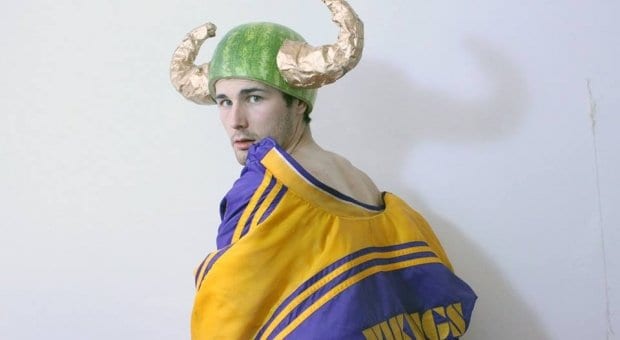
Vikings were fearsome people who raided and explored from the 8th to the mid-11th centuries. For their deeds, most people would say that Viking men were extremely masculine. But why should “masculine” comprise mostly brutal and inelegant traits? Humboldt Magnussen’s upcoming art exhibit expands the boundaries of what should be considered masculine.
Magnussen grew up in rural Saskatchewan. He was an effeminate queer kid, whose dad and auntie were eager to “butch up.” They’d often say, “you’re a Magnussen; you have Viking blood!”
He decided to figure out what it means to be a Viking, and came up with qualities like strength, roughness, and proficiency in battle. “So, I identified as a Viking, but I didn’t identify as all of these things,” Magnussen says. “When I later went to Norway to get in touch with my roots, I decided once and for all I wasn’t this traditional version of masculinity.”
This sparked his interest in how masculinity is, and should be, defined. Coming from the home of the CFL team the Roughriders, football was very much a part of Magnussen’s upbringing. “I was struck by how hyper-masculine football is, and how few ‘out’ queer athletes there were,” Magnussen says. “I decided to make visual representations of what a more inclusive version of masculinity in sports would look like.”
To that end, he did two performances. The first, “We are the Champions,” was a merciless parody meant to humorously undermine the popular conception of masculinity. He staged Swan Lake reinterpreted as a football game, with a watermelon as the football and some “weird, crazier” swans. “I played the role of the prince, and I fell in love with this swan character. We were both male, and we danced together,” Magnussen says.
Taking place at this year’s Rhubarb Festival, the second performance was called “Viking Blood.” It involved three challenges that Magnussen had to overcome in order to prove he was a Viking. He had to prove his strength, skill at navigating and sense of community. He failed. “The voice of the Viking god – in my world he represented hyper-masculinity – said I failed and am not a real Viking. I objected to that, saying I’m a Viking if I want to be,” Magnussen says.
His upcoming exhibit comprises artifacts from both of these events, including helmets and jackets ornamented with glitter, pom-poms, beads – anything kitchy, really. There will also be six photographs from each performance, showcasing not only what masculinity could be, but what a proud queer Viking looks like.
The opening reception for Go Hard or Go Home is Thurs, March 20, 7–10pm. The exhibit is Fri, March 21–Sun, March 23; Tues, March 25–Fri, March 28; and Sun, March 30, at Videofag, 187 Augusta Ave. videofag.com

 Why you can trust Xtra