I always believed that being bilingual would be great for my career. I never thought it would wreak havoc on my relationship with my mother.
Growing up in a Colombian household meant that my immigrant parents made damn sure that we held on to our heritage. They proudly passed down their Spanish to my younger sister and me. Our parents, aunts and uncles would band against us and our cousins, reminding us at every opportunity en español, por favor.
So, for a good couple of years, a younger me dutifully did the grammar-book exercise my parents gave me. Stuttering and pink-cheeked, I’d say, “Hola mucho gusto … bien y tu?” to family friends who swore they knew me as a baby.
It is only now, in my 20s, that I feel I have a good handle on my Spanish, at least conversationally. I introduce myself to extended family with ease, gossip with my sister in public and even coo to my dog, “Mi bebe lindo.” Still, I have come to see my life dichotomized by language.
My Spanish, no matter how well I wield it, has been limited throughout my life. Growing up in the suburbs of southern Ontario, it was only ever spoken with my family, during Saturday evening masses and used to text my parents. Meanwhile, most other aspects of my life were and are in English, from my exploration of identity and friendships at school to my exploration of queerness in online spaces. Even now, my closest relationships, my passions as a writer and artist, and my academics are all conducted in English.
Until recently, I had no issue with these two distinct aspects of my life. I resigned myself to these two lives quickly and quietly. As there was no overlap between my two worlds, there was no cause for concern. I let them coexist, parallel and peaceful, but I was also in denial and wilfully ignorant to an impending disaster.
I had decided a long time ago that I would come out to my parents only after moving out and becoming financially independent. Living with the belief that the love I had from my family was conditional, I expected that my queerness would unravel and complicate many of my familial relationships. Being haunted by this knowledge but ultimately accepting it, I’ve learned that to be queer is to exist without approval; we do so, in spite.
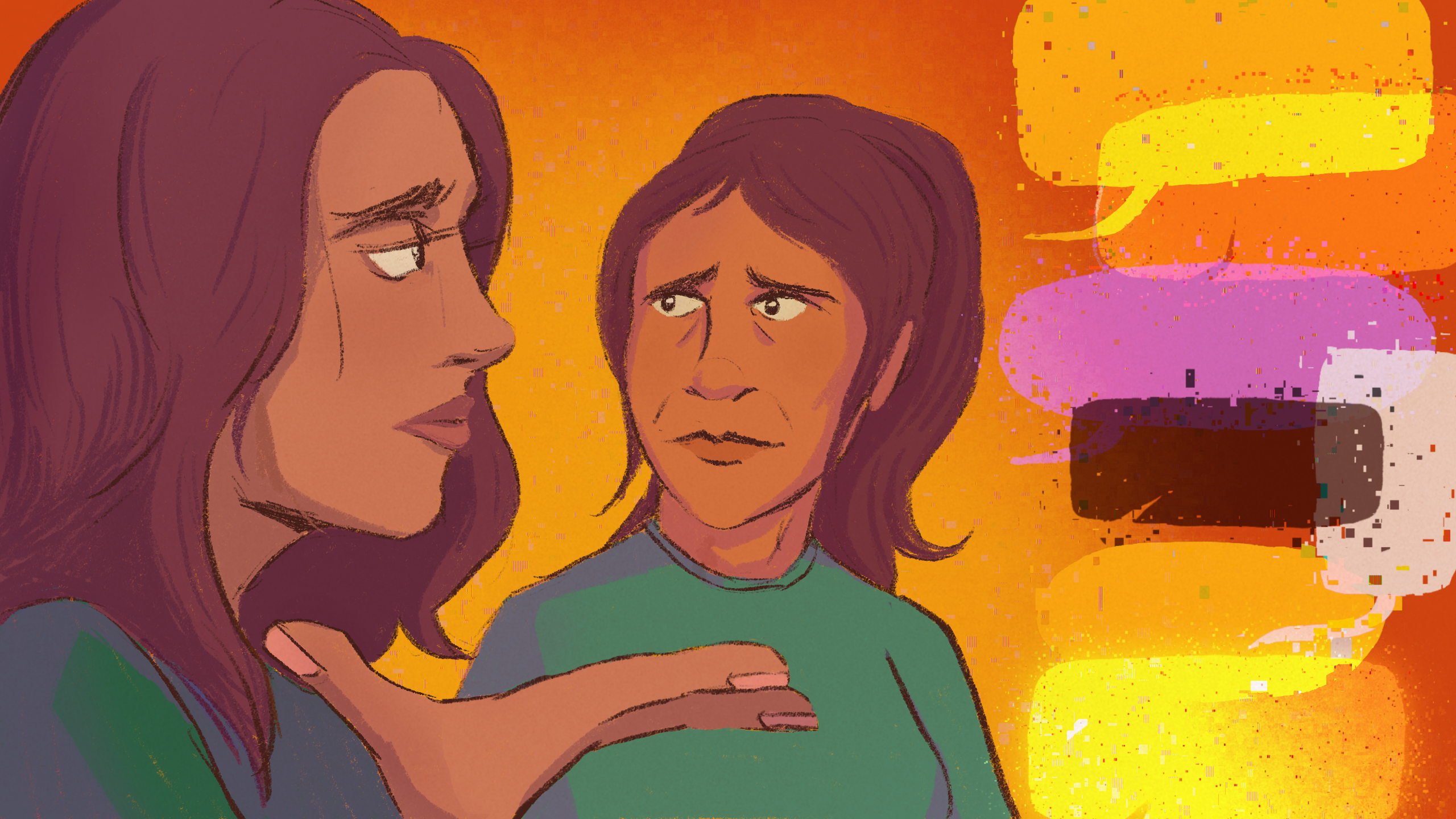
That is, until my mother came knocking at the closet door I was so sure was hidden from her and my father’s view. Until she took me aside one day and told me, “Quiero que sabes que te amo, no importa quien amas.” Until, incredibly, my mother proved this belief of mine wrong and brought my two worlds spinning and crashing into each other.
In that moment, with a twist of panic, I chose to meet her with silence and indifference. My heart frantically beating, I waved my hand, and quickly changed the subject. “Okay… vuelvo a casa más tarde, tengo que ayudar en un evento en la U.” I ignored her attempts at acceptance.
To simply say to my mother, “I’m gay,” seems inadequate and impossible. Ni sé cómo empezaría esa conversación.
Despite my aloofness, my mother continued to express her support for many weeks after this initial conversation. She’d wander into my room to affirm that if she were right, if I were queer, she would receive me with open arms. Still, I continued to dismiss her and even began to avoid being left in a room alone with her. Now, she expresses her openness less often after my consistent dismissals of her gentle gestures and words.
Although my mother has never been an outwardly homophobic person, I hadn’t expected her to be so forward or accepting. After all, it was in Spanish where I learned to assume that queerness was a phenomenon far removed from our family and who we were. Every time I try to imagine my queerness in Spanish, all I hear is my family’s casual usage of marica and maricaditas. My family has not granted me the gift of a queer vocabulary. I’m left frustrated, unable to find the words and phrasing in Spanish to describe my identity. In turn, this leaves my mother heartbroken, and confused as to why I won’t simply take the loving hand she extends to me.
I always thought that if my parents were going to reject my queerness, then it didn’t matter how I would tell them about it. But now, faced with my mother’s eager acceptance, I cannot find the words to explain what I want her to understand. To simply say to my mother, “I’m gay,” seems inadequate and impossible. Ni sé cómo empezaría esa conversación.
On top of this linguistic lack, I don’t feel queer in Spanish. Me siento asentada en lo que mi familia piensa de quién soy en español, en vez de lo que he explorado y cultivado en inglés. I feel like an entirely different person in Spanish, and I have found that this is an experience that is not uncommon amongst multilinguals. Many multilinguals feel and see a difference among their different linguistic selves. Recent studies suggest that this is because each language causes speakers to perceive their realities in a different way. So, perhaps, my two metaphorical worlds aren’t really that metaphorical afterall.
My English self has grown into themself. They are the first of my friends to beg to go out dancing, are loudly passionate and love a good bit. My English self is emotional, a lover and a poet. Conversely, my Spanish self is politely quiet and quite agreeable. My Spanish self is, above anything else, my parents’ daughter. Intelligent, at least based on her grades, responsible and presumably, almost unquestionably, straight and cis.
I know that this distinction I make between my queerness and my Spanish is not an innate quality of the language; it is a learned one, but it torments me all the same.
So now I am left to wonder ¿Cómo se dice, “Mom, I’m queer” en español?
Because gay in my mother tongue tastes and sounds like disappointment. Like Other, like “don’t say that word again,” like whispered disdain.
I wonder if I can let myself be understood in half measures, knowing I may never find all the words I need.
I am left to wonder, because there is no direct translation for the word “queer” in Spanish. Because I have never theorized about queer futurity in Spanish. Because I have never loved someone in Spanish, nor would it feel right or comfortable to.
Because I betray my non-binary identity every time I speak of myself in Spanish, because my mother tongue is gendered and self-referential. ¿Por qué como existo en esta comunidad, si no hay la lengua para describir quién soy? Because I am burdened by the fact that I could never write this essay in Spanish.
There are, however, small bridges, little pieces of vocabulary I have built while trying to amend the relationship between my two worlds since my mom’s knocking. I know that someday, I could introduce una novia or una pareja mia to her. I learned how to say Feliz Orgullo without it feeling awkward. These are a start, but there are still so many other words and ideas and phrases and feelings I am learning to embrace in Spanish.
My mother seems willing to at least try to understand this part of me, and if she doesn’t understand, at least, according to her, she loves me. Still, as someone who insists on clarity, I wonder if I can let myself be understood in half measures, knowing I may never find all the words I need. Tal vez siempre va a estar esta distancia entre mis identidades.
So maybe I will reach for a dictionary and thesaurus, or maybe I will seek to fall in love with someone whose only language is Spanish, force myself into learning and loving and being in Spanish. Perhaps, unfortunately, most likely, at least for the time being, I’ll continue to hold my tongue as my mother continues to wonder and worry, and I’ll leave her waiting at the door.
 Why you can trust Xtra