One of my favourite stories I’ve told in the two years we’ve been writing this column is about Niankhkhnum and Khnumhotep, noblemen (and possible lovers) from the Fifth Dynasty of ancient Egypt, who lived sometime around 2400 BCE.
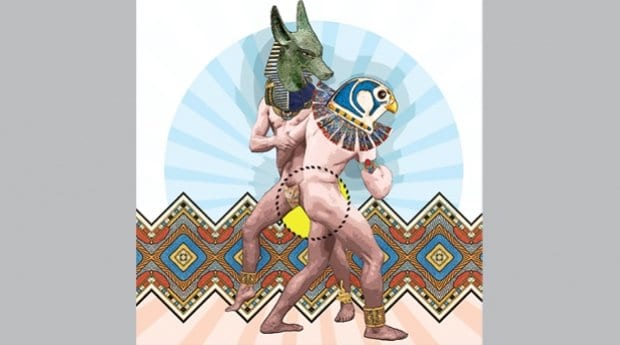
In that article, I mentioned a story called “The Two Divine Brothers,” referenced in a dinner scene depicted in the tomb of Niankhkhnum and Khnumhotep. This was likely a song about the gods Seth and Horus, where the former attempted to seduce the latter after a banquet. While we don’t know the lyrics, the story it was probably based on is pure, filthy raunch.
Seth, god of deserts and chaos, takes into his bed a young Horus and puts his erection between Horus’s legs. Horus catches Seth’s semen in his hands and takes it to show his mother, Isis. She reacts the way any reasonable mother would: she screams, cuts off his hand, throws it in the water and makes him a new one as an apology.
Later, Horus goes to his mother and says Seth wants to sodomize him. Isis counsels her son to take Seth to bed and put his fingers between his buttocks to catch Seth’s seed, then bring it to her without letting it be touched by the sun. Isis throws some of Seth’s semen into a river and puts the rest on some lettuce she gives Seth to eat. When Seth boasts to the gods about fucking the younger deity, Horus denies it. To settle the claim, the gods call forth the seed, which rises from the river and from Seth’s forehead — a whole new dimension to the term “giving yourself a facial.”
A single tomb, however, can’t tell us everything about the world Niankhkhnum and Khnumhotep lived in. What else can we infer about attitudes toward homosexuality in ancient Egypt?
For starters, the Book of the Dead was a funerary text placed in the tomb that included spells designed to preserve the body from demons and help the deceased navigate the afterlife. A section titled “The Protestation of Guiltlessness” was written as a declaration to Osiris, the god of the afterlife, and 41 other gods, detailing deeds the deceased allegedly never had done: acts like murder, blaspheming, being loudmouthed and making someone else cry.
Some refer specifically to homosexual acts, like the protestation that the deceased “did not sexually penetrate another male” or did not “unite oneself with an hm [effeminate male] or with a nkk [passive homosexual].” Others refer to sex acts outside marriage: “I have not committed fornication” or “I have not copulated [illicitly].” While engaging with a sexually passive male partner seems to have been considered less flattering before the gods, homosexuality wasn’t forbidden, and strict heterosexuality wasn’t something everyone could, apparently, claim.
Another story that survives only in fragments discusses the exploits of King Neferkare, possibly the 22nd-century-BCE Pharaoh Pepi II Neferkare. A man named Tjeti is out alone one night when he spots the pharaoh walking. Tjeti thinks to himself, “If it is so, then the rumours about him going out at night are true.” He follows Neferkare, who arrives at the house of General Sasenet, throws a brick after stamping with his foot, then climbs up a ladder that’s been lowered for him.
“After his majesty had done that which he had wanted to do” at the general’s home, he returns to the palace, tailed by Tjeti. The pharaoh spends “four hours” with General Sasenet, which may be a satirical reference to the mythical nightly union of Ra, the sun god, and Osiris, which happens at the darkest hours of the night. These events repeat, with Tjeti following the pharaoh every night until the ruler returns to the palace.
The point of the story is unclear from the fragments, but while ancient Egyptians were certainly concerned with heredity, family hierarchy and fertility, these stories don’t particularly condemn homosexuality. I take a great deal of comfort in the fact that even thousands of years ago, in an early, great civilization, queers — be they gods, pharaohs or mere mortals — were cruising.
History Boys appears in every issue of Xtra.

 Why you can trust Xtra