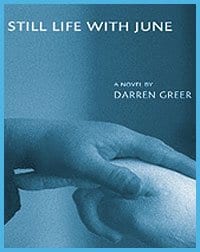
Ottawa writer Darren Greer begins his second novel with anecdotal scenes from a life, in this case a single man’s anxious existence in a seedy flat above a grocery in a nameless city. Cameron is 30-something, losing his hair and has a cat named Juxtaposition – easily the best cat name I’ve encountered in life or fiction.
Cameron’s voice is quickly engaging. Under a surface of casual irony he’s got oceans of simmering anger. Listing his top four personal abominations (Mideast violence, hospital food, Microsoft Word 6, his father) he’s in fact talking circles around his real bogeyman: Hatred of self.
“My cat doesn’t hate herself. If you hate yourself, you don’t spend two hours each day grooming with no chance of ever getting laid.”
The cat is his love and his curse. A few days after he brings her home from the pound, she claims him with a bloody caress in bed, “Saying with four deep claw marks carved incisively into my soft- as-butter rear-end, ‘Your ass is mine, oh great moving radiator.'”
Human love leaves different scars. On Christmas day Cameron heads out to a gay bar and chats up the faux-cowboy bartender. Lust kindles, but Cameron’s jaded heart leaps instinctively to the final scene. “I knew from experience that… after a few weeks or months of sleeping with him there would be another subtle shift in our relations. I’d change from a sex object into a human being. That’s just about the time the bartender/cowboy would dump me. Or I’d dump him, depending on who glimpsed the other’s humanity first.”
Besides working at a Salvation Army drug addict rehab centre, Cameron is also a hack journalist, writing stories under various pseudonyms about his “fellow gay losers” and other chronic underachievers. One of his many writerly pseudonyms is “Darren Greer,” which may mean that our real-life novelist is actually named Cameron Dodds, or simply that real-life author Darren Greer is pulling our leg. We also meet a recovering addict named Darrel Greene, who hangs himself in a closet. Greer is sending cryptic messages, but so far drops no clues on breaking the code.
“As an unsuccessful writer, piss poor, I have to make money somewhere.” The Sally Ann fits the bill, and also offers hope for more hard-luck stories – like the one he digs up when he sneaks a peek at Darrel’s file after his suicide. Darrel has a “retarded” sister (with Down’s Syndrome) who’s been in a locked hospital ward for years. Cameron begins visiting her, passing himself off as her long lost brother.
Meanwhile, he’s been attending a writers’ self-help group in the back room of a “Big Bad Bookstore.” One of the group presents herself as a famous writer, her critiques of the others so confident and scathing that no one thinks to question her credentials. Dagnia takes a shine to Cameron and pays him to spy on her ex-boyfriend, a pianist who happens to live above Cameron’s apartment, where he ceaselessly plays Chopin’s “Funeral March.” Except the “ex” turns out to be her twin brother, and Dagnia turns out to be Julie, not a writer at all.
Readers at this point may well ask why Greer is so intent on teasing us with name-play and hidden identities. It feels like he’s rambling, feeding us empty diversions as he searches for a way into his story – a far cry from his first novel, Tyler’s Cape, which plunged us into dysfunctional family life from the get-go and never lost track of its purpose.
Cameron continues to play writerly games. He begins penning fiction based on the stuff in Darrel’s confidential rehab file, but finds it impossible to make up fictional names. “It had to be the real names, or no names at all.” The short stories are about a family in Three Rivers, Quebec, a daughter with Down’s Syndrome and a mother who hangs herself in the bathroom.
Greer seems pretty much to write whatever comes into his head, from paraphrases of Nietzsche to extended (and banal) e-mail exchanges, to a completely unnecessary mini-history of the Three Rivers region. Three- quarters of the way into the book it still feels like an energetic, aimless second draft.
In the final pages, Cameron unveils his real story and true identity, and the novel at last overcomes its galloping self-indulgence. Pages and pages of material could have been cut from this book, and it would only be better for it. Thankfully, Greer’s closing punch is a powerful one, and offers a smart take on the mysterious and symbiotic relationship between art and life. But it’s a long slog getting there.
STILL LIFE WITH JUNE.
Darren Greer.
Cormorant Books.
335 pages. $29.95.
 Why you can trust Xtra