It was a hopeful atmosphere last November at Watch Me! Sports Bar in Long Beach, near L.A., as bartenders poured spontaneous blue shots for regulars and newcomers alike while waiting for the election results to come in, tentatively celebratory about dodging another Trump presidency.
The bar, which is known for screening women’s sports and fostering an accepting and inclusive environment, was packed full of folks who had chosen specifically to take in the election results surrounded by their chosen community, people who had wanted to be around others who they knew were safe, whether the results were what they hoped for or not.
As the night went on, the bar’s founder and owner, Jax Diener, says she felt the air leave the room.
“People were crying, people were scared and people felt that their rights were being taken away as human beings,” Diener says. “I felt a really big responsibility at that point. I had felt that already, but it changed that night.”
While the bar’s clientele processed their shock and grief at the election results, Diener was reminded of why she and her wife, Megan Eddy, opened the bar in the first place—and why now is a more important time than ever to make sure it keeps thriving.
“It’s a very pivotal time to be us, and we need to let people know we’re not going anywhere, you’re always welcome here,” Diener says.
With the Trump administration targeting LGBTQ2S+ people across the U.S., it’s been hard to stay positive, she says. In February, Trump signed an executive order banning trans women from competing in women’s sports, and his time in office has seen hit after hit on the queer community, from slashing DEI to cancelling hundreds of grants that funded LGBTQ2S+ health research.
But despite the continued attacks on queer people, the popularity of women’s sports bars, which typically attract a large queer clientele, hasn’t slowed. In fact, more women’s sports bars than ever before are popping up from coast to coast, with the number of bars expected to quadruple across America by the end of the year.
Like many other women’s sports bar owners, opening a spot had been on Diener’s mind for years, but it wasn’t until she saw Jenny Nguyen open The Sports Bra in Portland, Oregon, in 2022, that she realized her dream could really become reality.
Considered by most to be the first bar of its kind, Nguyen told CNBC that “the only competition is the status quo,” and by catering to fans often pushed out of sports spaces, she tapped into an unfed market, with her business racking in almost $1 million in its first eight months.
Nguyen has continued to be a key player in the ongoing success of women’s sports bars. Just last year, The Sports Bra announced that it had received a major investment from the 776 Foundation, owned by Alexis Ohanian, co-founder of Reddit and husband of tennis player Serena Williams who herself has always been vocal about supporting women in sport and has been a big draw for fans at Nguyen’s bar. With that investment, The Sports Bra is franchising, with plans to open locations in cities across the States, fostering more women’s sports and community building.
“Our community needs this now more than ever, we have to be this beacon, this place for people to feel safe.”
Watching Nguyen not just succeed in opening her bar but thrive doing it made Diener believe that women’s sports bars could be truly profitable, and seeing another women’s sports bar succeed on such a large scale is certainly a driver for other bar owners, with many taking the plunge to open their own businesses despite uncertain political times. One of the newest bars doing just that is The W Sports Bar, co-founded by Ally Eclarin, Shelley Pippin and Cassy Kopp in Cleveland, Ohio. Just two weeks after the presidential election, the trio announced their plans to open their bar, and they celebrated their grand opening on May 17. Eclarin says that the timing was no accident.
“We all talked to each other the day after the election and just asked ourselves, ‘Knowing this world we’re going into, do we do this?’” Eclarin says. “And we all said ‘Hell yeah.’”
Eclarin and her co-founders had spoken with locals excited about the bar’s opening. “Our community needs this now more than ever, we have to be this beacon, this place for people to feel safe,” Eclarin says. “We had to ask ourselves, ‘What can we do? What can we control?’ We can open a space like this, that’s an anchor for people.”
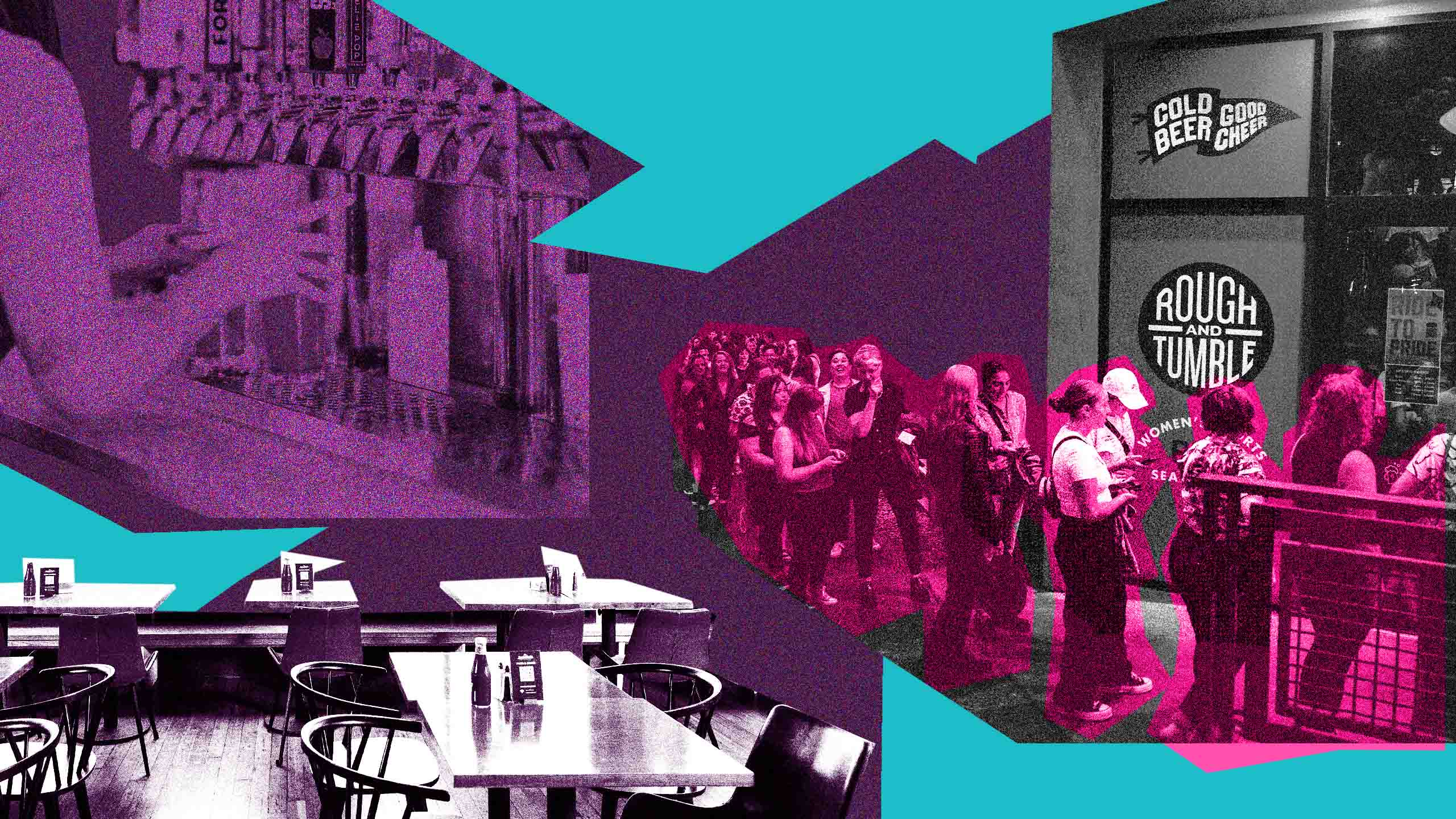
Jen Barnes, who owns Rough & Tumble Pub in Seattle, Washington, says that it’s been exciting to see more bars open their doors. “We need more spaces like this, and if we can be one of them, that’s a start,” Barnes says.
Rough & Tumble opened in 2022, with the mission of making women’s sports accessible for everybody. Throngs of regulars now make up the usual clientele, and Barnes says she’s seen friendships blossom at the pub—she’s even seen not just one, but several couples who met at the bar end up getting married.
As the community surrounding the pub has grown, Barnes said the space has adapted, hosting all sorts of celebrations alongside its regular programming. Barnes said it’s become a sort of “third place”—a space outside of the home or workplace where people connect with their community.
She’s hosted multiple queer weddings, baby showers, celebrations of life, divorce ceremonies, birthdays and anniversaries at the pub. “These are such big, defining moments in our own life timelines, and it’s such an honour that Rough & Tumble is the place that so many people want to come to,” Barnes says.
Being a multi-use space is becoming a common feature of many women’s sports bars. The team at The W have built a stage in their space for events like drag shows and concerts, and have even installed a podcast studio that can be rented out, as well as a separate events room and an outdoor patio that’s fully accessible, like the rest of the bar. Eclarin says that they wanted to make a one-stop-shop to fulfill community needs that she didn’t see being fully met elsewhere. “We’re kind of scratching every itch,” Eclarin says.
Over in Chicago, Whiskey Girl Tavern is also becoming a community staple. They too have hosted a variety of events, including birthday parties and going-away parties, and they’ve watched as more and more people have become women’s sports fans throughout their years of business.
“It’s been really satisfying to watch how we’ve been an active part of the development of the sports fan base,” says Heather Roberts, who opened the bar in the summer of 2022, with her wife, Christina Roberts.
“When we started out, it was about half the people that came in were there to watch women’s sports, and then the other half kind of just got pulled into it, because they happened to be there and realized how much fun it was,” Roberts says.
Roberts says that there are plenty of regulars at Whiskey Girl Tavern—and it’s not just women. “We’ve actually seen a lot of our male customers that come in to watch men’s sports really start watching a lot more women’s sports,” she says. “I think that’s an important part of the equation of building the audiences for women’s sports, is that it isn’t just women, it’s everybody.”
This sentiment is being tapped into across the border too. Though the expansion of women’s sports bars hasn’t been as fervent in Canada—one of Canada’s better-known women’s sports bars, Peaches, in Toronto, recently shuttered its doors permanently—there are still local businesses carving out the space.
One of those spots is Champs Sports Bar in Montreal, Quebec, which attracted a largely queer clientele when it reopened after a hiatus a few years ago. It soon became known for broadcasting women’s sports on its screens, with coverage of the Professional Women’s Hockey League (PWHL) being a major draw for local fans.
Saz Zenetzis is a former bartender at Champs who was working there at the time of writing. Their legacy at the bar includes the creation of weekly Dyke Nights, which are being kept alive by the city’s queer community even after Zenetzis’s departure from the bar.
Zenetzis says it’s vital that bars like Champs provide a safe place to connect for all members of a community. “I think we need queer spaces in general, and I think we also need spaces where queer people and their allies can exist in the same place and enjoy the same things,” they say. “I feel like sports is such a great way for that meshing to happen.”
Running a space where that’s a priority hasn’t always been easy. The bar has faced ongoing noise complaints and, in March, even had to close its doors for five days. They’ve not been able to host community events like drag shows and line dancing as a result.
“That’s stuff that would bring a lot of money into the bar. I think we’re definitely not the only place in Montreal that’s been hit with noise complaints and punishments. It’s been a struggle,” they say, “but we need to keep doing what we’re doing in spite of it. Nobody wants to give up on the bar, especially not the staff. We love it here, and someone needs to fight for these spaces to stay open.”
The past few months have shown that it’s impossible to know what the future holds for these bars. In the weeks after the election, Diener said that her business saw a noticeable dip in customers as people mourned the outcome, and she’s concerned about what could lie ahead with tariffs casting uncertainty on alcohol and food costs.
But while many are still grieving the state of global politics, it’s clear that there’s a more urgent need than ever for spaces to exist to help communities get through it. And, it seems, those spaces can financially thrive while doing it.
“I think women’s sports will save the world,” Barnes says. “We can be a place that feels good, and safe, and beautiful, and be a reminder that it wasn’t always like this and it will go back to something good.”

 Why you can trust Xtra