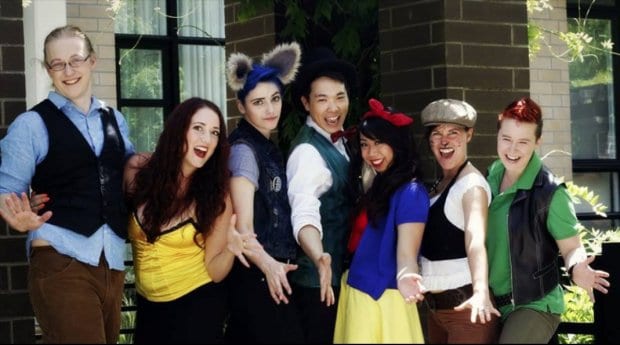
Fairy tales have been conveying moral lessons for hundreds of years, or thousands, depending how we define the term.
Lisa Simon figured it was time to update some of those teachings for the 21st century, so she set out to write and produce A Modern Fairy Tale, which premiered Aug 19, 2015, at the Metro Theatre.
“I’m kind of obsessed with fairy tales and I find them really interesting,” she says, “but I also find them really heteronormative because it’s always the princess meets the prince and then they fall in love, even though they don’t know each other, and then they get married.”
Simon thought it would be fun to mash up familiar stories and throw in some musical parody to update the lessons while inverting some of the characters’ sexual and gender identities.
The California native, a long-time performer but first-time director and playwright, has studied interactive arts and visual storytelling and is now pursuing a Master’s degree in forensic anthropology. Theatre is her creative outlet.
In one of several complementary story lines woven through A Modern Fairy Tale, Wolf has it bad for Red — as in Riding Hood — but in an endearing, nonviolent, consensual way. Still, their relationship faces hurdles.
There’s the stigma of inter-species relationships in Kingdom Town — a stigma that does not extend to queer relationships — plus, Red’s persistent ex, Hunter, is a really bad seed (though a really groovy dancer). And Granny has her own devious motives.
“Hunter is kind of an a-hole, a bit of a turd, a representative of toxic masculinity you could say,” says Sasja Towe, who brings Wolf to life with androgynous charm.
“Wolf is genderqueer, like I am as well,” Towe notes, “so their gender pronouns are they, their, them as opposed to she/her or he/him.”
As these things often do, the action centres around the lead-up to and climactic drama of a castle ball. Ever since Cinder moved into the castle with Chuck Charming, he’s taken to inviting the animal-people to the frequent balls. Social integration has its frictions — sometimes violent, sometimes verbal.
There is some violence in the play, which is actually quite vivid and disturbing, yet also, in one case, performed as a gauzy ballet that conveys horror with incongruous, fluid artfulness.
“The moral at the centre of this particular story has very much to do with consent and with acceptance of all people,” Towe says. “You look at the old fairy tales, there is a lot of non-consent happening in them. There is a lot of what we would call sexual assault today happening in those stories when you look at them with a fine-tooth comb.”
Yesterday’s poison apples are today’s roofies; the kiss that seals forever love could be a form of forced marriage. In a subtle way, these are some of the lessons A Modern Fairy Tale addresses with glee and wit.
Beyond the issues of unconscious princesses and unwanted advances, there is the overlay of prejudice against animal-people merely because they have rabbit ears or fox tails.
It’s an ambitious undertaking performed admirably, with a few truly standout voice and dance performances.
A Modern Fairy Tale
Runs most nights until Aug 30, 2015, 7pm, plus some matinees
Metro Theatre, 1370 SW Marine Dr, Vancouver
More info on their Facebook page.
 Why you can trust Xtra