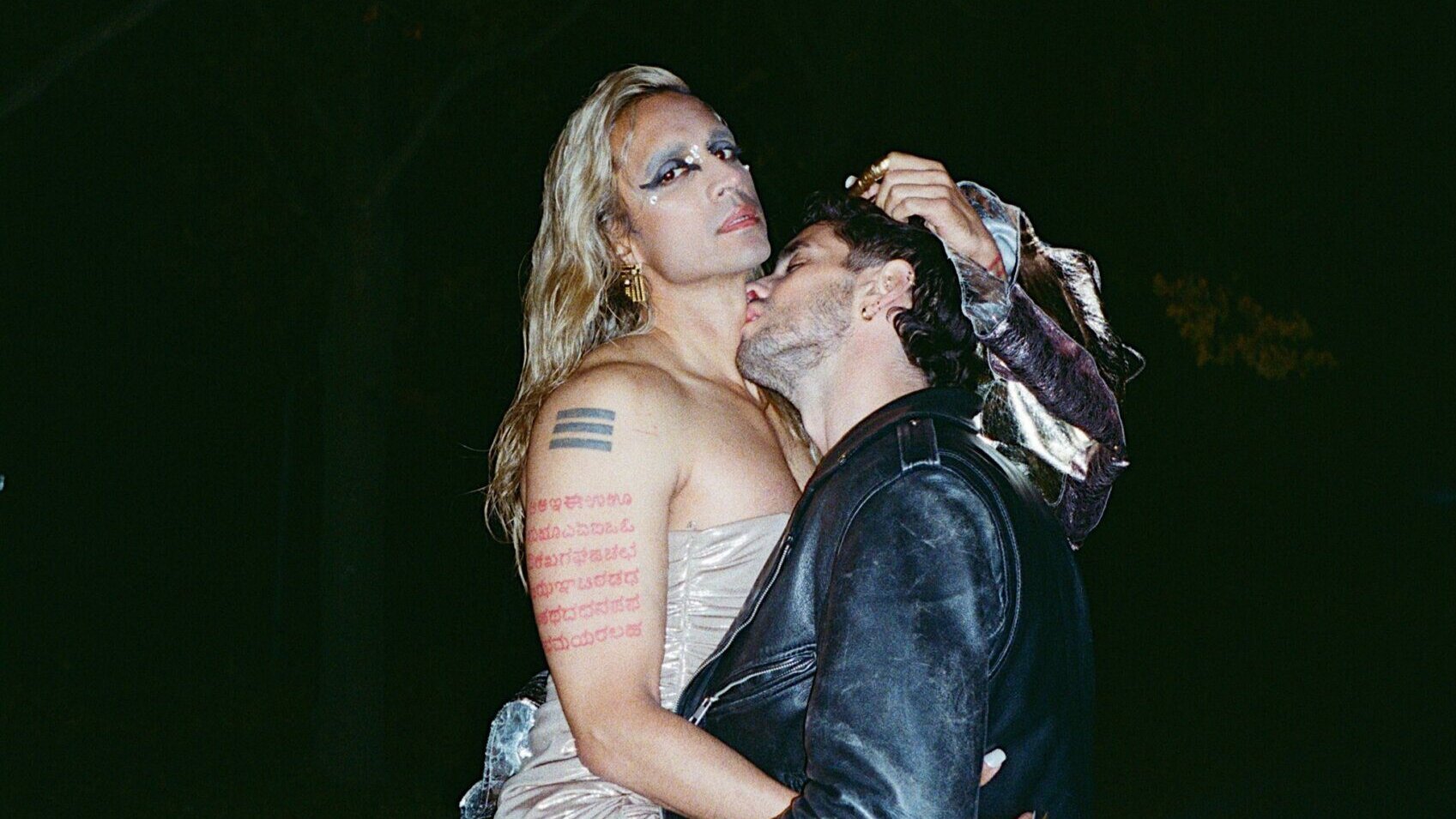
“What is appropriate for women and femmes to reveal about our desires?” This question, posed by multi-hyphenate artist and Toronto darling Vivek Shraya, is at the heart of her 12th solo album, VIVICA. Released this month, the new record takes its name from Shraya’s alter ego—a passionate, blond and uninhibited character who ventures into every shadowy corner of her sexuality. Part provocation, part dance-floor curation, VIVICA is “brash and egotistical,” according to Shraya—qualities the artist doesn’t necessarily claim for herself, but which she clearly wants to explore.
VIVICA is the result of a multi-year collaboration with producer James Bunton and photographer Christopher Sherman, who were instrumental in creating the album’s sound and visual direction, respectively. Together, Bunton, Sherman and Shraya have constructed a fully realized persona grounded in thinly veiled sexual innuendo and ’90s club references. The album leans into atmosphere and sensation over subtlety: these are the kind of beats you’d expect from a basement DJ at your favourite Berlin rave, not from a renowned activist and author. And that’s precisely the point. In the guise of VIVICA, Shraya discusses topics ranging from masturbation to group sex without batting an eye, inviting listeners to her brunch table or meeting them at the leather event. Citing SOPHIE and Beyoncé as influences, she blends hyperpop and experimental rhythm in an oversaturated palette that feels equally indebted to queer nightlife as it does to early-aughts maximalism. For some, these songs may be overwhelming. For the right audience, they’re absolutely exhilarating.
Xtra caught up with Shraya to discuss the ins and outs of her artistic process, her love of collaboration and the code-switching necessary to birth her effusive and unbridled alter ego.
Even though you say Vivica is your alter ego, this project seems in line with who you are as an artist and a person. What do you see as the difference between Vivek and Vivica?
A lot of the things that are said on the album are things that I wouldn’t normally say. It’s quite explicit, raunchy and kinky. The more I got into creating and inhabiting this character, the more the character grew, the more exciting it was to think of her as separate from me. I like to be in bed by 9:30, and I see her as going to the after, and the after-after. I live by my Google spreadsheet and my Google Calendar; she doesn’t know what Google anything is, you know?
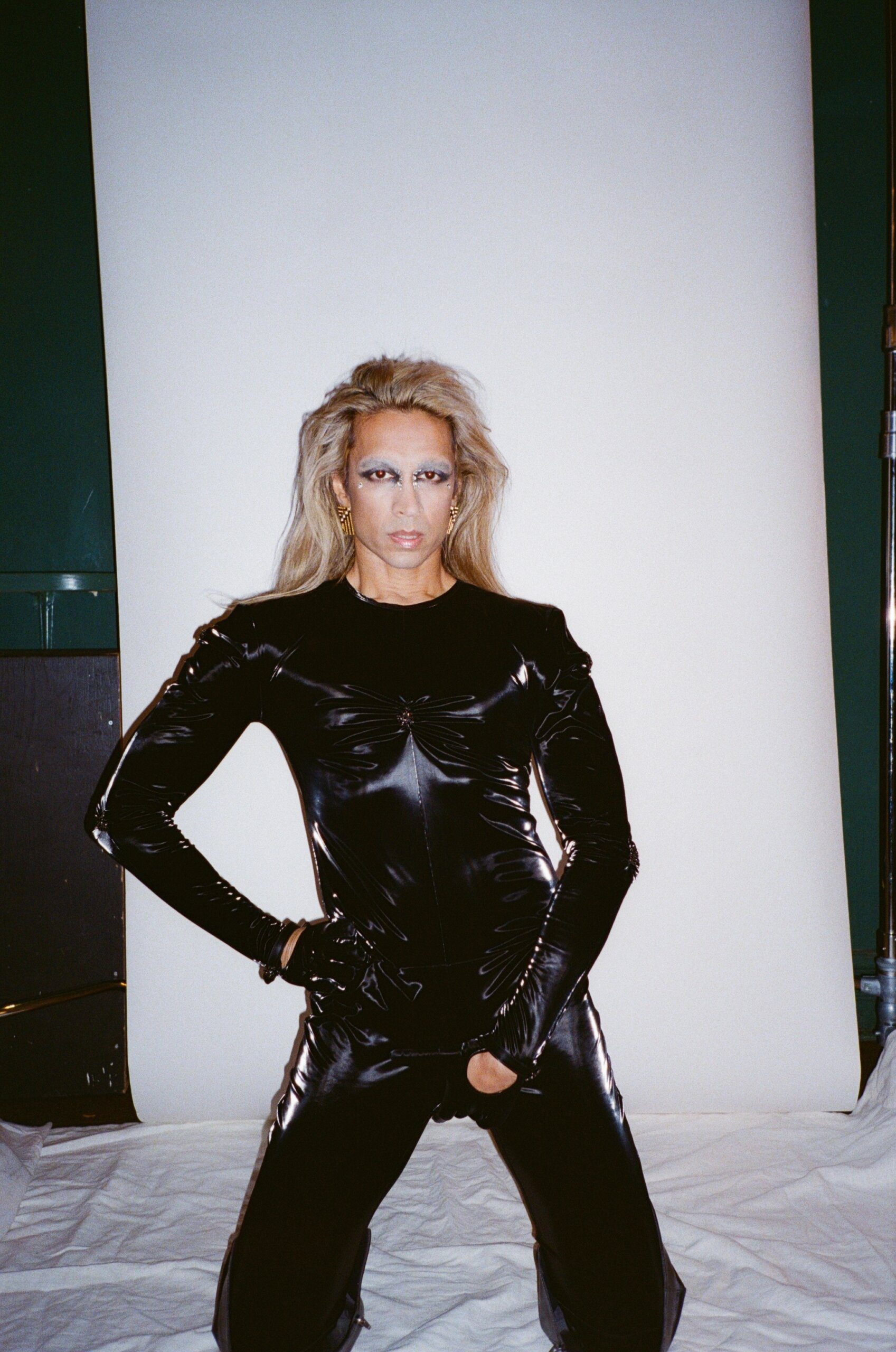
Even aesthetically, her look is always with bleached brows, which I’ve never done before. I always have my waterline filled in with eyeliner, but with Vivica, I said absolutely no waterline. It seems small, but I’m hoping all these things together create a more distinguished character.
You’re calling VIVICA a horny dance album. How does it feel to be exploring your sexuality in this way for the first time at 44?
Because of the homophobia I experienced growing up in a smaller city like Edmonton, I used to be quite disconnected from my sexuality. I managed that by trying to distance myself from my queerness. It has taken me a long time to embrace my desire—I’m definitely a bit of a late bloomer. My joke with this project is that before I met [creative director] Christopher Sherman, whose aesthetic is very free, I’d kissed, like, five people, and now it’s closer to 20.
In pop culture, it’s also not something you really see. When I think about artists who have made albums that explore sexuality, the ones that come to mind are Madonna’s Erotica and Beyoncé’s self-titled. Both were in their early 30s when they put out those albums. Kim Petras was only 29 when she put out Slut Pop.
Credit: Christopher Sherman
It’s almost impossible to avoid internalizing the idea that, past your 40s, you should be focused on things other than sex. Did you have to let go of some inhibitions to make VIVICA happen?
It was a process throughout the songwriting. When we wrote the first song, which I incidentally ended up cutting from the project, it was called “Succumb.” The last songs I wrote are called “Crass” and “Some Weird Shit.” You can even tell from the titles that it got raunchier and dirtier. Some of the lyrics in “Some Weird Shit” are like, “What if I want to fuck your belly button?” That is not what I was writing at the beginning of the project.
The more I got into it, the more I let myself go. That’s what’s exciting about an alter ego: she became a device to say not only things that I’ve never said before but also to explore a whole other world of sexual confidence.
So, these are not necessarily things that you yourself are feeling or thinking?
No, exactly! It was funny shooting the visuals because then I had to lip-sync to these things that I don’t necessarily identify with.
I was really fascinated by the song “3WAY.” That one feels like you’re speaking from inside a character.
That’s my first speaking interlude at the beginning of a song! It’s straddling that line. When you have a moment where this character is just talking, and she’s giggling, you get a sense of her. As someone who grew up in the ’90s, I always think of that one song by All Saints. Those speaking moments can be iconic in and of themselves, so it was fun to think about how this character might go about it.
I love that song because you’re basically telling monogamous couples “Let me deliver you from your shackles.” It’s subversive in a different way than I was expecting.
I do not like the middle position in threesome situations. But Vivica does. Power to her.
Another song I loved was the one the album is named after, “Vivica.” You use the word “need” repeatedly in your lyrics: what is that word doing for you in the song, and within the project as a whole?
That song was really inspired by the film Babygirl. That scene where “Father Figure” came on was such a beautiful, sexy scene. I love George Michael, and I really wanted to write my own version of “Father Figure.” In a way, Vivica transcends the parent in that song. And this is where we’re very different: I don’t believe that a healthy partner needs to fulfill all your needs. But Vivica does. I mean, she’s completely deranged.
It’s also meant to be romantic, in a weird way. I think we’ve all experienced those first few weeks of being with someone, where it’s all-encompassing and isn’t necessarily healthy. The whole project is about desire, but desire sometimes can sound a bit formal. I think “need” is the raw version of desire.
Given that the project is different from your usual pop vibe, which leans more toward emotionality, who were you picturing as your audience when writing this album?
I wasn’t thinking of an audience as much as I was thinking of dance environments. Whether it’s a house party or at the club, I was thinking less about demographics and more about where I’d want to hear that song. If I couldn’t place it, it didn’t make the cut.
It sounds like you do have experience with the dance scene, even though you say you go to bed at 9:30! Are you someone who might hear these songs yourself on a night out?
I hope so! I went out more in my 20s. After COVID, I’ve taken a long time to feel comfortable in those environments. But last year, when my partner turned 44, one of his resolutions was to go dancing more, so we’ve been rediscovering the club. But I’m not the biggest party animal in the world. I go out maybe once a quarter?
I want to dive a bit deeper into your process. What did writing these songs look like for you?
I’ve been working with my collaborator, James Bunton, for about 10 years now. He first came on as a producer and has worked on most of my albums. Over time, we’ve also started songwriting together, and many of these songs were built from scratch as a collaboration.
Sometimes he’ll send me a beat, and I’ll come up with an idea, and then we’ll sit together to shape the lyrics and hash things out. Other times, I’ll bring in a melodic idea—since that’s usually how things come to me—and we’ll build the production around it, working through the lyrics together.
There’s a lot of back and forth, and what’s great is that James always asks thoughtful questions. With this project, because it involved a new character, those questions extended beyond the songwriting itself. We spent a lot of time figuring out who she is. I even put together a whole Google folder with photo references and personality charts. It became about defining her parameters and making sure the lyrics stayed true to the traits I’d given her.
Credit: Christopher Sherman
Who else helped you bring Vivica to life?
I’ve been working with [costume designer] Mic. Carter for almost ten years. He’s an amazing queer Black designer. When I was touring in my 30s, I found it frustrating to have to think of an outfit to wear every day, so I got really into the idea of a costume. Mic. designed a lot of costumes for me. He knows the things I’m drawn to and what I’m comfortable with.
For this project, I reached out to him and said, “Let’s do stuff we haven’t done before. All the things I would usually say no to, let’s say yes.” In one outfit, my ass is literally hanging out. I think it was fun for him.
You work with a lot of Toronto artists, and I know that’s always been part of your practice.
I say this unironically: I think Toronto is the greatest city in the world. Wait for my next album, when I’m on the CN Tower like Drake. I’m kidding, but I think there is so much amazing talent here, and so much of it gets ignored because we’re so bad at supporting our own. I’m constantly paying attention to art that’s happening here, and in Canada more broadly.
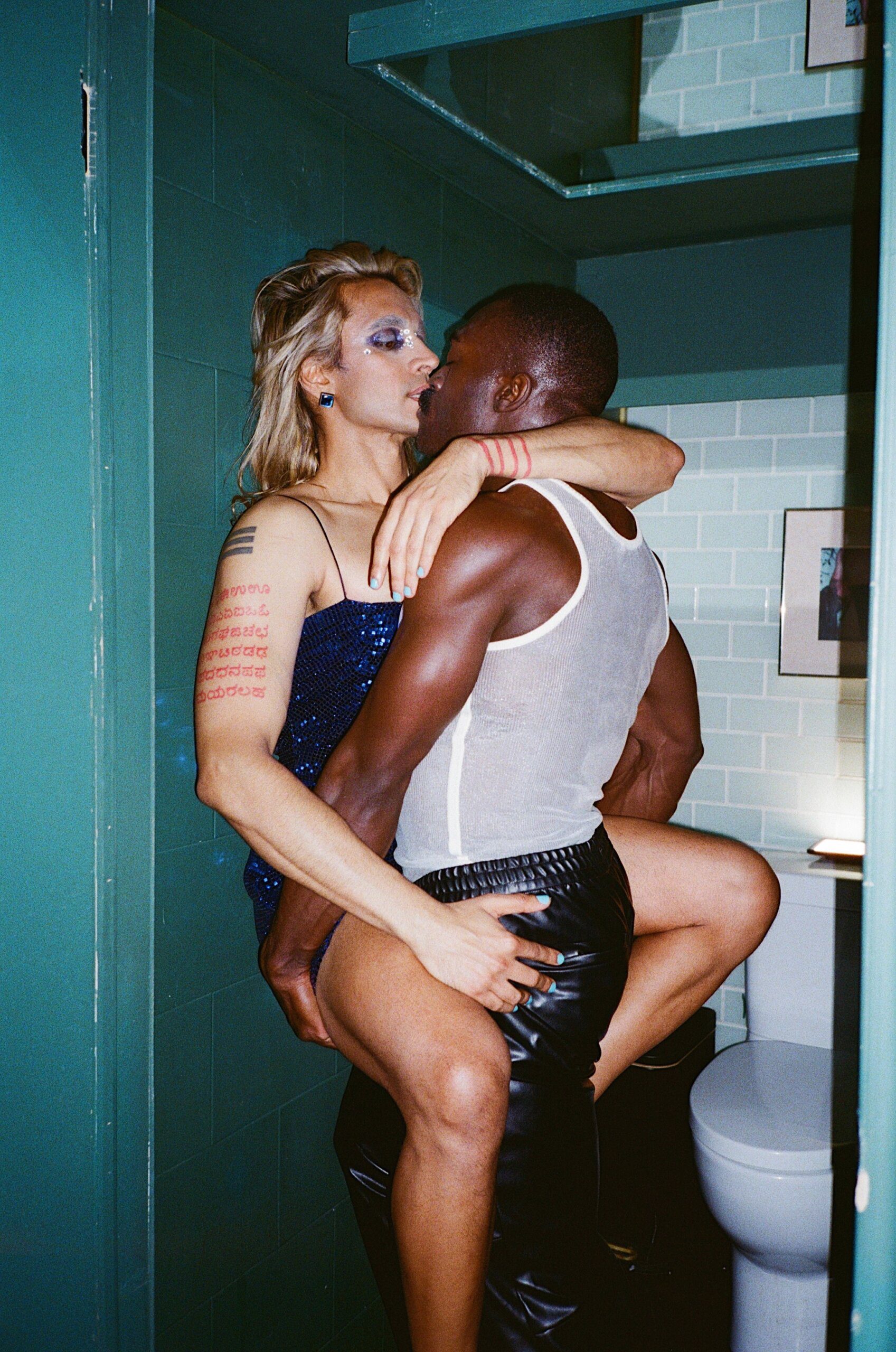
I have to give a shoutout to Toronto businesses as well. We shot a lot of our visuals at Three Dollar Bill, and they were so lovely to work with. To me, the fact that there’s a queer bar in Toronto in 2026 feels so important to support.
VIVICA feels like a departure from your usual aesthetic, but I’ve also seen hints of her in your work up to this point. Did you feel like her birth was a long time coming?
Totally. After turning 40, I’ve had a bit of an agenda around wanting to express more sexuality in my work. It had crossed my mind to make a more sexually explicit album, but it wasn’t a conscious decision. When I started working on these tracks with James in 2024, the beats were just really sexy, and the project evolved from there.
The visuals for VIVICA were inspired by a ’90s sex tape, voyeuristic vibe. I also cut down on my usual editing: the final videos for this project were probably only the fourth cut, as opposed to the 12th cut. What separates these visuals from previous ones is how free and fluid they are, the lack of rigidity, the lack of lip sync and the emphasis on aesthetic and fashion.
Were you inspired by any other alter-ego projects, in particular?
Sasha Fierce comes up a bunch. But what makes this project different from a regular alter ego is that I really wanted the vocals to sound different. There is not a single pure vocal on this album: everything has been modulated and pitched. My favourite compliment is when friends tell me, “I would never know this was you.”
As a trans person who hasn’t gone through gender reassignment surgery or taken hormones, I see this project as a form of sonic transition. This character has allowed me to embody a kind of voice that I can’t tap into. I was initially trying to pitch the voice higher because one of my greatest melancholies in life is that I don’t sound like a cis woman, but it ended up sounding chipmunk-y. There is something about pitching it down that gives it a bass and a roundness that is appealing in a different way and can still be feminine.
You work in so many different media. Why did VIVICA have to be an album?
There are things you can get away with in a pop song that you can’t say anywhere else. I wrote a song for my TV show called “I’m a Fag for You,” and I love when straight people get into that song. They’re like, “I love that ‘I’m a Fag for You’ song!” and I’m like, “Yeah, you do!” If a song is catchy, there’s a desire to still own it in a particular way.
Like when straight people are singing their heart out to “Good Luck, Babe!” at karaoke. You’re also allowing other people to create their own alter egos by making these songs. They can lip-sync for two or three minutes and then go back to their regular life.
Exactly.
What do you feel had to come together for this project to be possible?
On the surface, this is a horny dance album, but there is still a politic tied to it. It’s a product of a time where trans people and trans rights are being eviscerated. I felt that one of the most radical things I could do is own my transness and my desires in a world that tells me that I shouldn’t want or need.
I hope this album can be put on while people are dancing and humping, but that it can also be heard at a protest. I think it’s meant to be a form of resistance in its own way.
 Why you can trust Xtra