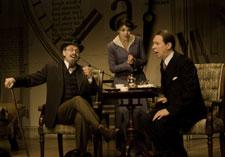
Take one stuffy conservative bureaucrat, add some colourful characters, mix well and serve with a generous side of Wildean camp. Et voila — you have Travesties, a classic 1974 play from Tom Stoppard. These days the prolific British playwright is probably best known for his movie work. Stoppard directed the big-screen version of his most famous production, Rosencrantz and Guildenstern are Dead, and won an Oscar for his Shakespeare in Love screenplay. But back in the day he specialized in cerebral stage plays like this one.
Travesties is a heady mix of fact and farce. It takes aim at dismissive conservative attitudes to art in society — a topical subject, given the Harper government’s recent stance. For this reason, and just because it’s a damn good play, Soulpepper has chosen it as the opening act of the 2009 season. Directed by Soulpepper founding member Joseph Ziegler, Travesties opening Tue, Feb 17 at Toronto’s Young Centre for the Performing Arts.
Set in Zurich in 1917 the play is narrated by British consular official Henry Carr — the aforementioned stuffy conservative. The story is based on memories of his meeting Irish novelist James Joyce, Russian revolutionary leader Vladimir Lenin and Romanian/French artist Tristan Tzara, a cofounder of Dadaism. The play’s structure, though, is borrowed from Oscar Wilde’s The Importance of Being Earnest. “It’s so playful it’s almost naughty,” says Dora award-winning actor David Storch, who plays James Joyce in the play. “Stoppard thought, ‘How can I go deeply into this heady terrain and not make it a lecture for the audience?’ The Importance of Being Earnest is a framework on which to pin these things that lifts them out of the mundane or didactic.”
To prepare for playing Joyce, Storch waded through the writer’s 644-page masterpiece, Ulysses. “When I was at university I read a couple of chapters and thought, ‘Well I mastered that!'” he says with a laugh. “This time I got the annotated student edition and went all the way to the end and back again.”
Joyce is an important figure in the play: As well as being a central character, Stoppard also infuses the piece with the author’s distinctive writing style. Carr’s unreliable stream of consciousness, for example, is distinctly Joycean. Carr is constantly replaying events in a way that revises them — a device that gives Stoppard free rein to play with the historical facts. In reality the three revolutionaries were in Zurich at different times, but Carr misremembers them being there together.
Although that meeting is fictional, the relationship between Carr and Joyce is based on fact. While reading a biography of Joyce, Stoppard was intrigued by a footnote about Henry Carr, an injured Canadian soldier wokring in the British consulate, who was plucked from obscurity by Joyce. The author was in need of an Algernon for his production of The Importance of Being Earnest and Carr had some amateur acting experience. The play was a great success, but the friendship quickly soured. Both thought that the other owed him money — Carr demanded reimbursement for some pants he’d bought for the performance — and a bizarre lawsuit ensued. “Sometimes what happens in the play seems like Stoppard has had too much to drink,” says Storch, “but in fact he’s just telling us the history, which is absurd in places.”
The play is full of delightfully farcical moments. At one point, Lenin is smuggled across the Russian border disguised as a Swedish deaf-mute. And the speech he makes upon his return is a direct parody of Wilde. “To lose one revolution is unfortunate,” says Lenin, echoing Lady Bracknell’s famous line in The Importance of Being Earnest. “To lose two would look like carelessness!”
This kind of vaudevillian camp succeeds in loosening up what could be a rather stiff piece. Stoppard has taken ideas that, on paper, are quite dry and made them entirely digestible. Above all, it’s a hoot — albeit an intellectually challenging one. “As often happens in the theatre laughter opens a hole in the air through which thoughts can be breathed back in,” says Storch. “These are intensely serious arguments about the purpose of the artist, but they’re so much fun to watch and listen to. Anyone who thinks about art — what it does for our lives and what it doesn’t do — should come see this play.”
Travesties.
$34-$68.
Tue, Feb 17-Mar 21.
Young Centre for the Performing Arts.
55 Mill St, bldg 49.
(416) 866-8666.
Soulpepper.ca.
 Why you can trust Xtra