Canadian theatre legend Mavor Moore once told Sky Gilbert that if he wanted “to have a hit, write a play about a deaf mute girl; it will rake in the dough.”
Moore was caustically referring to the classic American script Johnny Belinda, a tale about a big city doctor who moves into a tiny rural community, which he successfully adapted as a stage musical in the 1960s.
Another theatre classic, Michael Healey’s The Drawer Boy, used a similar formula – a character with a disability and a clash between city and country. It became the fourth-most-produced play in the US between 2000 and 2010.
Publicity for Reconciliation queries, “What would happen if Sky Gilbert wrote The Drawer Boy?” Using his own country/city dichotomy, Gilbert provides the narrative foundation for his newest play.
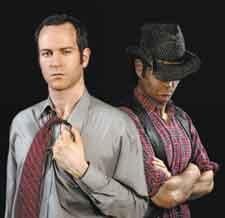
This sexy triangular dramedy has two brothers meeting in a farmhouse and wrestling with family issues the way only brothers can. The possibility for underwear-tearing homosocial behaviour and subtle titillation are stage techniques that Gilbert, as both writer and director, may inject into the production with his trademark physically and emotionally charged style. He describes actors Jason Cadieux and Wes Berger as “really hot guys” who will provide audiences with prime examples of how “a gay gaze” often occurs when we spot hot brothers and begin to fantasize.
Cadieux has described himself as “30 percent gay” and lives with his wife in Hamilton, where he runs the Essential Collective Theatre. He says he has made a career out of acting gay: “I even played a gay doctor on Train 48 for two seasons. Interestingly, I get asked to play gay men who don’t seem gay.”
Berger, as Cadieux’s brother, also has experience playing sex/gender diversity onstage. His presence in Nina Arsenault’s virtuoso performance Ladylike, another Gilbert script, brought a smouldering sensuality to a small but crucial role. Berger says Reconciliation isn’t just gay or straight — it’s a universal story about “meaningful human connections…. It also contains an intricately detailed discussion about cocksucking and a forced exchange of at least one type of bodily fluid. Who can’t see themselves in that?”
Rounding out the cast is Bruce Beaton as the men’s father. Beaton’s work in Gilbert’s The Shakespeare Project over the past two summers showcased a kind of tender masculinity that conveyed authority and dignity from the outset, a crucial quality for the character he will be playing in Reconciliation.
When Gilbert entered the acting program at York, he says, “it was very clearly a place for me to be the effeminate guy that I was… the only place for me to be happy and accepted. Theatre people sometimes treat me as one of them, but I don’t really feel like I am one of them. I feel like an interloper.”
Gilbert’s self-perception as interloping agent may lie, in part, in his unflinching desire and ability to lay bare the raw emotions of sexual and emotional identity. Reconciliation promises to do just that through the age-old father/brother/son triangle that has proved stageworthy in classics such as Sam Shepard’s Fool for Love and Shakespeare’s Hamlet. And there is even a ghostly figure. So if you want to find out whether the spirit that moves two hot brothers and one handsome dad is gay or straight, don’t miss Sky Gilbert’s latest.
 Why you can trust Xtra