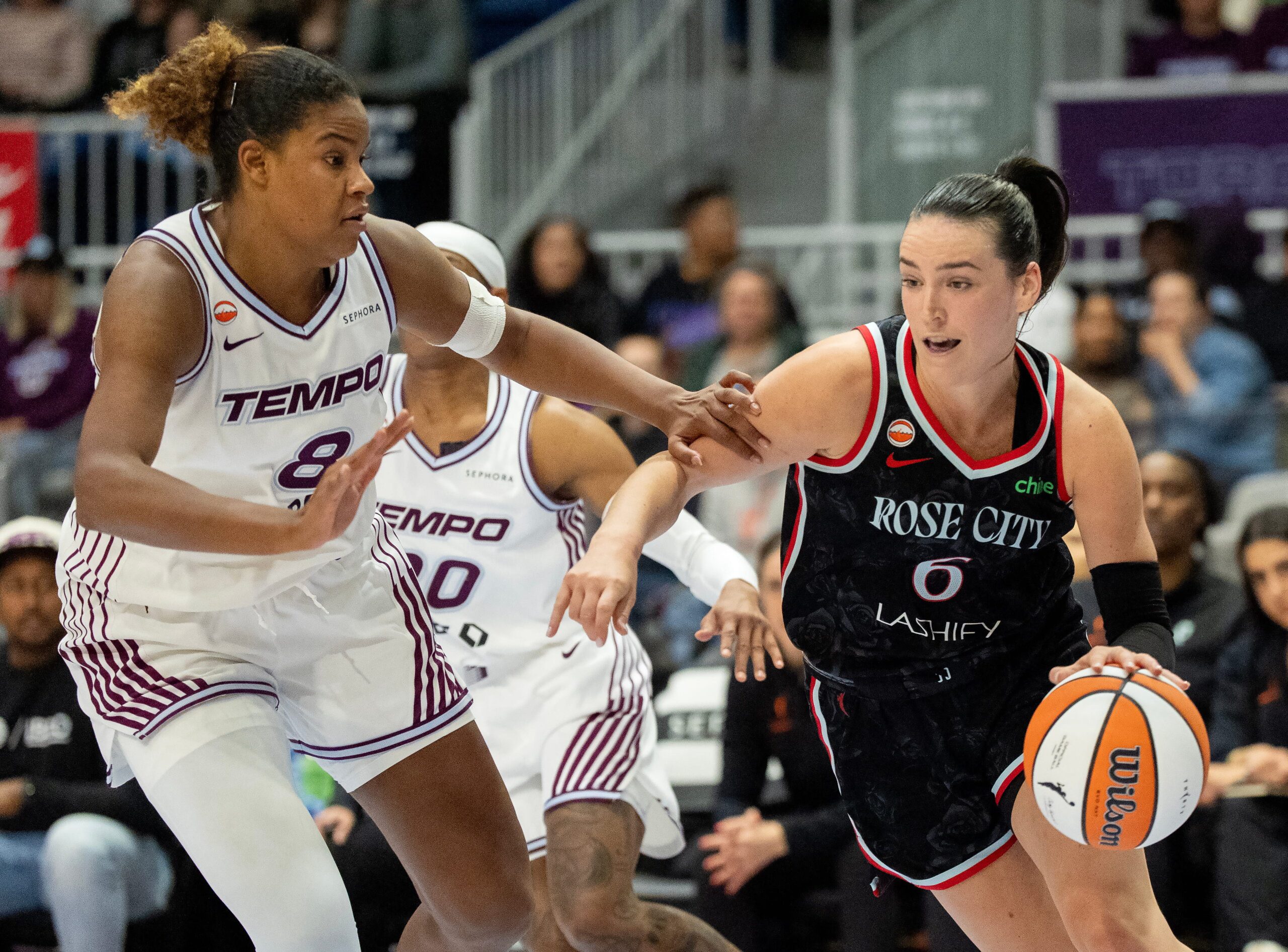
When the Toronto Tempo took on the Portland Fire at Coca-Cola Coliseum on May 23, it was a historic occasion. The game marked the meeting of the two newest WNBA teams, who had joined the league in expansion at the start of the 2026 season. The first Canadian team in the history of the W has been met with nothing but enthusiasm. Season-ticket packages sold out almost immediately and prices for single-game tickets on the resale market have been out of reach for many.
WNBA veterans Brittney “Slim” Sykes and Marina “Money” Mabrey have quickly been adopted by the Tempo fan base, and despite the SLAM magazine cover with the pair’s photo on it debuting just the week before, I spotted dozens of fans around the arena sporting shirts with the cover photo on it. Anywhere you go in and around Toronto, you’re sure to find at least a few people rocking Tempo gear. It’s clear that the city is 100 percent behind this team—perhaps no one more so than the queer community.
“I think it’s such a big difference between the MNBA and the NHL, [those] games just feel a little bit more intense, like people are a little bit more aggressive,” says Ally Dwyer-Joyce, who attended the Tempo game with her wife and friends. “We are big sports fans in general, so of course we go to those, but it’s just different to have the W here, because … it’s queer people everywhere, Pride flags left, right and centre. You just feel so much more included and everybody’s welcome.”
The vibe in the stands was buzzing. The Tempo play at Coca-Cola Coliseum, the 8,500-seat venue that felt outgrown by the team before it ever took the court. Even still, it sounds like an arena built for tens of thousands when the Tempo go on a run. And with DJ Shannyn Hill spinning beats for the crowd, it’s not hard to see why they turn up. Hill is an openly queer woman who grew up in a traditional Jamaican household and told the Globe and Mail that homophobic attitudes were the norm. Now she’s living what feels like a dream as the first in-house DJ for the Tempo.
“This is meant to be. This is exactly what I want to do,” Hill told the Globe and Mail last month. “I never dreamed a position like this would be possible, and I never saw anyone who looked like me doing a job anything like this.”
Women’s sports are booming across North America. And even though the WNBA is in its 30th year, it’s taken until now for the league to cross into Canada. Basketball has often felt like the red-headed stepchild to the country’s first love: hockey. The PWHL launched in 2023 with three Canadian teams—it will have five Canadian teams by the start of the 2026-27 season—giving women’s sports fans a league to invest in. The enthusiasm for women’s sports has only grown, and the WNBA is now stepping in to help give Canadian women’s sports fans a team they feel they can invest in.
“It’s about being somewhere that feels connected, feels like community, feels like you have like-minded people around you, but also visible on the court,” says Natalie Kachmarsky, a Hamilton resident who attended the game with her partner. “If I was my 10-year-old self now, it would have been a much different coming out story for me at that time, being able to see this and see faces that look familiar and look similar to what I do.”
The queer visibility on the court, in addition to in the stands, resonates with LGBTQ2S+ fans. “I think it’s special to see representation of queer players, and some are more out than others—which I totally respect their personal lives, of course,” Dwyer-Joyce says, “but even to sometimes have an insider look into their personal lives on social media, where they sometimes are dating another player, or they have somebody of the same gender identity as their partner, it’s just nice to also see representation in that way.”
Everyone I spoke to said that Tempo games feel very much like queer spaces, even though it is a diverse crowd where people of all identities are welcome and there are tons of families in the stands too. That includes queer families like Tammy Shubat and her wife Deniece Bell, who say that the atmosphere is one that feels comfortable for them to bring their eight-year-old daughter.
“The Tempo games bring our whole family so much joy,” says Shubat. “Our queer mixed-race family feels at home in this space. It’s a space of representation for us, in terms of players, support staff and fans all alike. It’s a truly special opportunity for us that we admittedly haven’t found anywhere else.”
The Tempo’s reach goes beyond just the Toronto queer community. The franchise is marketing itself as “Canada’s team,” and taking that role quite seriously. The Tempo are investing in Canadian college women’s basketball by hiring assistant coach Carly Clarke, who was the coach at Toronto Metropolitan University (TMU). They drafted Hamilton native Kia Nurse to their team, and brought in Yvonne Ejim, who is from Calgary, for training camp. The game I attended against the Portland Fire was Canada National Team member Bridget Carleton’s first W game in Canada and the crowd was cheering for the Tempo—and Chatham, Ontario, native Carleton.
“I’m really happy for Bridget, obviously, to be in the position that she is in Portland, and she’s been very deserving of that and of the new role that she’s gotten,” Nurse said in a post-game press conference when asked about Carleton’s Canadian debut. “I think it’s great that on this level, on this stage in the WNBA, that she’s getting the opportunity to really show what she can do. I’m really proud of her.”
Nearly from day one, the Tempo accounts have highlighted part owner and “Designated Hype Officer” Lilly Singh and the Beaches guitarist and keyboardist Leandra Earl as queer icons who are also visible fans of the team. “To see them embrace the fans and be embraced by the organization, it feels joyous at a time where I think it’s more absent from our lives than we may recognize,” says Grace, a Tempo fan from Alberta, who asked to be referred to by first name only due to the political climate in Alberta.
The Tempo will play games in Montreal and Vancouver this season, giving other parts of the country the ability to attend a game in-person. Heather Myers and her partner, Kelsey McCue, are alpaca farmers living in Winnipeg, but made the trek to Vancouver last season for the WNBA Canada Game between the Seattle Storm and Atlanta Dream. “We used to drive to Minneapolis a few times each summer for [Lynx] games, but since that’s not safe anymore, we are going to Toronto a couple of times and Montreal, as well,” Myers says.
Alicia and Sam Loren-Ogoms, who live in Vancouver, plan to go to both Tempo games being played there this season. “My dad was a professional basketball player, and my mom played for the University of Winnipeg,” says Alicia, who plays pro volleyball for Team Canada. “For a long time, I thought I was going to play in the W, but volleyball stole my heart. It makes my heart so happy to see the sport expand in popularity and recognition, especially here in Canada.”
In Alberta, which has been on the front lines of fights over trans rights and women’s sports, having the Tempo to cheer for has felt even more important. “I think especially as an Albertan who is watching aggressive anti-trans and anti-queer policies being rammed through at lightning speed and with sheer force, while also seeing such treasonous anti-Canadian and separatist rhetoric, having the Tempo and that space for queer joy and excellence is like a beacon of hope,” says Grace.
Alberta has even passed a law banning trans girls 12 and older from participating in women’s sports. “There’s been a big increase in violence toward Two-Spirit, trans and queer people,” says Lyndsay Helfrich, a Calgary resident who co-hosts the Wine and Dime podcast. “But obviously the queer community here is fighting back the best we can. Resilience is important. And sport has been a way for that resilience.”
Loren-Ogoms also says that having a WNBA team in Toronto goes beyond just issues of representation, and can be something that—if leveraged correctly—can help close the wealth gap that many queer people face. “Professional women’s sports creates economic opportunity for many marginalized groups, but especially for the queer communities that support them: for queer athletes, for queer-owned businesses, for queer creators and journalists and vendors who have a seat on the mainstream stage,” she says. “Visibility at scale moves money, and when that money starts flowing into communities that have historically been left out of the sports economy, that matters more than people realize.”

 Why you can trust Xtra