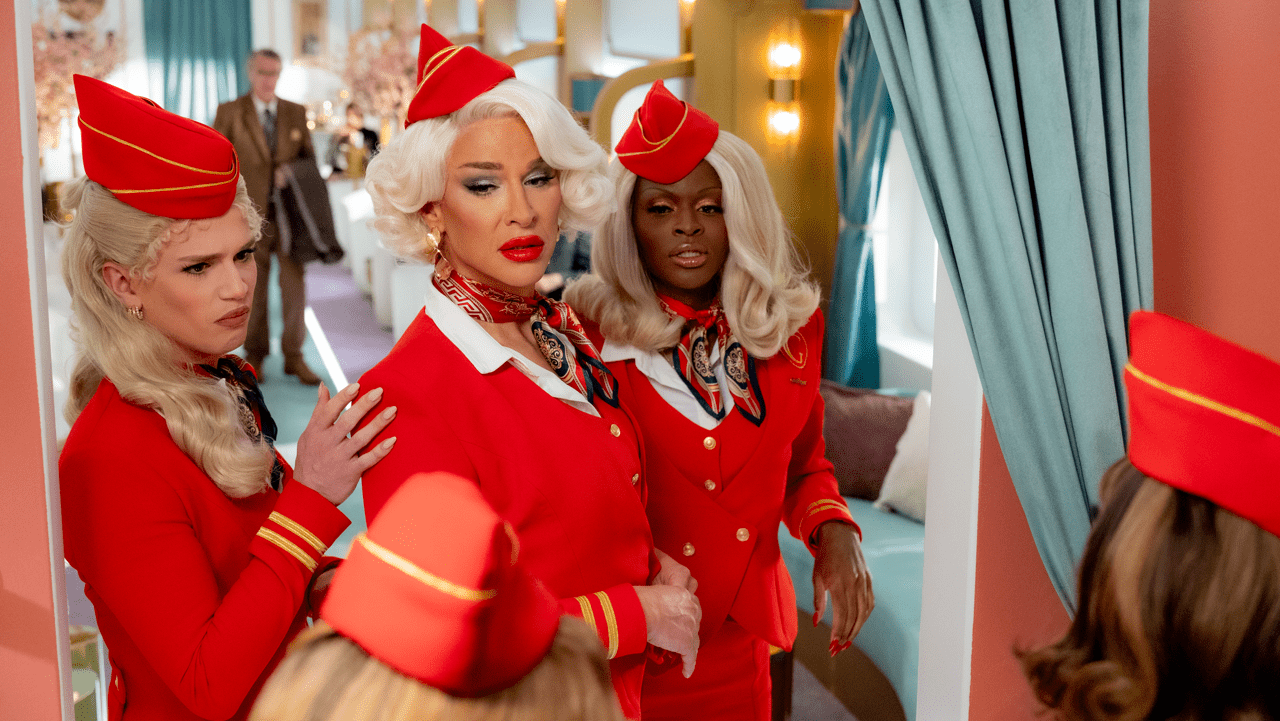
Stop! That! Train!, which hits theatres across Canada and the United States this Friday, is an exceedingly rare type of movie: a gay comedy that’s receiving a wide theatrical release.
Bleecker Street, the studio distributing Stop! That! Train!, has placed a big bet that fans of RuPaul’s Drag Race will turn out in droves this weekend. The film, which plays out something like a punched-up Drag Race acting challenge where everyone delivers a winning performance, is littered with celebrity cameos, including Sarah Michelle Gellar, Nicole Richie, Lisa Rinna and Joel McHale, who appears shirtless in a harness. But the real stars of the movie are the Ru Girls—Ginger Minj, Jujubee and Brooke Lynn Hytes all star in lead roles.
In recent days, the film and its director, Adam Shankman, have also been criticized because some have accused him of using artificial intelligence in the making of the film. Shankman released a statement in response, stating in part, “There are a sum total of ZERO shots conceived by AI in the movie.”
But prior to releasing the statement, Shankman had spoken to Xtra about using AI in concert with traditional computer-generated images and stock footage.
Shankman, who also directed the 2007 remake of Hairspray, made the comments during a wide-ranging conversation in Toronto ahead of Stop! That! Train!’s opening gala screening at the Inside Out LGBTQ2S+ film festival. He spoke to Xtra about meeting RuPaul in the ’90s, Stop! That! Train!’s theatrical release and exactly how much AI was used in the making of the film.
How was the premiere in L.A.? I heard RuPaul was the D.J.
RuPaul was the D.J. at the after-party. The dance floor was cooking.
I saw some videos. It looked like she had a damn good time.
She had a damn good time.
What does it mean for you to have this movie open theatrically?
I’m honestly stunned. That was not something that I understood was going to be this movie’s reality when I said yes.
It’s uncommon even in cinema history that we have gay movies that open theatrically.
Well forget just gay—basically, all the leads are drag queens who don’t play drag queens. That’s one of the really fun parts of it for me. When I came into it, I’m not sure everyone understood that I was going to be like, “No, you’re not playing drag queens. And I also want you to act like you’re in a drama.”
Did you see a shift in people’s performances when you gave them that direction?
I gave that direction before I called action, so people knew.
They got used to it real quick, which was all the time we had, because we shot it in 19 days.
Wow. That’s a truncated period.
It certainly was. I had just made a movie in the same year. Stop! That! Train! was the second movie I made last year, and weirdly it’s coming out first. But the first one was 60 days, so I had a 60-day film and a 19-day film.
Did you know Ru prior to being a guest judge on Drag Race?
1994.
How did you meet?
I choreographed a very early performance after “Supermodel.” When that exploded and made him international, he did this big performance in Los Angeles at a benefit and I was the choreographer.
What’s it been like to watch the way he’s become a media mogul and global star?
That part doesn’t surprise me. What surprised me is the way he changed culture. To have done what Drag Race has done by pulling drag out of the night and putting it into the day and letting us into the lives of all of these incredibly talented performers was pretty unexpected. I don’t think anybody could have seen that coming.
You have cast Canada’s own Brooke Lynn Hytes as a villain. How do you think that is going to impact Canada-U.S. relations?
I think it was a risk worth taking. God, I think Brooke is so amazing. I think Brooke is so great. Brooke Lynn is so funny. God, I want great things for her.
Let’s talk about Hairspray. Were there parallels between this experience and that one?
The parallel to me was being able to play in the world of absurdist humour. And a colour palette that had some relationship, I suppose. This is going to sound insane, but it didn’t occur to me until very late: I’ve always said I’ve never directed drag queens. Then the John Travolta thing came up and I was like, “That wasn’t a drag queen. That was John Travolta playing a woman.”
This movie is packed with celebrity cameos. Who was the hardest to land?
It wasn’t about landing anybody, it was about scheduling.
That’s my next question, because it was shot in 19 days.
You know who got so busy? It was Matt Rogers. We had to shoot one day in the “Oval Office,” it was like nine-and-a-half pages. We had to shoot that three weeks before we started regular production to qualify for the California tax credit.
The hardest person to schedule around was RuPaul because of Drag Race. The amount of work to be able to get those days with Ru was hard.
I want to talk about the look of the movie. There’s a mid-century art deco thing happening on the train. I’m not entirely sure when this movie takes place.
What does it matter? No, I think coach just looks like coach, but it’s salmon-coloured. I did this sort of Orient Express-meets-Wes Anderson kind of vibe. For 10 dollars. You do not want to blow on that set. The whole thing would go down. It was virtually made of matchsticks. It was just supposed to look super over the top and weird, but on a shoestring budget. We were working with string cheese, not brie.
Talk to me about using green screens and animations. Did you use AI in some of the backdrops?
Some of the windows were AI. There was only one AI shot or two AI shots of the train, the rest are CG. Most of the CG is the train, then out the windows is mostly AI. But the Florida station, all that, that’s CG. And different licensed imagery.
What does success look like for this movie?
Success for me is if it helps part of the community let off a little steam in this moment when we’re really having the shit beat out of us. I like the idea of the community coming together and laughing, of having something to quote. For me, long-term success would look like years and years of people acknowledging this as queer canon, as a piece of queer comedy that we can feel good about.

 Why you can trust Xtra