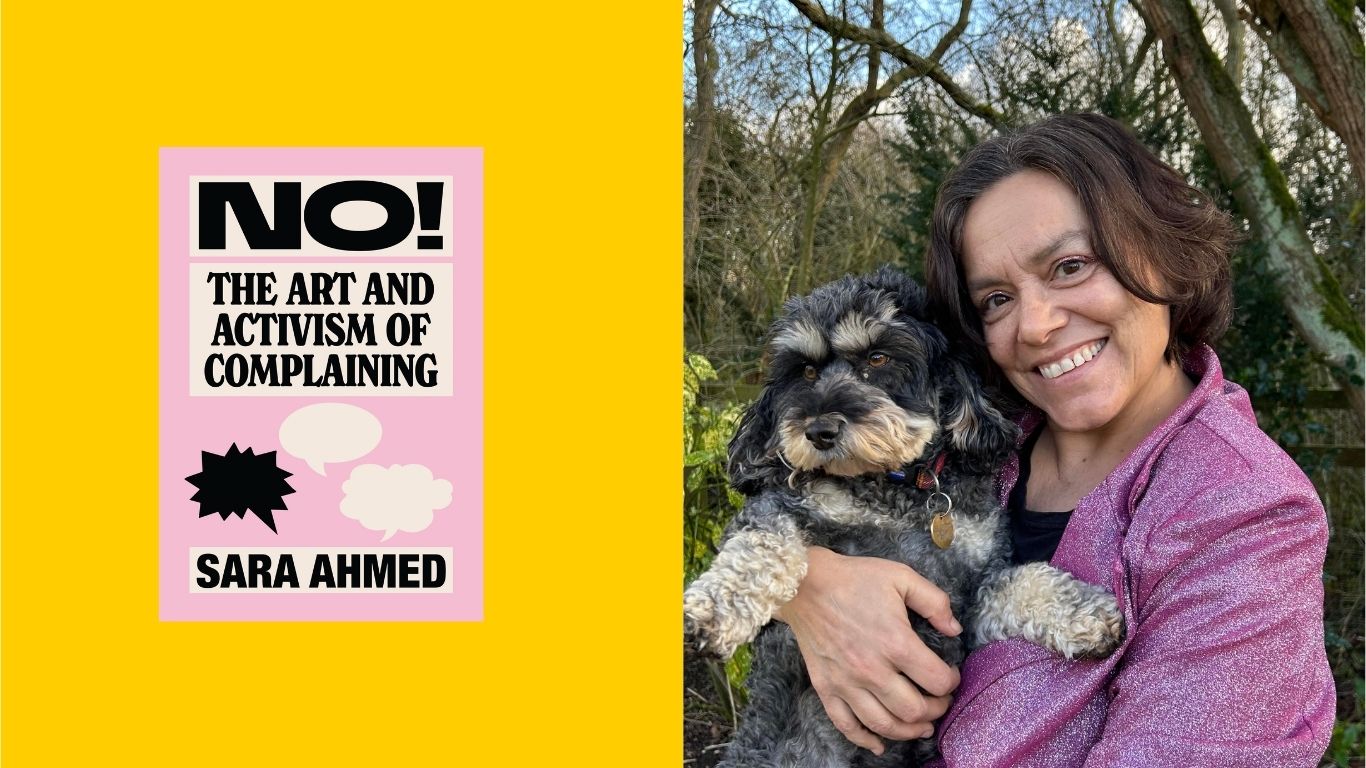
No! The Art and Activism of Complaining is the latest book by Sara Ahmed, an award-winning, U.K.-based scholar in feminism, queer studies and race who’s published a dozen books (and co-authored many others) spanning post-colonialism, racism and diversity, queer phenomenology and the cultural politics of emotion, and more. She famously quit her position at University of London in 2016 in protest over the university’s handling of sexual harassment complaints by students. Ahmed now works as an independent scholar, focusing on writing feminist texts that are accessible to a wide audience.
No! was originally envisaged as a companion text to her Feminist Killjoy Handbook (2023). No! explores what happens when you make a complaint, drawing on examples to reveal the ways institutions like universities and workplaces deflect, delay or dismiss complaints. Institutions also often weaponize complaints processes against the person speaking out. The book’s original U.K. title—No Is Not a Lonely Utterance—reflects the isolation felt by those who speak out, but also emphasizes the importance of solidarity with those who do speak out. Ahmed reveals how complainers are often not alone in their opposition to institutional violence, and discusses some of the creative ways of supporting them, such as forming complaint collectives to push for institutional change. Complaint collectives, she explains, are systems that remind complainers they’re not alone: they could comprise collections of complaints (such as those in her book), support networks of friends or even strangers who are there to listen and support people through the complaint process, or any other forms of mutual collective support to offer presence and solidarity through a complaint.
Xtra spoke to Ahmed about her new book and the relevance it holds for the queer community.
Could you speak to the particular importance of this book for the queer community? I’m thinking about a queer community, which on the one hand is under attack on so many fronts around the world, but also a queer community that is often fraught within—there are so many complaints within and between queer organizations and Pride organizations, for example.
There’s so much to say about this. I think the word “complaint” has that negativity about it like the word “queer.” And I think about the way in which queer gets repurposed. It has been used as a slur and we use it to speak back against the system, against the world that designates us in negative terms. I think of it as a redirecting of the “no” back at the institutions that don’t accommodate us. And complaining has that kind of negativity to it as well. That’s why I think of complaint as a queer method, because in a way it is about redirecting a “no!” to the institutions, saying no to them. There’s power in that.
Yes, it’s really important to remember that there are complaints made within our communities—people complain about racism within the queer community or transphobia within the queer community or lesbophobia within the queer community. So I think if there was a lesson for queer communities, it would certainly be to think about complaints as information. They’re telling us something about what’s going wrong. A lot of people said to me that one of the hardest things is that when you’re complaining: say you’re working in a queer workplace, what then do you do with your complaints? Because your complaints might threaten that workplace, which itself is really precarious by virtue of being a queer workplace. But it’s really important in those contexts for us to be able to complain, and for the complaint to be seen as a source of social solidarity. If there is an issue that’s preventing you from doing your work or living your life within a queer organization, you need to be able to express that without the organization falling apart.
We need to find ways of doing our community work, our workplace work, that allow things to be strengthened by recognizing internal problems. The feeling that we have to cover them up in order to appear stronger actually doesn’t work. It actually implodes our community when we aren’t able to express complaints within them. That’s often why people don’t complain, because they’re told it would damage the organization or their own careers or their own lives.
I think it’s important for us as members of a queer community to think of that complaint that we’re making, even if the object is a queer organization, as being in order to create a better and safer queer space for all of us.
I love thinking of complaint as information-sharing rather than simply a negative thing. For me, this relates in many ways to the sheer power of saying things out loud and naming things, which you address in the book. It seems to me that often people are afraid to name things for what they are. This might come from fear, servility, sycophancy or a desire for personal gain. In institutions—whether they’re universities or governments—so much harm is perpetuated by the complicity of those who simply echo the statements of those in power, even though they know they’re not true.
Yes, I think there is something about what you just said, about speech that you know is not true, and the person who says it knows it’s not true, and the person who hears it knows it’s not true, and yet it gets repeated because if you don’t repeat it, you potentially lose something. Maybe you lose access to resources or access to membership in a given social order. So the repetition of the non-truth just becomes a condition for accessing resources. I think that would be a good description of where we are.
One of the things that I really wanted to do in this book is to work out the perversion of a system that gives so much power to so few individuals—and that can be true within an organization or at a bigger level—and then more and more people are implicated. Because if that person has more power, then they also have more power to withhold things from others who then have to say “Yes” to that person. And that “yes” then spreads. It spreads so far because there are so many people invested in that person that any “no” then becomes not just a “no” to this or that person, it’s a “no” to the whole system. And it becomes really hard to speak out against that.
Often in that system you aren’t even allowed to name it. You can’t use the word “genocide.” You can’t support certain political groups because we’ve decided they’re terrorists—that’s happened here in the U.K., this absurd situation where everyone knows [what’s happening in Palestine] is genocide, but you’re not allowed to say that it’s genocide, and even saying that it’s genocide is seen as worse than actually committing genocide. It’s just bizarre how actually not naming something becomes a condition of possibility for being part of civil society. Not naming something so extreme.
I think that right now to be part of a progressive movement of any kind is just so alienating. Because everything that is true has become hard to say, and punishable for saying. So it becomes even more important to say “no” and to keep naming it, and using the words for things that are happening. But people are losing a lot by doing that in terms of their employment or opportunities for publishing their work, and livelihoods are at stake. So we need more people, more organizations, to stand up to it. That’s what we have to be part of—generalizing the willingness to risk loss of resources to say “no” to this demand not to name what’s going on right now.
@xtramagazine Feminists have been pushing to dismantle the gender binary for well over a century—and this free journal from the early 20th century put that work into action. From 1916 to 1940, Urania was privately distributed to an underground network of friends and supporters. The British publication was founded in part by lesbian suffragists Eva Gore-Booth and Esther Roper. Before Urania, they were members of the Aëthnic Union, a short-lived radical feminist group in London that aimed to disrupt the conformity of “the stern masculine and the trivial feminine.” And Urania kept the sentiment of gender abolishment throughout its pages. Each issue claimed that there were no men or women in Urania, and the phrase “Sex is an accident” was often used. The journal was largely made up of newspaper clippings from around the world highlighting feminist struggles and instances of gender troubling. Urania also provided a contrast to Western ideals upheld by the British Empire by encouraging its readers to learn from feminist struggles around the world. In challenging binary gender distinctions, Urania spoke to the needs of queer and trans communities and served as a queer archive of sorts. The journal often criticized heterosexual marriage and documented instances of taboo topics like cross-dressing, intersexuality and gender-reassignment surgeries. #lgbtqnews #lgbthistory #queerhistory #feministhistory ♬ original sound – Xtra Magazine
You certainly have done that in your own life. I think you put your finger on that risk that people are afraid of. What would you say to folks, whether it’s an admin assistant in an office or a member of an activist group, who are wrestling with the desire to name something, to speak out, to make a complaint, but are fearing the consequences, fearing losing resources for their material survival?
It’s really important to be in solidarity with people who fear the consequences of speaking out, given the consequences might be not being allowed to sustain the life that they have. But I also know that a lot of people use the potential of precarity to justify not speaking out when really they’re not necessarily going to be losing the capacity to sustain their lives. There’s a real difference between people who really do fear that if they speak out they won’t have the capacity to sustain their lives, and those who use that sense of potential precarity to justify to themselves being unwilling to speak out. That’s quite important to point to, even if we can’t be clear who’s who in any given situation.
When you really feel that maybe you just can’t afford the risk of speaking out because you would risk not just your own circumstances but that of others who are dependent on you, then I think it’s important to remember that there’s lots of ways of speaking out. Some of them involve using your name and putting your name out there and saying things out loud. But there are also lots of underground ways of expressing our refusal. One of the things that I learned from doing this research was just how inventive people are. A student who didn’t feel they could speak out about a professor that was abusive because that professor who’s abusive holds all the cards, could do other things. They might write the name of the professor on a wall and make that complaint unofficially. Or I think about somebody who told me about how she turned her complaints about racism into songs that she then sent to museums.
There are all sorts of ways in which, if we feel unable to put our names to an act of naming and saying something, there are lots of other ways of doing it. People become very creative. Any protest movement involves many different types of actions. Some people say “no” very loudly and some people do their no in other ways, behind the scenes. Some do it in how they spend their time, who they spend their time with, where they spend their energy. It’s not all about being loud or being public, it’s just about being committed, however you can be, to build the kind of world you think is right and just. There’s lots of ways of doing that. If you feel that in order to keep your job you have to be quiet in certain ways, don’t you worry, we know that you can be noisy in others.
This interview has been edited for length and clarity.

 Why you can trust Xtra