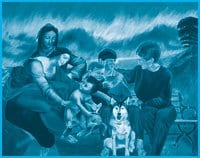
“Does your mother use the ‘L’ word?” quizzes local painter Nancy Duff, sitting in a cozy chair by the fireplace in her East Vancouver home.
“No, it sounds too much like something you take antibiotics for,” I reply, sipping my tea. “My Mom did amuse me once by asking if she could call me queer. She wanted to be politically correct without using the dreaded ‘L’ word. I told her, ‘No, Mom, just call me gay, but thanks for asking’. What does your mother call ‘it’?”
“She doesn’t call ‘it’ anything.”
We laugh, realizing how pertinent words, like art, are to people’s comfort zones.
As an artist and teacher, that comfort zone is something Duff strives to stretch.
“My father tells people, ‘Nancy doesn’t make art. She makes political statements.’ I’m interested in storytelling and politics.”
Duff’s recent exhibit at SOMA Café on Main St demonstrates the Calgary native’s passion for representing lesbians in visual art. Her “corrective paintings” series is a body of work in which Duff takes historical paintings or popular images and inserts lesbian characters into them.
Dykes on Bikes/Lesbian Chic “contrasts a middle-aged, middle-class, white lesbian couple in their suburban driveway with a ghostly image from an Italian fashion magazine. The women are friends of mine. One is a dancer. The other is a retired Fed Ex pilot.”
Alternative Conceptions puts a controversial spin on Leonardo da Vinci’s revered Holy Family portrait of St Anne with her daughter, the Virgin Mary, and her grandson, Jesus, who’s holding a lamb. Duff’s painting adds a lesbian couple sitting beside the Holy Family on a park bench holding their child with a dog at their feet.
“I was looking for art historical pictures of families,” explains Duff, who also teaches painting, drawing and cultural theory full-time at Kwantlen University College. “I thought the absent male in the house was interesting-just two women with a baby and a lamb. With the lesbian baby boom, I knew a lesbian couple who each had a baby using the same sperm donor, and I decided to use that family image. In both cases, the babies were conceived in unusual ways.”
In Elles, Duff substitutes Manet’s heterosexual couple with a lesbian couple in a café. “When two women are looking at each other, there’s an intensity. It makes people wonder what’s going on.”
Doing her part to epitomize lesbians through her own visual art, does Duff see herself represented in pop culture?
“I’ve watched a few episodes of The L-Word. The women are super thin, rich and white, with some women of colour represented, but not many butch women. It is definitely representative of one slice of the LA lesbian scene-more like the Orange County blonde golfer girls.
“I remember a friend and I went to a bar in Laguna Beach and we were the only two brunettes among a sea of blonde and tanned women. Young and beautiful women with money is an idealized lesbian. There are no older lesbians. Where are the women my age-in their 40s?” she asks.
Intellectual and witty, Duff’s personality is as diverse as her background. During 12 years of university, she received three Canadian undergraduate degrees (Art and Design, Science, and Education) plus a Masters of Fine Arts from the University of California in Irvine. Duff and her partner of nearly 30 years also ran a bed & breakfast in Vancouver’s West End for three years.
Interestingly, although Duff admires many women artists, including 17th century painter Artemisia Gentileschi, 20th century psychological portrait painter Alice Neel and contemporary American painter Judy Bamber (acclaimed for her vagina paintings), she admits that her work is more “informed” by feminist writers/theorists such as Margaret Atwood, Luce Irigaray and Monique Wittig.
Having toured her art shows (which also include photography and video installations) across most of Canada, Duff says her experience studying art in Southern California also sparked a political consciousness all its own. It’s something she clearly brings to her canvas in The Lay of Your Land (her “Bad Penny” body of work inspired by having Canadian pennies flung at her in US stores when she forgot to separate her Canadian from US coins and people thought she was giving them fake money), and her latest work Borderdom (a series of aerial shots of the borders between the US and Canada and the US and Mexico “conceived several years after my return in 1999, before 9/11, SARS and Mad Cow disease.”).
Successful on many levels, Nancy Duff does cite two life regrets: not having children or enough creative time in her studio.
“When you teach, you have to be ‘on’ all day, which requires a lot of energy,” she explains. “It’s exhausting. In focussing on work with visuals in an immersive way-especially in all-day critiques of students’ work-I can’t make art when I get home.
“And the visuals are so persistent that I dream about them,” she adds. “I have ‘artmares’ where I’m also critiquing all night.”
 Why you can trust Xtra