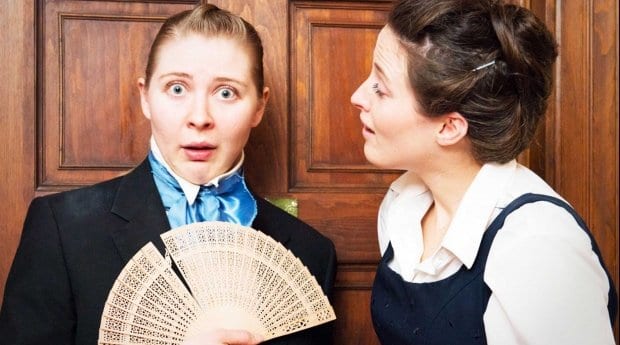
Hallie Burt and Kate Werneburg have somehow managed to make their original theatrical adaptation of Jane Austen’s Pride and Prejudice sexy. Burt says the sexiness is all in the tension that results from holding back. “You did not touch anyone then and if you did, you had a glove on,” she says. “It’s like all I can do is talk very properly to you, but all I want to do is rip your clothes off.”
This makes for an exciting version of the story, especially since this is a two-woman production, with Burt and Werneburg playing all the parts. With Burt, who identifies as lesbian, as Elizabeth Bennet and Werneburg playing Mr Darcy, the love story takes on a novel appeal. “Kate and I are good friends and we’re very competitive, so it wasn’t hard to find that tension,” Burt says.
They’ve also made the character Charlotte Lucas a lesbian (she has often been speculated to be so). They never explicitly state it in the play or try to make Charlotte, played by Werneburg, somehow seem lesbian in spite of the gender switch — the adaptation is too true to Austen’s story for that — but this understanding of Charlotte’s orientation has in subtle ways guided how they’ve developed that character.
Burt and Werneburg didn’t alter the genders to make some grand argument, although they’re happy to have other people find some gender-related enlightenment in the plot. It was more that they’re good friends and wanted to perform in a play together and both happen to be female. They also wanted to take on the challenge of playing both female and male parts and do it well enough that audiences wouldn’t object.
Elizabeth–Darcy: An Adaptation of Pride and Prejudice
Thurs, Dec 18–Sun, Dec 21, various showtimes
Campbell House
160 Queen St W
elizabethdarcy.brownpapertickets.com

 Why you can trust Xtra