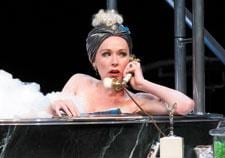
Interviewing lesbian director Alisa Palmer just before the opening of her latest Shaw Festival production, Clare Boothe Luce’s The Women, brought new insight into a beloved comedy in which one might not expect, at first glance, to find anything terribly queer going on.
Palmer breathes bent air into each script that she tackles, and Luce’s scathing indictment of the behavioural patterns of upper-class straight women caught in a world of philandering husbands and gossipy friends is no exception.
Luce was a political writer, landing a Republican seat in the US House of Representatives in 1942 and editing a book of essays in 1952 that included work by Evelyn Waugh and Rebecca West. In the hands of a queer, political director, her biting dramaturgy takes on a sharp critical focus.
The Women, written in the 1930s, boasts an all-female cast of characters that spend a great deal of time plotting against each other through their husbands. With the aid of gorgeous sets and costumes by William Schmuck, evocative between-scenes musical punctuation by Lesley Barber and appropriately eerie lighting by Kevin Lamotte, this production examines the women’s cultural milieu in an entertaining and critical manner.
At one point, one husband is called a “pansy.” Palmer sees this as an instance of individuals caught in complex relationships, demanding particular kinds of intimacies. These intimacies unravel gender politics and reveal marriage as a business transaction that quickly loses its romantic lustre.
At its most basic, the script is camp fun filled to the brim with bitchy quips worthy of the most formidable drag queen. The temptation to use male actors did occur to Palmer, but the opportunity of putting 19 talented actresses onstage together was too exciting to pass up.
Festival director Jackie Maxwell’s take on Oscar Wilde’s An Ideal Husband goes even further into queer innuendo. Sets and costumes by designer Judith Bowden mix up gender in a subtle and fabulous way. A central male character wears a semi-period costume that sports an almost skirtlike element. Sets in Act Two are particularly engaging: huge Andy Warholesque portraits and centrally placed furniture that screams S/M dominatrix.
For a bit of fantasy-infused fun, there’s Mary Chase’s 1940s queerish farce, Harvey. It’s a simple story about a man who befriends an invisible six-foot-tall rabbit, and yet, at its core, this is a poignant wartime comedy about an open secret — something that everyone knows about but is afraid to see.
With clear, action-packed direction by Joseph Ziegler, divinely detailed sets by Sue LePage and a brilliant performance by Peter Krantz as Elwood, the bunny-loving kook, this is a moving and lighthearted must-see this summer at Viagara-on-the-Lake.
For musical theatre aficionados, Kurt Weill’s One Touch of Venus — with quirky lyrics by poet Ogden Nash — is given uneven yet engaging direction by Eda Holmes. Performances by Deborah Hay, Julie Martell, Patty Jamieson and Neil Barclay make this another fine production.
Later in the summer, hot lesbian-infused action will be seen in Linda Griffith’s brilliant Age of Arousal, while productions of Caryl Churchill’s Serious Money and Chekhov’s The Cherry Orchard round out the season with classics that cover more than a century of theatre magic.
 Why you can trust Xtra