He had his life experiences, his convictions and his questions — all that Nir Paldi’s play needed was a wig and some makeup.
He grew up in Israel and later moved to France, where, for the first time in his life, being Jewish made him a minority. There he encountered a lot of anti-Israel sentiment. “I think in Europe there is a real sense of a [superficial] picture of what Israel is and what Israelis are,” he says. “And I’m like, ‘I’m with you: I’m against the occupation [of Palestine], but the way you are speaking is really stupid; the situation is extremely complex.’”
“[The Israelis] aren’t occupying because they’re evil or greedy for land. It’s because they’re fucking terrified they’re going to die if they don’t.”
He wanted to find a way to convey the complexity of Israel’s position in the Middle East on stage. His life in Israel had been complicated: he’s gay and liberal, and had grown up on an Israeli settlement. After high school, he served in the Israel Defense Forces. “I did an interesting job,” he says. “We taught theatre for impoverished communities while in uniform. The highlight of my military career was directing the musical Hair.”
“At the time it was funny, but looking back it was terrible. It was propaganda — this normalization of the army — because these children [who we taught] would someday be soldiers.”
He first set down what he wanted to say — informed, in part, by his life experiences — in monologue form. The next step was to transform the monologue into a play, but he needed a way to portray Israel — a way to be Israel. “I eventually decided to play Israel in drag because I needed a mask,” he says. “It relates to the feeling in Israel that the army covers everything up.”
“And like the fool in Shakespeare, drag queens can say whatever the fuck they want. The audience accepts it, or at least they won’t stone us just because we say something controversial.”
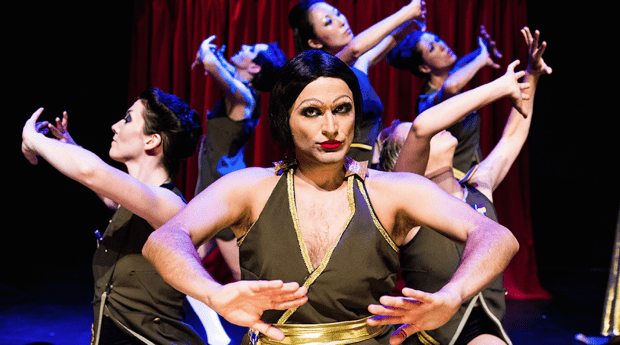
Co-created by George Mann, Ballad of the Burning Star premiered at the 2013 Edinburgh Festival Fringe, where it won for best acting ensemble. The play is set in a cabaret — Paldi’s drag persona Star is joined by five women called The Starlettes. They perform a series of numbers while Star presses The Starlettes into service as the Palestinians, her interactions with them mirroring Israel’s relationship with Palestine.
Paldi anticipates Ballad of the Burning Star’s North American premiere in Toronto to generate some strong feelings. “The interesting thing about this play is it annoys everyone, right-wing or liberal,” he says. “But I just show my thoughts and feelings, and you can watch and then go and decide what you think and feel. It wakes you up a bit. You might not like being woken up this way, but it does something to you — you remember it.”
Ballad of the Burning Star
Tuesday, May 19–Sunday, May 24, various times
The Theatre Centre, 1115 Queen St W, Toronto
burningstar.ca

 Why you can trust Xtra