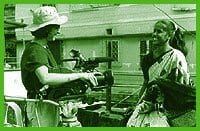
You might think watching a documentary on sex workers in India would be a depressing experience. But viewing Shohini Ghosh’s 74-minute Tales Of The Night Fairies is exhilarating. It takes you down winding side streets tourists would never travel into the heart of Calcutta where we meet a group of incredibly powerful women – and one man – who are demanding their rights as citizens of India. They are all sex workers and activists within the DMSC (Durbar Mahila Samanwaya Committee or the Durbar Women’s Collaborative Committee) founded in 1995.
Some of their stories are harrowing – one woman was forced into prostitution when she was only nine and, following a police raid, was placed in a shelter only to be brutalized by a drunken policeman – yet the film never feels oppressive. Each woman has found a way to take a great deal of control over her life, at times turning the tables on police harassment and violence, gangland extortion, poverty, social stigmatization, dismissive middle-class feminists or self-serving politicians. You can sense their glee at every victory.
The DMSC grew out of an HIV/AIDS health clinic in Shonagachi, one of the oldest and largest red-light districts of Calcutta. The success of this earlier initiative depended on sex workers disseminating info among themselves. And that began a total transformation in the way they viewed their lives. Giving voice to the estimated 60,000 sex workers in West Bengal, the DMSC now operates 33 health clinics, a cooperative banking system and a cultural troupe, while lobbying for the decriminalization of prostitution, the formation of a trade union and other legal changes.
The women and men behind such momentous changes are real characters – eloquent and feisty. Besides showcasing their resourcefulness and forthrightness, the video features the added drama of whether the group will be allowed to hold the country’s first-ever sex workers’ carnival, an event bursting with theatre (lip-synch), music, panel discussions and other colourful forms of outreach.
There is a hilariously incongruous section where women and girls play a rather cutthroat game of musical chairs – innocence and fighting spirit are evident in equal measure. The ensuing chaos seems to threaten the carnival more than any political duplicity. “If you don’t play by the rules,” yells the male MC, “we’ll have to stop the game.” Totally nuts.
These women are changing the rules by which society tries to denigrate and control them.
Tales Of The Night Fairies is a refreshing reminder of how a simple belief in your own worth and dignity is revolutionary.
This 2002 video (screening at 12:15pm on Sat, May 22) is part of Inside Out’s queer India spotlight. Other offerings include two rather odd short dramas, Beauty Parlor from Pakistan and The Pink Mirror from India, that screen with the quixotic BomGay, an experimental film by RV Wadia and Jangu Sethna, based on poetry by author and gay rights activist Raj Rao. Made in 1996 and considered the first gay film in the country’s history, BomGay is comprised of six intriguing little films tackling everything from love in the library stacks and colon health to sex tourism and colonialism (at 2:45pm on Sat, May 29).
Manjuben Truck Driver, Everything, Bombay Longing, The Crooked Line and (A World Without) Pity are also part of the spotlight; a panel discussion with director Sunil Gupta and other guests follows the screening of the latter three films (at 3pm on Sun, May 23).

 Why you can trust Xtra