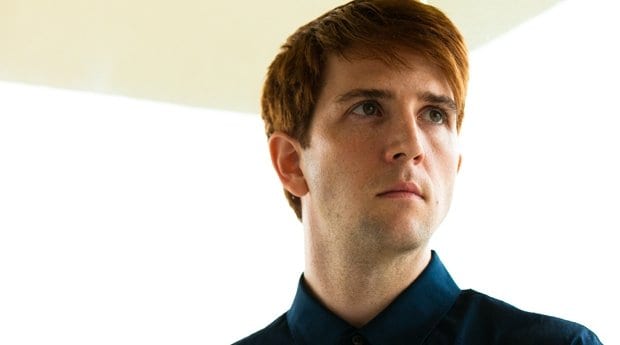
Owen Pallett has won acclaim for his genre-blending music, his tours with Arcade Fire and the arrangements he has done for artists from REM to Taylor Swift to Linkin Park.
He’s performing at the National Arts Centre on Sept 27 in support of his latest album, In Conflict, which was nominated for the Polaris Music Prize for best Canadian album. Inuit throat singer Tanya Tagaq took home the prize, but that’s fine with Pallett, who tells Xtra he doesn’t believe in rating artists and finds awards problematic. In this edited interview, Pallett talks about artistic rebirth, being queer and the hunger that keeps him prolific.
Xtra: After your recent tour with Foxes in Fiction ended, you tweeted that “Warren [Hildebrand] and Brian Vu and Emily Reo killed the old me and made me new again.” What did you mean by that?
Owen Pallett: To be playing onstage with Foxes in Fiction every night, this is coming after a year of playing with Arcade Fire and singing their songs and feeling kind of like I’m not a part of a song like “Tunnels,” which is about heterosexual domestic bliss. I’m singing a beautiful song about something that is completely unknown and unavailable to me, but then to be onstage and play with Warren and feeling like his songs were something I was part of, I started to recognize in my songs that there were those moments, too, that did feel kind of rooted in more of a generosity of spirit than an iciness. It just reminded me of sensitivity, and it kind of unlocked a sort of lyrical ability that I feel I’d been missing for some time.
Is there such a thing as gay music?
I have different answers for this at different times of day, but consistency is a patriarchal concept, so I’m happy to be inconsistent. On some days, I feel as if people who identify as not heterosexual in many cases must have made a very public decision where they prioritize their sexual or bodily needs over what is dictated to them by civilization. As a result, it just naturally brings out a more transgressive or more subversive spirit, which can be heard even in instrumental music.
Do you self-identify as a gay musician?
No. I identify as queer. To me, [queer] feels very inclusive. It even feels inclusive of heterosexuals. I feel like it’s an anti-essentialist sort of word, and I think that non-specificity is very strong. It challenges people to stop pigeon-holing other individuals, but it’s also very accurate for me in terms of my own sexual interests and gender identity, so that’s kind of why I embraced it. But, many publications identify me as a gay man and I have no problem with that. I don’t give a fuck. People can think and say whatever they want.
How do you feel about artists being given awards?
I feel that it creates a sense of competition between artists and forces them to measure each other’s work. I’m 100 percent against all quantitative methods of evaluation. I don’t believe in objectivity. I don’t believe in rating records. It’s not the way my brain processes things. I think it’s a tool of white supremacy and heterosexual oppression, and I think it has to be stopped. That said, the Polaris awards are fundamentally about putting money into the hands of artists, and I think the [Best Album long-list shows] it does stay true to its mandate of celebrating the diversity and breadth of Canadian music culture. It fills me with incredible pride to be a queer on a long-list that [included] so many non-English speakers, Rae Spoon, rap artists and metal artists.
When you’re doing arrangements for a band like Arcade Fire or REM, how much liberty do you have in your work?
It depends. I really prefer when working with a band to have as little freedom as possible. I want them to be as specific as they can about what they want to sound like, and I even take an incredible joy when a client looks over my shoulder and has me adjust note for note, because those are the opportunities that I really feel like I have to learn about the relationship between scored music and a producer’s ears.
You’ve been incredibly prolific in your career. What influences you to work so much?
It’s sickness, for a large part of it. I have a part of my brain that has a hard time relaxing or enjoying normal activities. I really love to be at the piano and the computer, and I love to work. It’s also hunger. I am still living essentially hand to mouth at age 35, so I have to keep working to pay the bills.
Owen Pallett
Sat, Sept 27, 8pm
National Arts Centre, 53 Elgin St
http://nac-cna.ca/en/presents/event/9338

 Why you can trust Xtra