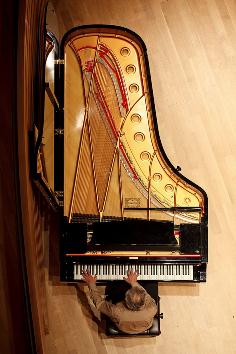
Getting six grand pianos on a stage is a lot of work. Aside from the simple mechanics of transporting the unwieldy instruments, sourcing them can be a challenge. But that’s the task that’s been given to Soundstreams executive director Chris Lorway for the company’s upcoming event, Piano Ecstasy.
Featuring nine pianists from across Canada playing compositions written for multiple pianos, the evening promises both a unique sonic and visual experience.
“It’s rare to see more than one or two pianos onstage, which makes it an interesting concert to watch as well as to hear,” Lorway says. “The works we’ve programmed don’t get performed a lot, because of the logistics of getting that many pianos together. It’s definitely not something you get to see every day.”
One of the works is queer composer John Cage’s 1990 composition The Beatles 1962-1970, consisting of segments of several dozen Beatles songs overlaid simultaneously on six pianos. Like many of Cage’s experimental works, the piece varies each time it’s performed, the results based on chance. Beatles fans will recognize parts of certain songs, while others will be lost in the overall texture.
“Paul McCartney cites Cage as an influence for some of The White Album,” Lorway says. “And Yoko Ono was part of the scene Cage was involved in at the time. It was a period where artists from all different disciplines were hanging out and feeding off one another.”
Cage was the long-time partner of celebrated choreographer Merce Cunningham, and many of his works were deeply influenced by their relationship. “They were each other’s muse,” Lorway says. “The way Cunningham made his dances and the way Cage made his music were both heavily influenced by each other. The depth of love and respect they had for each other translated to a great artistic collaboration.”
The evening also features works by Canadian composer Colin McPhee, Steve Reich and Glenn Buhr, most being performed on multiple pianos at once. “In a lot of cases, the piano is either relegated to the role of the orchestra, when one can’t afford an orchestra, or the accompanist for singers,” Lorway says. “In this case the instrument is front and centre, allowing performers who are usually the accompanist to be the soloist, while at the same time working as part of an ensemble.”
Lorway, who was raised on Cape Breton Island, says the piano is as much a part of his heritage as foggy days and fresh lobster.
“There was always a piano in every house when I was growing up,” he says. “It was a piece of furniture that became a beacon for people to gather around. It’s not as portable as a guitar, but it does have the sense of being a democratic instrument because you can learn the basics really easily.”
Soundstreams presents
Piano Ecstasy
Fri, April 26, 8pm
Koerner Hall
273 Bloor St W
soundstreams.ca
 Why you can trust Xtra