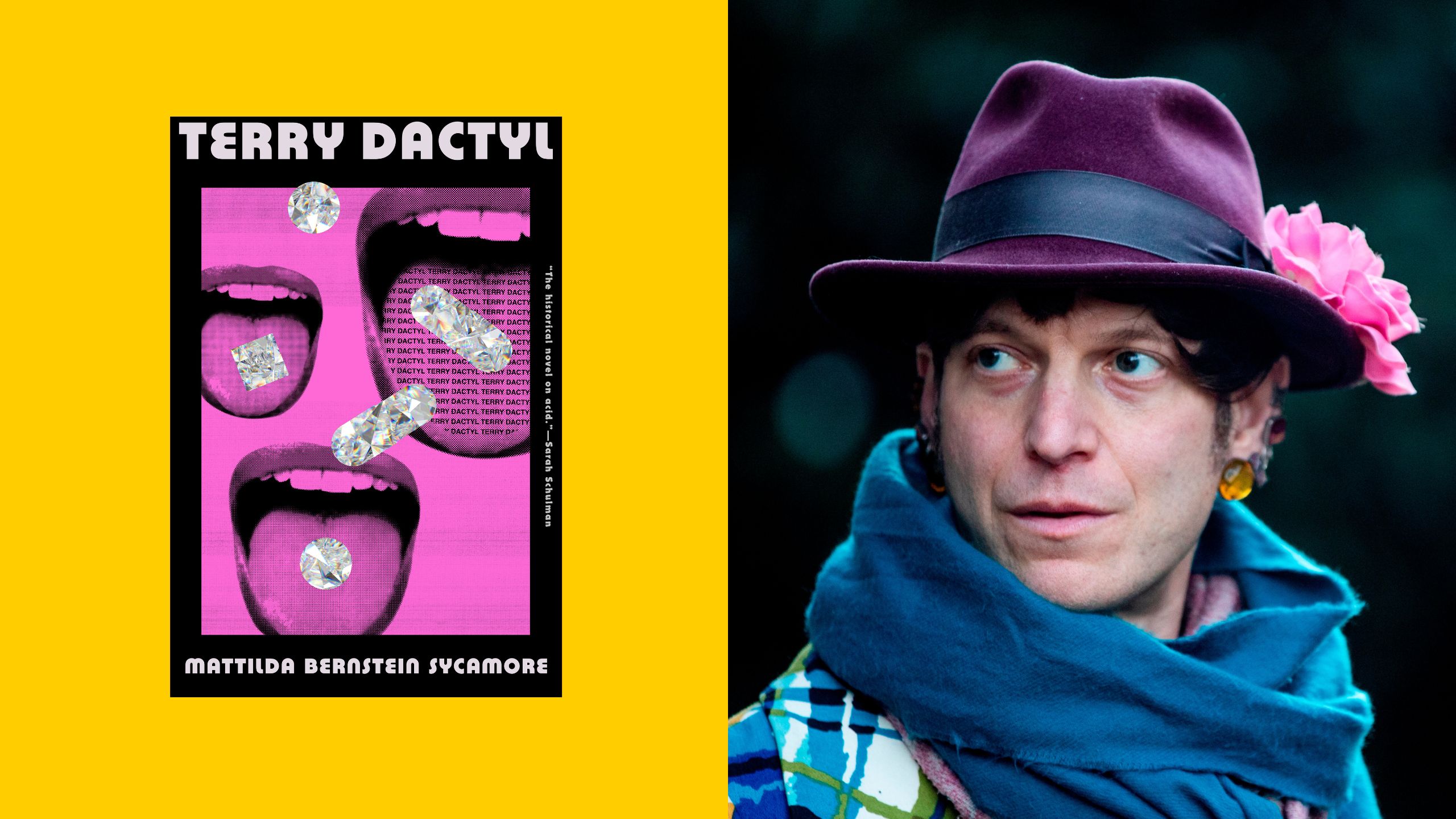
Long known as a chronicler of the AIDS crisis and the generational traumas that it has inflicted on the queer world, author and activist Mattilda Bernstein Sycamore now gives us the novel Terry Dactyl, in which she puts AIDS into conversation with the more recent COVID-19 crisis. The titular protagonist is a study in contrasts and simultaneity: born to two lesbian mothers, she comes into a world of queerness and love, but also one full of the daily suffering and death that were a part of AIDS in the 1980s and ’90s.
Terry makes her way to New York City, experiencing both the club and art worlds of the ’90s and early ’00s, then back to her hometown of Seattle, where she rides out the COVID lockdowns, reconciling with her childhood history while trying to also find intimacy, connection and resilience as a trans woman in America. The book is at once a subtle, outrageous, energetic and kaleidoscopic look at queerness, with Sycamore’s trademark energy and high literary style.
I met with Sycamore over Zoom to talk about her character Terry, how two epidemics coexist in queer bodies and our desire for connection and resilience.
To begin, I’m curious to know what made you want to tell this particular story?
The character of Terry Dactyl came to me when I was going on lots of very long walks around 2020 and 2021, so I just started to think about her life in an obsessive way. I would be walking around in Seattle, and I would think, “Oh, there’s the house where Terry Dactyl grew up,” and I’d be like, “Okay, here’s what happens here.” I just kept obsessing for probably like six months, eight months, nine months, something like that. I had a lot of the character and the sensory details.
Who is Terry, in your own words?
I was thinking about this trans girl who’s growing up in this basically entirely queer world, and then, you know, as she’s living through AIDS and she’s like 10, 11, 12 years old, she watches as all these queens, who are her mothers’ friends, are partying in her living room, and who are also dying of AIDS. So that’s her formation. These are party girls who are living in very flamboyant worlds, and this trans girl looks at them as role models in a certain way. Her story engages all these questions about intergenerational formation and queer world-making and the AIDS crisis. And then, of course, this new pandemic, which is the present day of the book.
What was it like to go back to the AIDS crisis? This is territory that you’ve covered quite extensively in other books.
The AIDS crisis was so formative for me as a queer person, coming of age in a world that wanted me to die or disappear, and then coming into my own desire and realizing, “Oh, that can kill me.” The intertwining of desire and death, it’s always been that way. So I am thinking about all that in these different characters. Now, Terry has a very different experience than I did. I grew up in a world where there were no queers, at least no out queers, and there was no possibility of imagining that in any way.
A lot of writing this book was the experience of writing all the layers of that trauma, and then the self-actualization within that trauma, and the continuation of that trauma and the way it manifests in all these different ways over time, the very obvious traumas like the death of friends and family, and also the more subtle ways that become internalized. For me, I’m always writing toward vulnerability, and so I want to go to where all the emotion is, whatever that emotion might be, and the interweaving of all of it at once.
I’m so struck by you giving Terry this world where she’s surrounded by queerness. For many of us who grew up in the ’80s and the ’90s, it was exactly the opposite.
Totally! I wanted to explore what that would feel like, but without a romanticization, because I don’t believe in nostalgia—these false ideas of hope. And so, in one sense, yes, she has this incredible childhood, she has all these possibilities for freedom. But then also, this trauma of watching all these people die, and then after her own coming of age, going to New York, becoming a club kid, living in this nightlife world and all the possibilities of flamboyance and pageantry.
But this is also in a world that is bonded by drugs and dislocation, and that isn’t really dealing with what’s happening. So I wanted to be honest about everything that might happen while allowing for a kind of grounding. It’s really people spending so much time together and being very flamboyant, trying to find this authenticity, but also just having a lot of drugs, a lot of distancing themselves from anything.
You’re trying to find some truth of that world, where you’re very dissociated by also really trying to be, where there can be all of these simultaneous experiences . . .
I think I’m always wanting it to be everything at once, because that feels more authentic, to both my experience and the experiences of the characters. It’s not usually one thing at a time. Sometimes, grief might take over, or love might take over . . . but, you know, you’re on the dance floor, and you’re just in another world, right? So often it’s everything at once. And so I want to show both the complication and the contradiction.
What was your experience of the COVID years?
My first experience was drama [laughs]. But, there were moments very early where we were all in this together. There was that feeling, and it was something that people were saying, because, collectively, in an extremely broad cultural way, literally everyone was like, “Oh, I might die if I don’t, you know, wash my groceries.” And so I think it was a glimpse for me of communal possibility, and then as soon as businesses started reopening, that was gone.
But it wasn’t so great in some ways, because, for instance, I literally had no physical touch for maybe a year at least. And so that really traumatized me in pretty deep ways. And it also came at a time when I was actually figuring out ways to have more of that touch in my life, like ecstatic dance and contact improv. And those things just vanished, they were gone. So I think for myself I’m still negotiating that sense of loss.
@xtramagazine Did you know that kissing can be a form of activism? The first documented kiss-ins took place in 1970 in New York City during a gay liberation march commemorating the first anniversary of the Stonewall Riots. While the use of kiss-ins petered out after the late 1970s, they became an organizing strategy among ACT UP chapters in the U.S. and Canada in the late 1980s and early 1990s—including at the historic HIV/AIDS protest at St. Vincent’s Hospital in New York. While more recent kiss-ins have taken place from 2002 up until 2018, they have once again become a less common form of activism. But its history and impact should not be forgotten 👨❤️💋👨 #lgbtqhistory #activism #queerhistory ♬ original sound – Xtra Magazine
I’m struck by your writing a book that covers both AIDS and COVID. I don’t know if anyone but a queer person could write that kind of a book. I’m curious about having a single narrative that brings these two plagues together and puts them into conversation.
MBS: To hear you say that, I think you’re right about that. I mean, anyone could write it, but I don’t know if it’d be very good. It felt to me like there would be no way to write Terry Dactyl’s story without both of those narratives intertwining, and I honestly think that’s true for all queer people: we’re all living with the trauma of the AIDS crisis in different ways. That there are two crises are intertwined.
In the book, the AIDS crisis has been going for decades, but for COVID, this is just 2020, so it’s the most saturated moment, and I think it’s that saturation that I wanted to come through. The dailiness of COVID is really clear, but there’s also this dailiness of how Terry lives with the AIDS crisis. It’s in her core. What I wanted to come through was both the mundaneness and the subtleties and the memories—the gestures of warning and care, but also this undoing, the breaking down and the flailing, the deep personal unweaving.
This seems very much a book about queer intimacy, the way that queer people pursue intimacy in a world that often tries to deny it to us. And diseases really heighten the concept of intimacy in very different ways.
For Terry, because she grew up seeing her mother’s friends start dying, death is traumatic but it’s also mundane. I think there’s a way in which negotiating, experiencing and witnessing are all kind of almost the same for her. There’s no witnessing at a distance, and I think that allows for a kind of intensity in the book that also allows for an intensity of connection.
This is a book about friends, and about what happens to the people who survive, and the way that friendships endure. Terry is always searching for connection, it’s like over and over and over again, and I think that is a clear drive, it enables us to continue in the face of so much loss and violence and dismissal. I really wanted to show those relationships and all their hilariousness and nourishment and brokenness and connection. That drive for connection is the pulse of the book.
Part of that urge toward connection is an urge toward finding safe spaces and finding safe people. That relentless search strikes me as a very queer thing—like what queer child in this world ever has enough of an experience of safety in their childhood where they aren’t going out and trying to find that in adulthood?
In the book, a lot of the connection happens through coincidence or chance. And I think a lot of it is through Terry asserting this in extremely over-the-top, flamboyant and fun ways of being. Her nurturing and the nourishments often come in surprising places that may not exactly be what we’re told to expect. And so I think I wanted to hold that openness too, because I think that that’s another thing that the book is striving for, that public sense of an embrace that may never come, but it can still occur in moments.
This is so much a book about resilience in lots of different forms; what is resilience for you?
When I was, say, 18 or 19 or 20, and walking out in the street and, like, everyone was telling me they wanted to kill me, the only way I could survive was by projecting invulnerability. Like, Don’t even, as if nothing could touch me. And, now, I think it’s actually vulnerability that will save me. And one of those ways is by putting it in my work so I can find people to connect with in meaningful and deep ways
So I think it’s remembering that moment of, like, someone’s stopping his baby carriage and getting in my face and telling me, “What the fuck are you doing in my neighbourhood?” or someone throwing me against a metal pole in the middle of a crowded dance floor just for existing. And these things still do happen today, although not in such a dramatic way. I think it’s about not allowing that, and all the other losses in my life over the years, not allowing them to make me cold, or dissociated or unable to search for ways to thrive in spite of what will always be there to tell us that we don’t deserve to live.
This interview has been edited for length and clarity.
 Why you can trust Xtra