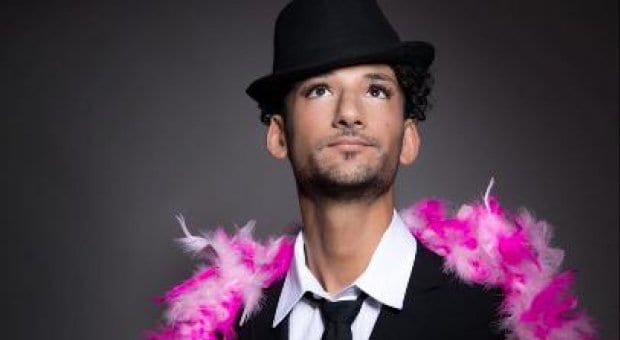
While many people toss back their morning coffee mid-commute from paper cups, Lorenzo Pagnotta enjoys his daily dose in a ceramic cup, comfortably seated at his kitchen table. Born in Edmonton to Italian parents still steeped in Old World tradition, he learned early to enjoy his brew the traditional way.
“In North America we often treat coffee as something you take to go, rather than an experience to be savoured,” the Toronto-based writer/performer says. “But in Italy and other countries, it’s more of a ritual. It becomes a metaphor for how capitalist behaviour often changes experiences that are meant to be pleasurable into a basic source of sustenance.”
Pagnotta’s play Making Love with Espresso translates that Old World/New World conflict to the domain of dating. The multi-character solo show (in which he also performs) follows a young Italian-Canadian (known only as Actor) as he navigates the world of online hookups. Also in the mix are the Professor (a self-proclaimed IT expert who provides a counterpoint to his own internet ineptitude) and a series of iconic male characters drawn from Italian literature, which serve as his references points for masculinity.
“Because of his cultural background, he’s naturally geared toward marriage, so he takes the whole internet thing more seriously than he should,” Pagnotta says. “He comes to online dating hoping to meet people who are more like him, but it’s not exactly a successful experience. All of us have certain values and history that come with our cultural upbringing. But especially when you’re gay, those things don’t always match how we view ourselves in the world.”
Though not completely autobiographical, the play makes liberal use of Pagnotta’s own life experience. Like the character in his story, his struggle was less about coming to terms with his sexuality than finding a place in the gay community.
“Masculine men are often considered to be the most attractive,” he says. “You don’t need to be macho to have validity or contribute something to your community, but it can be easy to feel that way since so many of the messages we receive say that. It leads to a lot of feelings of inadequacy for younger guys coming out. There are many different ways to be a man, but not everyone has had a life experience that teaches them that.”
While many burgeoning scribes choose personal stories as an easy entry point to the world of writing, in Pagnotta’s case the subject matter was more about addressing a specific cultural phenomenon.
“While I was in grad school, there was that string of teen suicides across North America,” he says. “I started to reflect on how much of our happy, positive energy was actually just a front to mask problems. I’ve been performing my whole life, but I’ve never spoken about myself onstage. I decided that if this was happening, I needed to do something, and telling my own story was a good start.”
Making Love with Espresso, part of the rock.paper.sistahz festival, is Thurs, May 30, 8pm at the Artscape Wychwood Barns studios, 601 Christie St. bcurrent.ca

 Why you can trust Xtra