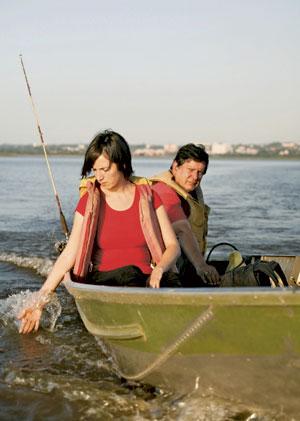
At a time when most of us are still slogging through winter slush and wishing we could go someplace the weather is more forgiving, the Canadian Film Institute is taking a look at life a little closer to the equator. The 16th annual Latin American Film Festival (LAFF) kicks off March 22, offering 15 films from 15 countries. This year’s festival includes some notable queer content, with Old House (Casa Vieja) from Cuba and 108/Cuchillo de palo from Paraguay exploring the queer experience in those countries.
Queer LAFF content tends to vary from year to year, says CFI programmer Jerrett Zaroski, who notes it is slowly becoming a trend in Latin American cinema. He attributes this to growing social acceptance of the queer community. “Every culture has its idea of safe,” Zaroski explains. Although it depends on the country, he says, in Latin America there is a sense of machismo that historically led to queer issues being swept under the rug, which means some secrets simply haven’t been told.
Secrecy plays a key role in 108/Cuchillo de palo, a feature-length documentary by filmmaker Renate Costa. The film gets its title from the 108 list, the first in a series of blacklists ordered by dictator Alfredo Stroessner during his 35-year reign that publicly named suspected homosexuals. These lists demonized homosexuality in the public consciousness to such an extent that the number 108 became a derogatory colloquialism, the Paraguayan equivalent of “faggot.” Furthermore, homosexuals were seen as synonymous with assassins. In predominantly Roman-Catholic Paraguay, “it’s every person’s mission to have children. If you’re not doing what God intended and procreating, you’re assassinating the way of life and the family line,” says Zaroski.
Nowadays, the 108 lists and the era of blacklisting have become a secretive, if not quite forgotten, part of Paraguayan history. 108/Cuchillo de palo deals with filmmaker Costa’s revelation that her own uncle, Rodolfo, was on one of these lists. What follows is her journey to uncover the truth of what happened through speaking with her family and community. In particular, Costa helps her father come to terms with his brother’s sexuality. For much of the film, Costa is in front of the camera rather than behind it as she talks to people about what is still a very secretive topic. “Everybody sort of looks away,” says Zaroski of the Paraguayans’ tentative approach to acknowledging homosexuality. “Even before complete acceptance there’s a denial at least.”
Also featured in this year’s festival is the Cuban film Old House, about a gay man who returns home after a long absence to face his family and some demons from his past.
When choosing films to include in the festival, programmers work closely with the embassies of the countries from which the films are drawn. They provide suggestions as to what films they would like to bring to Ottawa in the hopes of securing distribution rights while taking the embassies’ suggestions into account. Zaroski says that even with a multitude of stellar films to choose from and the preferences of the various embassies to consider, “usually we’re able to show exactly what we want.”

 Why you can trust Xtra