When Joan Chen turned 30 years old, she felt it was the end of her youth. But it didn’t take long for her to realize getting older had no impact on her desire to dream, to love and to reinvent herself.
This same passion for growth and change has fuelled a film career that spans nearly six decades. From her early breakout in Bernardo Bertolucci’s The Last Emperor to her role as Josie Packard in David Lynch’s Twin Peaks, Chen has moved between continents, genres and generations of cinema. In 2004, Chen starred in Alice Wu’s landmark queer Asian American film Saving Face, a tender and funny story that lies at the intersection of queerness and familial expectations.
Two decades later, Chen finds herself returning to queer stories with a renewed depth and clarity. Chen says she has long experienced being a minority in Hollywood and she feels a kinship toward queer family stories such as Saving Face, Andrew Ahn’s 2025 remake of The Wedding Banquet and her latest film, Montreal, My Beautiful.
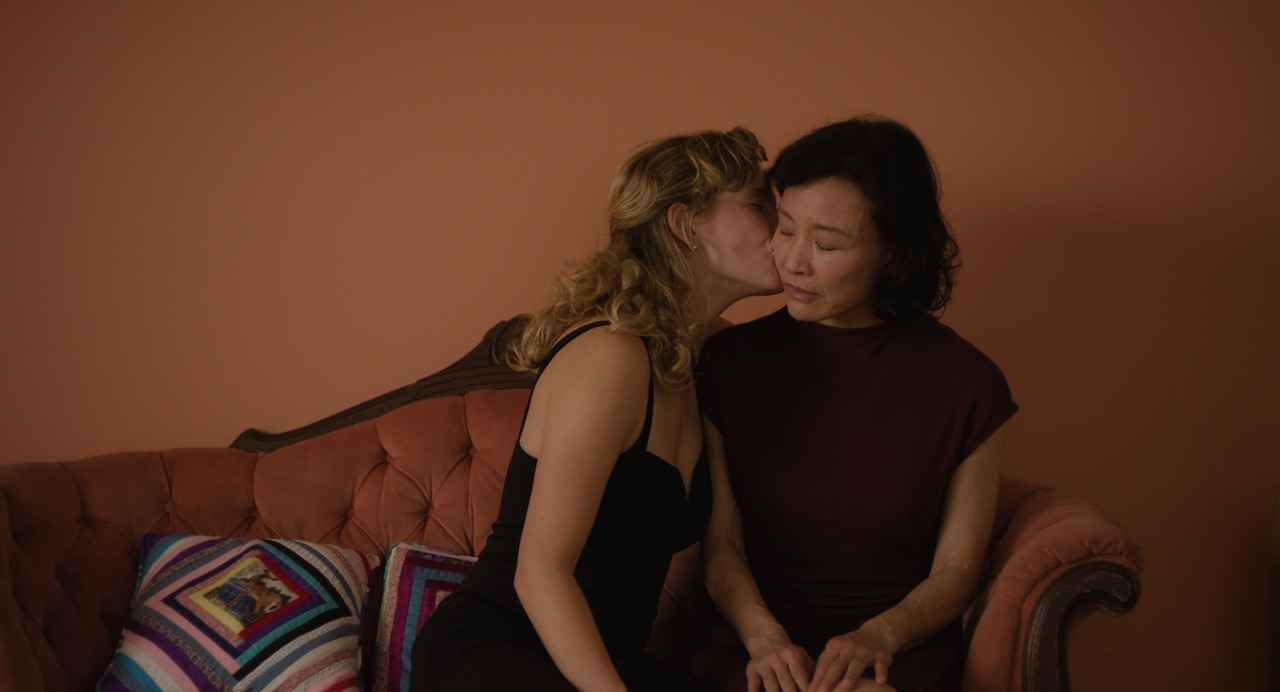
Written and directed by Xiaodan He, Montreal, My Beautiful tells the story of Feng Xia. She is a 53-year-old Chinese Canadian immigrant and mother living in Montreal. Her life of quiet duty is upended when she meets Camille, a young Québécoise, on a dating app. This chance encounter changes Feng Xia’s life as she tries to find the courage to choose her own happiness.
Ahead of the film’s theatrical release in Canada, Xtra spoke with Chen about love, aging and why the most honest work always begins with the innermost self.
I wanted to start our conversation by talking about Saving Face. When that film was released, queer Asian stories were still fairly rare on screen. What do you remember about the cultural moment surrounding that film?
I do remember very well when Alice approached me. We chatted not about the script but about our lives. She told me about her relationship with her mom and I told her about my own upbringing. We just gelled, and I love the script. I thought that she wrote such a beautiful story. Her own mother is an immigrant and with so much tender love and understanding, she wrote the character of Ma—even though it was her first film. But from the way she wrote the script, I was confident, and I wanted to support her. I wanted to make it possible for her to make this film.
I was wondering if that movie shaped your understanding of the importance of visibility as an actor.
I think I’ve dealt with this problem ever since I first began in Hollywood. When I first began, you hardly saw anybody who looked like me, sounded like me. It was almost non-existent. And very, very difficult. And I did then know that I needed to fight for visibility, and it would be a long process. There were stereotypical characters, there were even offensive characters, and you try to make the best of it. Then fast-forward to, well, let’s say, Saving Face. It’s slightly better, but still not so much better. You can imagine, if Saving Face was released today, it would have done much bigger business. The climate wasn’t as friendly then. But today, it’s a lot better. So I have been dealing with trying to increase our visibility for half of my career.
More recently, you were in The Wedding Banquet. So how did returning to a similar kind of queer family story feel different for you this time?
I love the original The Wedding Banquet. And when James Schamus sent me the script, he asked if I would want to be part of it. I said, yes. It’s another chance. I often played very tragic characters, but this was one opportunity that I could do a situational comedy. I think, in a way, I’m attracted to queer stories. It’s also about representation, because it is, again, another minority.
In Montreal, My Beautiful, you play a queer character for the first time since the ’90s. What made you feel like this was the right role at this moment?
When I first read the script, I knew I wanted to do this movie. I wanted to play her because I seemed to know her and I had never seen anybody like her on screen. As an immigrant story, it was really a life that I know very well. Our situations are very different but I know people like her, like myself, who left everything they knew. They uprooted themselves trying to establish a home that they felt was better for their children.
I first came to the United States and I worked in the school library and I worked in restaurants. Some people give up their whole careers just for survival. The character of my husband in the film was an architect. But the two of us [our characters] tried very hard to open a convenience store so that we have a relatively comfortable life for our children. All that struggle, responsibility, duty and that sense of exile and loss of leaving your mother culture—I understand very, very well.
At the same time, it’s exhilarating to enter into a new horizon, to experience brand-new things and to have that freedom. My character in the film, Feng Xia, experiences that too. So that is a big draw for me. It’s a life that’s seldom portrayed on screen, and yet it’s a life that’s worthy of the screen. The second is that it deals with the desire and the longing of a woman of that age, which you seldom see.
That was another question I had for you. How do you think age and life experience change the way an actor approaches intimacy, family and chosen family on screen?
I feel that one’s age is certainly something you can boast about. I think you have endured all the hardships, you have conquered all the sicknesses, you have endured all the losses and you’re still here. Just the fact that you’re still here standing and still dreaming and hoping is something to boast about. And I think because I’m at this age, I’m actually more comfortable dealing with the issue of desire. I’m no longer shy. I’ve owned it, I still own it and I admit it.
Maybe when I was 30, I thought I was old. I remember my 30th birthday was like a funeral. Gosh, so many flowers. I’m not one to actually celebrate or party, but 30th, I thought that was the end of youth, and it was huge. I thought from now on, I am old and life will continue but youth is gone.
Then I realized that you still long, you still dream, you still desire, you’re still the same. And I know that when I’m 80, when I’m 90—if I’m alive—I will still have the same longing, just as youthful as a young girl. That is another thing that attracted me to the character of Feng Xia. It’s so seldom seen on the screen, it’s her first love and summer fling. It’s the most meaningful fling that any film could ever present, I would say, because that is once she was finally herself. And she was only herself that once.
For you, when you take on queer stories like this, do you feel a sense of responsibility to the communities that these films represent? Or do you try to protect the work from outside expectations and pressures?
I never think about the outside expectations. If I write something, if I choose something, when I’m performing something, it’s always to relate and connect to the most inner part of myself. The authenticity actually comes from the most personal and not a cause, not a community, not any of that. But I think when I took this job, I did have the realization that this is not so ordinary. Not very many films are portraying [queer Asian stories] and that is pretty unique and important. I do have that sense. But I think any artwork, any creative endeavour, it always is from the innermost of your own heart, your soul, your own emotional experiences. That’s the only way to be honest.
I wanted to ask you about the city of Montreal itself and its role in this film. How did Montreal shape the way you inhabited Feng Xia?
That summer [of filming] was an enchanting summer. I could feel a certain stirring in myself. In such a city, walking around such streets. Winters are long and cold, and when summer comes there is a celebratory atmosphere. Over the weekend, people are out drinking their icy beer, there are outdoor concerts and the gardens are in full bloom. And the charm of Montreal is not all these brand-new high-rises and everything. It’s slightly dilapidated, like old churches about to close, with plants growing on their stairs. There is a sense of past, present and future all in that one space. And I can imagine the freedom and the stirring of the heart that Feng Xia feels. If you allowed yourself to look and to actually consider the beauty of the city, you’d want to fall in love. She never had that chance. She was about duty above all and responsibility above all. She didn’t have a chance until that particular summer and magic happened.
I also wanted to ask you a question about Dìdi, which you recently starred in and executive produced. As someone who has directed, produced and acted, what kinds of stories make you want more creative control?
It’s almost like describing a lover you haven’t yet met. It’s like saying “I’m attracted to this type, that type” or “I would really love to meet a guy like this.” But in the end, you could fall in love with a totally unexpected thing. The projects are just like that. It’s always better to have creative control. That is the most valuable thing because you want your voice heard. So that you have this give and take amongst the creative departments. That really is the joy of filmmaking. It’s to somehow make each other better. We all try to make each other better.
When you look at your body of work, what do you hope people understand about your choices as an artist, especially when it comes to these quieter, more intimate films?
Honestly, I have no idea. I have no idea what other people think, and I don’t think I can begin to even think about it. Mostly, I’m not a great planner. That’s just not me. I take what comes my way. And in my younger days, I had that free-floating angst, like, “Where is my next job? What should I do next?” And I no longer have that. Now, I understand that we just have to know our destiny. I feel like I have finally fallen into my destiny, I embrace it. I think I’ve taken terrible parts and I’ve also taken wonderful parts. It’s a messy hodgepodge of experiences but I value even the worst part that I’ve played. It’s part of my life, it gives me growth. I value experience above all, really.

 Why you can trust Xtra