Have you ever looked over and found a naked man you barely know sleeping in your bed? Have you ever wondered about the nature of your relationship to him, sexual or not? John Monteith has, and he explores these feelings in his latest body of work, AM: After Midnight. If you have only ever longed to have a beautiful naked man sleep beside you, these paintings may prove to be the next closest thing.
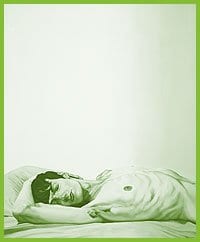
Each of the 12 paintings in After Midnight is a slightly larger-than-life-sized portrait of a man lying on a bed – Monteith’s bed, to be specific, though it could be anyone’s, really. Each painting is titled with the date of the morning after Monteith meets his subject. “It’s a time,” he says “when you are coming back into yourself and feeling a little more introspective.” Most of his subjects are sleeping, but some lie in quiet contemplation. The men in these paintings take up roughly one-third of the canvas, and are cut off somewhere around the waist. Such placement means that more than half of the canvas is virtually empty. The empty space adds to the subject’s vulnerability. Rather than dominating the picture plane, each man’s presence is diminished by the pale quiet of the wall behind him.
According to Monteith, these paintings were created to explore his doubts and insecurities, and also those of his subjects. To this end, he includes a self-portrait, turning the gaze on himself, and acknowledging his lovers’ feelings toward him. While looking at these paintings of sleeping men, it is as though the viewer were sharing the bed. It feels slightly intrusive to be watching someone sleep, but that is one of the feelings Monteith wants to explore. The work, he says, “references the connection of a one-night stand,” where the familiarity of space meets the uncertainty of its inhabitants. Without any action or conflict occurring, viewers are left to contemplate bodies and ponder assumptions, the same way the artist does.
Considering his background in photography and the fact that these paintings could easily be seen as a set of figure studies, it seems obvious to wonder why Monteith does not present the work in photographic form. “We are saturated with photographs,” he suggests. “Painting has a lot more weight because it is a labour-intensive process.” This process creates work that both artist and audience relate to differently. For example, most everyone has taken a photo, but not necessarily created a painting. As paintings, these works may encourage contemplation more so than the same photograph would.
Though his palette remains the same throughout (think pink!), Monteith’s paintings are vibrant and sensual. His figures seem to radiate and reflect light. Monteith freezes a moment in time, and makes everything just a little more scintillating. The flesh looks soft and the sheets look fluid. Through attention to detail, and lush rendering of flesh, Monteith’s affection for his subject matter is obvious. Although he says the paintings “are not necessarily intended to be homoerotic,” it is hard to deny such overtones. Perhaps it would be accurate to say these paintings talk about a particular expression of the sensual, rather than to assert that they constitute erotica. Either way, admirers of the male form everywhere will get a kick out of After Midnight.
* The opening reception runs from 6pm to 9pm on Sep 23. Go to Johnmonteith.com for more info.
AM: AFTER MIDNIGHT.
Thu, Sep 23-Oct 16.
XEXE Gallery.
624 Richmond St W.
(416) 646-2706.
Xexegallery.com.
 Why you can trust Xtra