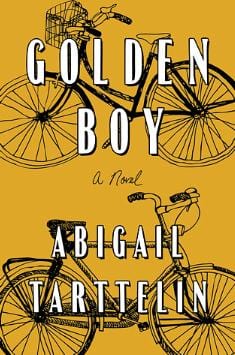

UK writer Abigail Tarttelin opens her second novel with a rape that is certain to be unlike any you've yet encountered in print.
Fictional intersex has been on a roll for a decade now. Jeffrey Eugenides’s 2002 blockbuster, Middlesex, sold in the millions worldwide. Closer to home we have the critical splash of Kathleen Winter’s Annabel, matching the tenacious Canadian trope of hardscrabble backwoods lives with an earnest chronicle of a child caught between male and female.
UK writer Abigail Tarttelin opens her second novel audaciously, with a rape that is certain to be unlike any you’ve yet encountered in print. Best friends Max and Hunter are sporty British schoolboys in the hormone-fuelled storm of late adolescence. Hunter is wildly drunk on this particular evening and in the grip of a dangerous crisis of identity. Max, surprised by his friend while masturbating, is in utter shock witnessing this cruel stranger in the guise of his long-time friend. It’s a scene that could easily read as a manipulative authorial ploy to snare readers’ attention. Instead, Tarttelin’s careful setup and writerly assurance render the flaring violence fully convincing and horrifying. The scene reveals Max’s sexual anomaly, known only to his family and Hunter, with a subtle nonchalance that precludes voyeurism.
Max is intersex: equipped with both vagina and penis. We experience his rape from within – the complex pain of it, and also his deeper knowledge of what this watershed encounter means for both parties. The harrowing scene, extending for several pages, shows the intricacy of Max’s unresolved gender turmoil and offers glimpses of Hunter’s own sexual demons. It’s virtuoso writing, the one lapse being a tendency to explain too much, underscoring what’s already visible between the lines – but some readers may benefit from the extra signage.
Max’s sense of guilt after the rape is heartbreaking, bound up with years of feeling he’s a freak, of being grateful for Hunter’s friendship, of being so shocked at the brutality that he assumes some deep flaw in himself must be a factor. He tells no one about the attack.
The story unfolds in six first-person voices, with Max, his mother Karen, brother Daniel and friend Sylvie taking precedence. Oddly, a secondary character, a doctor, is extensively voiced, while the crucial voice of Hunter is left unexplored. Given that Hunter has been Max’s closest friend since early childhood, it’s an unproductive choice. Hunter becomes the cardboard villain of the piece.
The rape has a predictable but, in Max’s case, a completely unexpected consequence. He must deal with the fact that he is a self-identified male who is pregnant. His mother insists that he abort the fetus. Facing the added medical recommendation of surgery to remove his female parts and commit fully to maleness, Max is hugely ambivalent, still unsure of what course he himself wants to chart from the middle ground that has defined him: “I am not an everything. I am not a nothing.” His burden is increased by his parents’ long-time reluctance to deal openly with the mental and medical dilemmas spurred by his condition and society’s expectations.
And so we watch this tender youth, a boy by every usual definition except the anatomical, secretly dreaming that he could be a mother someday to the fetus that it makes enormous sense to abort. Charting a meticulously humane course, Tarttelin tugs heartstrings with surprising skill. Her dialogue is pitch-perfect, erring only in an occasional tendency to extend conversations to match the rambling of real life rather than the tighter frame of storytelling. That said, the extended chat works to suspenseful advantage in a pivotal scene where Max, after much fearful stalling, tells his friend Sylvie he is intersex.
We come to see the bewildering complexity of Max’s identity and the ultimate inadequacy, and even inappropriateness, of any decisive “fix.” As a character, Max is effortlessly lovable, a hurting, seeking, stumbling proof of our troubling societal fixation on gender dichotomy. What troubles him is exactly what bothers many of us about the gender polarities we see first in our families, and then in the vast world.
Abigail Tarttelin reads from Golden Boy
Sun, May 26, 6pm
Glad Day Bookshop
598A Yonge St
gladdaybookshop.com
 Why you can trust Xtra