In her YouTube series Dragvestigations, drag queen and self-identified cross-dresser Lushious Massacr vlogs herself roaming through large retail chains searching for apparel that might suit plus-size bodies, trans women and other feminine queer people. One such vlog features her strutting through the night toward the entrance of a Best Buy in Brownsville, Texas. It is Black Friday, and Massacr wears her signature bob, a pink Jessica Simpson purse and a floral dress. As people move in and out of the store—some staring at her, others pointedly not—Massacr holds her iPhone and begins to read the Best Buy to filth.
“Bitter!” her voiceover interjects. “These Black Friday sales, baby, you already know they’re playing games with us, honey, don’t do it!” Not unlike the big bad wolf at the little pig’s straw house, one must imagine that Massacr does not simply blow the Best Buy down. More accurately, she huffs, puffs, reads, shades, shreds and drags the corporation to the ground by the chinny chin chin of their profit margins.
“You know there are no sales, no discounts, baby, they’re just trying to get you, honey, no!” Massacr seethes. Finally, she exclaims, “Let’s go see what monstrosities, what atrocities we can find at the Best Buy in Brownsville, Texas,” and walks into the store.
I believe that gay people are at their best when they are being mean. When gay people take pleasure in meanness, and when this meanness is directed toward exposing, unsettling or dismantling the exploitative and oppressive socio-economic conditions around them, my heart sings. I imagine a golden web of meanness linked from the scene of Marsha P. Johnson throwing the brick that sparked the 1969 Stonewall uprising, to Massacr’s shadings of mass-market retail behemoths, to the demon twinks and butch lesbians we know who love to pick fights with callous bouncers. When she drags Best Buy, Massacr does not simply complain. While her goals are less revolutionary, she nonetheless performs in the wake of the transgressors who came before her. In Massacr’s shade, as in the demon twink and riotous butch’s incendiary spitfire, history echoes back the unruly queens, acerbic dandies and troublesome women who first made incivility their method.
As a queer person raised in the prison of compulsory likability as compensation for my failure to be straight, my first lesson in meanness came from the trans icon and drag queen Crystal LaBeija. LaBeija was a beauty queen who wore offence like a crown. Consider her historic feud with fellow drag queen and trans woman Rachel Harlow following a crowning fiasco at the 1967 Miss All-America Camp Beauty Contest. A seasoned pageant queen, LaBeija lost the crown to the newbie Harlow, a younger white ingenue and protegé of Flawless Sabrina, the (also white) drag queen who hosted the pageant. Upon her loss, Labeija knew that Harlow’s win was a fake, fixed fad. As a Black queen suddenly ensnared in the rigid hierarchies of desirable whiteness and anti-blackness, she resolved that if she was going down, she would drag Harlow and the pageant to hell with her. As director Frank Simon depicts in his 1968 documentary, The Queen, LaBeija erupted in mean-spirited fury.
“Miss Thing, I didn’t say she’s not beautiful,” LaBeija says of Harlow as the white queen recoils in a corner, “but she wasn’t looking beautiful tonight! She doesn’t equal me. Look at her makeup, it’s terrible!” Accused of “showing her colour” for being a sore loser, a comment that reeks of anti-black racism, LaBeija snaps back, “I have a right to show my colour, darling! I am beautiful, and I know I’m beautiful!” Without naming the pageant’s racial value system for what it was, LaBeija reconfigures her rejection into an epic read. As Simon’s film shows, even in loss, cast as a villain by the camera and the situation, LaBeija’s bitterness imbues her with transmogrifying powers. She becomes narratively untouchable, slippery, almost divine; meanness for her functions as a means of escape from the damnation of loss.
By performing as herself in a space fashioned against the transgressive magnitude of her queerness and blackness, LaBeija delivered one of queer history’s most exemplary performances of meanness-as-social-critique. As a Black person myself, LaBeija remains an important lesson in how critique can be delivered in the style of glamour, and how glamour itself can take the form of critique. Without naming racism as the cause of her loss to Harlow, LaBeija successfully resisted the system of values that had been set up to judge her in the first place. All it took was insulting Harlow to tears, draining the pageant of every trace of joy and embarrassing the judges before their own audience. Decades later, it is LaBeija we still speak about, not Harlow. Harlow may have won the crown, but LaBeija won the war.
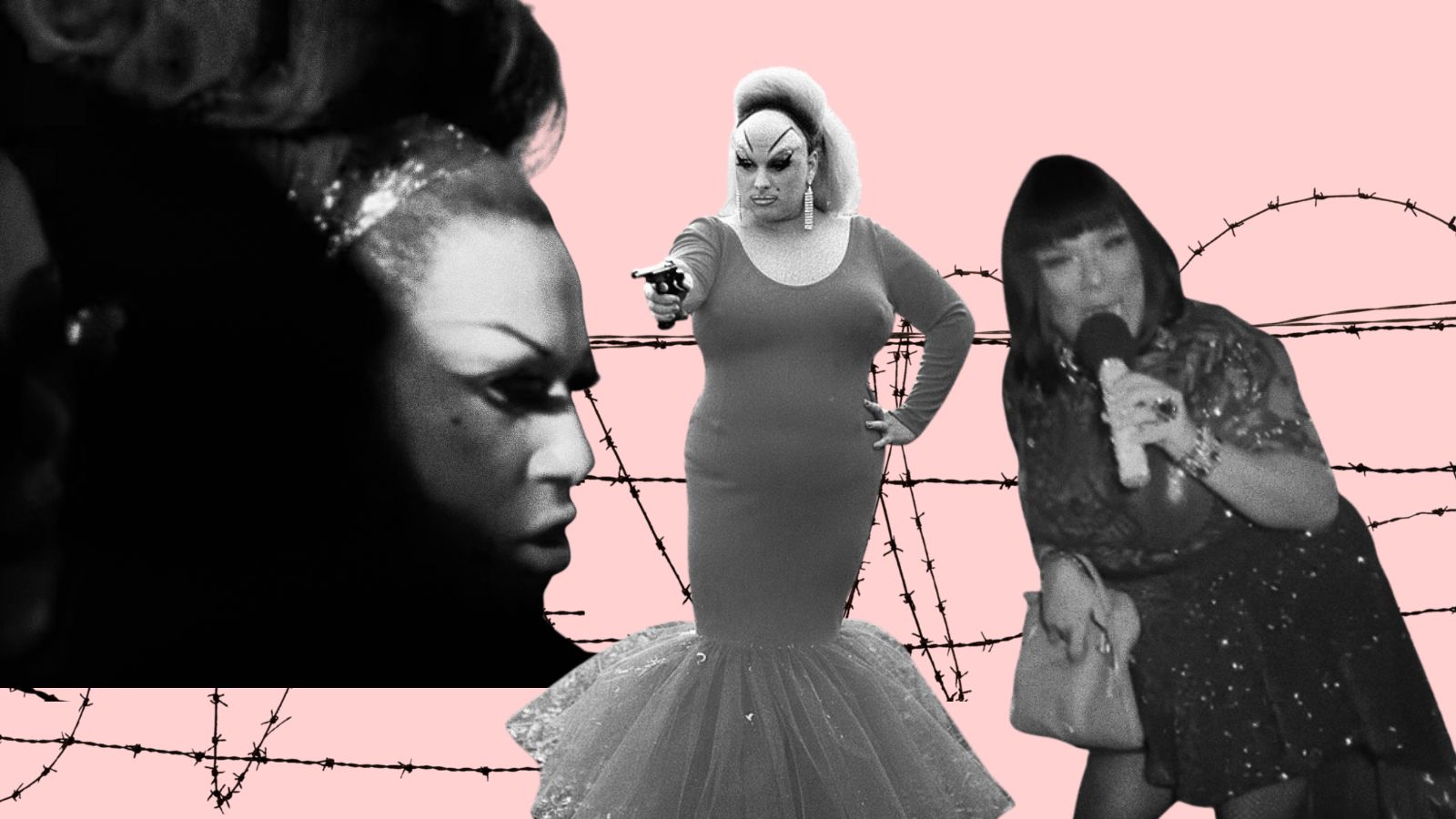
Hatred, negativity, meanness and bitterness are dark, critical paths figures like LaBeija, Marsha P. Johnson, Divine the drag queen, James Baldwin, the Cockettes, Valerie Solanas and others paved into queer history. For many queer people after them, this ill-feeling similarly functioned as a template for taking up space, a starting point for civil disobedience. For Black people and other queers of colour, harnessing this ill-feeling even constitutes a method of protective, anarchic self-presentation and social performance that art and performance scholar Tavia Nyong’o coined as “afro-fabulation.” And yet, as many of us come of age in the roaring, tender-queer 2020s, meanness seems to have lost its place in critical gay life. Though we inherit these bad manners as tools of resistance, few queer people now seem bold or discerning enough to deploy them with precision and panache. Everyone is either frightened of confrontation, fearful of seeming villainous or wields meanness egoistically and neurotically as a surrogate for their suppressed ego. The question remains: So who the hell is driving this bus?
By speaking queerly against Best Buy in queeny complaint, arch dismissal and mean insincerity, Massacr soliloquizes a pointed suspicion of the manufactured urgency of Black Friday, the predatory seductions of consumer capitalism, and the moral pageantry underwriting holiday spending to her online audience. Just as misery loves company, meanness as a style alchemizes misery into a generative social force. If the carnivals of cancel culture teach us anything, it is that negativity brings people together, for better or worse. And for the better, there is real community and solidarity to be found in being a hater with a fagcent. Though none of the corporations Massacr critiques suffer any immediate damages, shade nonetheless becomes a utopic gathering point for many other bitter, busted queers on the internet. It is so fun for sisters and sissies to spew hate together. As a subjunctive practice based in reality as it should be—free, fair, just—toward navigating reality as it is—cruel, unjust, ugly—gay meanness is most interesting as camaraderie and a means of making community. If you want to be Regina George, remember that the real enemy isn’t the sissy who pushed you into the road, but the system that set you up to be run over by that bus.
Don’t be afraid of being a bitch, because it might save you from despair. Along the racial and sexual lines through which (especially) queer people of colour are cast as monstrously excessive or less than human, ferocity provides a means of working on and against our oppressive situations, to our own ends. Meanness can be wielded like artillery.
Consider Billy Porter, who recently shaded Nicki Minaj on the red carpet at the MusiCares Person of the Year Gala in Los Angeles over her sudden support of Donald Trump and the MAGA movement. When the interviewer mentioned her name, he snarled, “Fuck her. Fuck. Her!” while twisting his face in disgust. Consider the face of “sceney” L.A. gay guys, actor Jordan Firstman, who was virtually crucified for rightfully criticizing the television series Heated Rivalry as “not gay” and “posed” in its depictions of gay sex. Both instances of gay meanness immediately went viral. People laughed at Porter’s red carpet moment for days. Despite not caring for Firstman initially, I agreed with his comments. Out of curiosity, I even watched his 2023 crime thriller Rotting in the Sun, and I couldn’t recommend it enough as a dirtier and far less beautiful alternative for people like myself who also gave up on Heated Rivalry after episode two.
Spring is here, summer is coming and we get another chance to be our best selves. But consider that your best, most authentic self is sometimes a Negative Nancy too. Imagine you stopped redirecting your capacity for negativity inward as shame and melancholia, and instead styled it outward as critique, dissent and rage. If the room permits cruelty, break the silence, make it awkward for everyone. Did someone say something nasty to you in the street? Yell back something nastier. Are you a basket weaver enraged that Ontario premier Doug Ford, a man who never graduated from university or college, is trying to tell you what to do with your education? Find your fellow weavers and throw a giant fit about it. Sharpen that fagcent and throw it like a knife. Raise your voice to interrupt deceit, expose exploitation where politeness would excuse it and make a spectacle of hypocrisy. Exaggerate yourself to reveal the absurdity of the powers that delineate the borders of that self.
What compels is not the psychic wound of meanness but the imaginative force of it: shade as refusal, rudeness as boundary-setting, meanness as a sudden rearrangement of power. If queerness has always been marked as excessive, impolite and out of line, then perhaps our task is not to outgrow that reputation but to wield it with intention. Let the sissy be insurgent. We were born for this.

 Why you can trust Xtra