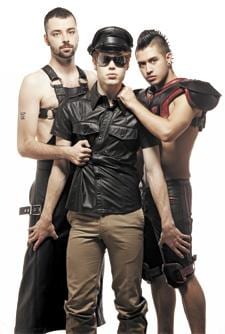

Travis L'Henaff, Del Stamp and Kevin Ayton models. Wardrobe by Priape. Credit: Shimon Karmel
If you thought the gay men’s leather scene in Vancouver was stale and dying, you may need to think again, say the people behind the upcoming Hard Party.
Not only is the men’s leather and kink scene alive, but it’s getting younger, says Hard co-organizer Del Stamp.
“Young people are more confident and coming out earlier now; they’re being more open. There’s nothing holding them back,” the 27-year-old says.
With its images of dominant, brooding musclemen, the leather and kink scene may have intimidated some younger men in the past, Stamp suggests. But if the diversity of those buying tickets is any indication, the Hard crowd will offer fresh faces of all ages.
“There are people coming from New York, Seattle, Portland,” says Stamp. “There’s bears, twinks — the biggest variety. I was shocked.”
Stamp attributes the surge in interest to the scene’s increased visibility on the web. “It’s all over the internet and Facebook; it’s making more of an appearance in nightclubs. It’s just more prominent now as opposed to five, 10 years ago.”
Stamp fell into the world of leather five years ago when, after showing some interest, he “kind of got sucked in.”
“Now it’s just something I generally love — the look, the attitude, the feeling of it.”
Travis L’Henaff works at Priape. A newer-than-newcomer to the scene, the 20-year-old is looking forward to the Hard party. “I’m always curious to try new things.”
But L’Henaff says he’s more interested in the scene’s fashion than its sexual opportunities. “I love leather in terms of clothing,” he explains.
He believes leather love is less taboo than it once was. “It’s maybe becoming not as big of a deal because of the fact that we don’t have to hide anything as much anymore.”
An injection of new blood into the scene is exactly what organizers, including 28-year-old Nikitas Chondroyannos, are trying to achieve.
Chondroyannos, who is organizing December’s Mr Leatherman contest, says he has seen some renewal in the scene but not as much interest as he’d like from younger men.
“Locally I don’t see a lot of the new faces, and that’s one of the reasons we’re trying to make these events more prominent,” he says.
For Chondroyannos, new faces are key to resurrecting a Vancouver leather culture that hasn’t been very prominent at all.
“One of the critiques about Vancouver is that there’s not enough going on for gay leathermen,” he says. “Instead of thinking the grass is greener elsewhere, we’re trying to make a Vancouver that will attract people to the scene.”
Chondroyannos identifies as a leather “traditionalist,” someone who appreciates the hierarchical nature of the leather world. “It’s almost like the military — you earn your honour.”
How one dresses generally reveals where one fits in the leather world, he says. “You find the old guard tends to identify with the traditional image of leathermen who wear caps and uniforms. The new guard will wear Nasty Pig jeans, or rubber and a harness — something considered less traditional. Perhaps even fashion-forward.
“The new guard, they bend the rules and they do what they want. They’re the rebels.”
 Why you can trust Xtra