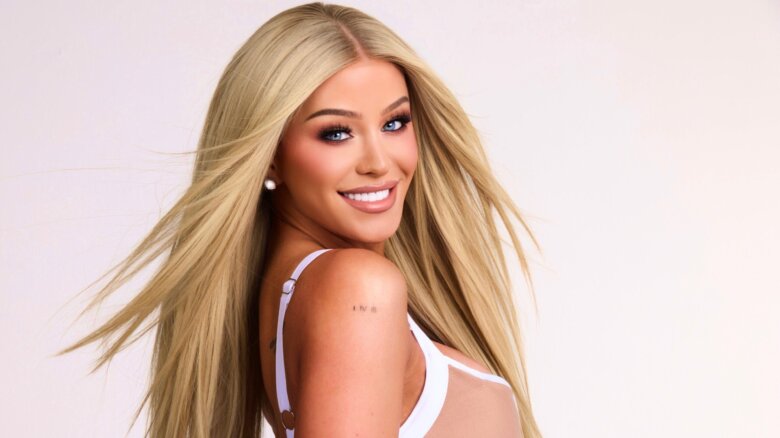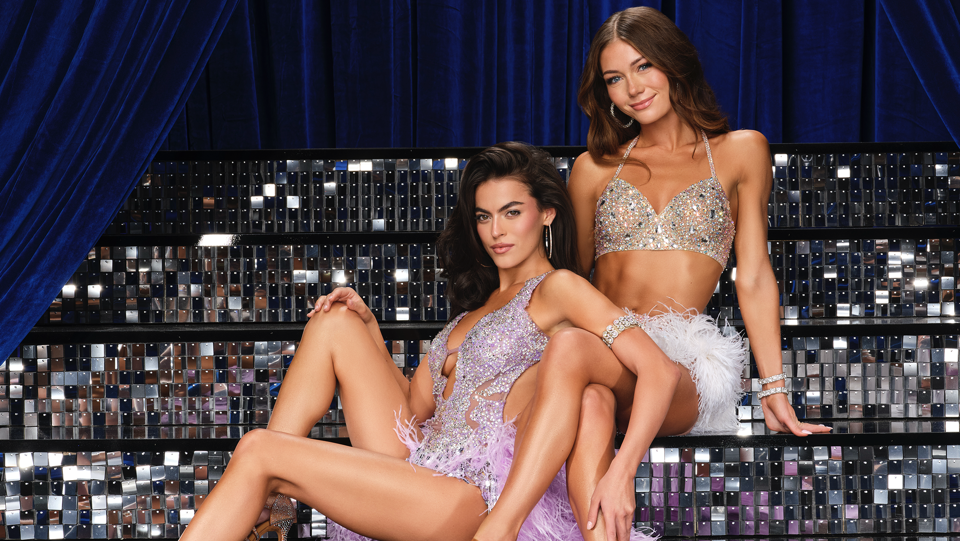
When reality star Sarah Jane Nader debuted on this season of Dancing with the Stars alongside her pro partner, Hailey Bills, the judges’ critiques of their jive to Avril Lavigne’s “Sk8r Boi” were fairly harsh, mostly centred on the fact that the pair were out of sync for most of their dance. But alongside the criticism of dance technique, judge Carrie Ann Inaba added that she loved the “besties without boundaries” vibe that they were giving off, and that it would “help a lot of people.”
Nader, who had recently come out publicly as bisexual, had chosen to dance with another woman to provide representation that she hadn’t seen growing up. While Inaba’s comment was meant to be a supportive one, the framing of two women dancing together as “besties”played into homophobic stereotypes that minimize the depth and legitimacy of Sapphic relationships. Nader and Bills were eliminated after their first episode.
Now in its 35th season, Dancing with the Stars is a television juggernaut. The show has given a mainstream platform to the art of ballroom dance while reinvigorating the careers of countless celebrities. And while there have been strides made in recent years, for a program that has had its fair share of queer contestants and showcases a sport that is full of gay athletes, the show itself is conspicuously straight. Painfully straight, really. That heteronormativity is baked into the very DNA of the show.
Dancing with the Stars premiered in 2005 as an American version of the U.K.’s Strictly Come Dancing (longtime judge Bruno Tonioli, who is gay, came over with the show). The premise was that it paired professional ballroom dancers with celebrities who had no dance experience, and fan votes would determine who won the season. Over its 35 seasons, the show has featured 54 professional dancers. After original pro Louis van Amstel, it wasn’t until season 33, when Ezra Sosa joined the cast full-time, that there was a second openly gay pro on DWTS.
“Louis Van Amstel was the blueprint. He was the OG,” Sosa told So Gay magazine. “I remember my first season as a pro, I called him and I was like, ‘I don’t even know how to present myself,’ because there hasn’t really been a space for a queer pro except for Louis. And he gave me the best advice ever. He told me that there’s a magic to being gay, and it’s not that you just have to be femme all the time, or you have to be rhinestones, you can also be masculine too.”
A huge number of the pros on DWTS are from Utah, or come up through a Utah-based dance studio. As a result, many of the pros are Mormon or ex-Mormon, a religion that is not exactly known for its embrace of queerness. After original pro Ashly DelGrosso appeared on the first season of the show, her mom Kim’s dance studio, Center Stage Performing Arts, became a pipeline for ABC to scout talent for future seasons of DWTS. Pros like Derek Hough, Julianne Hough, Witney Carson, Rylee Arnold, Jenna Johnson, Brandon Armstrong and Sosa, among others, came from the studio.
Whether or not DWTS is explicitly seeking out straight dancers to hire, nearly all of the dancers have been. And that straightness is often on display, as many of the cast members are married to or dating each other, or have dating histories among themselves. Just among current pros on the show, Val Chmerkovskiy and Jenna Johnson are married; Daniella Karagach and Pasha Pashkov are married; Emma Slater and Alan Bersten are dating (and Slater was previously married to former pro Sasha Farber). Add former pros in and the list expands exponentially.
This is not entirely surprising; as any queer person knows, when people with shared interests and experiences spend a lot of time together, the dating pool is bound to have plenty of messy and overlapping relationships. (See also: the WNBA.) But it does mean that the DWTS pros haven’t just been straight; many of them have been in public relationships with their co-workers and those straight relationships have helped to promote the show itself.
And the product that the show platforms is ballroom dancing, which pairs a man and a woman in dance routines that are judged according to the chemistry between the pair. Often, points are docked for pairs who can’t manage to channel romantic or sexual connections on the dance floor. The dances are also often based on traditional gender roles or expressions. The men have to lead the dance, and be strong and masculine in their performances. Meanwhile, the women are the ones who get lifted and have to carry the sensuality of the dances. There is something beautiful, though, about watching straight male celebrities who have never danced before embracing a softer and stereotypically feminine activity like ballroom dancing, and seeing the ways it lets them express more vulnerable sides of themselves.
Recent seasons have slowly started to see these norms shift. Chaz Bono competed on Season 13 of the show, and Season 31 had drag queen Shangela compete (in drag) with pro Gleb Savchenko. On Season 30, openly queer singer JoJo Siwa became half of the first same-sex partnership in DWTS history, when she and Johnson made it to the finale. On the current season, although Nader and Bills were eliminated after the first episode, they became the second two-woman pair in DWTS history. And while there has never been a two-man partnership on the show, the groundwork has been laid for that to change—Chmerkovskiy said earlier this year that he’d “love” to be paired with a male contestant. “I want to challenge myself creatively and also recreate and reinvent what I’ve done in that ballroom for the last 22 seasons,” he told In Touch magazine.
Current contestant Amber Glenn, the Olympic figure skater who is openly pansexual, has also been quietly reinventing what’s acceptable in the ballroom. She danced a tango to Harrison’s version of “All the Things She Said,” and channelled the famous scene from Heated Rivalry that featured the song. The dance began with her looking longingly at a woman before dancing with her dance partner, Pashkov. For Disney Week, the pair danced a quickstep to “A Star Is Born” from Hercules. The dance had both Glenn and Pashkov dressed as Hercules, and halfway through the dance, Glenn took the lead from Pashkov. It was the first time in DWTS history that a woman had led her male partner on the dance floor.
These slow changes haven’t come without pushback, though. Alongside Sosa, two of the male members of the DWTS troupe, Jaxon Willard and Carter Williams, are openly gay. Mid-season, former pro Artem Chigvintsev made a comment on the Ramble app that the dances on the show needed more “masculine energy.” Sosa responded by posting a TikTok featuring him, Willard and Williams doing pirouettes under the text, “bringing some ‘masculine’ energy to the ballroom.” He captioned the video, “Male troupe have been killing it this season.”

 Why you can trust Xtra