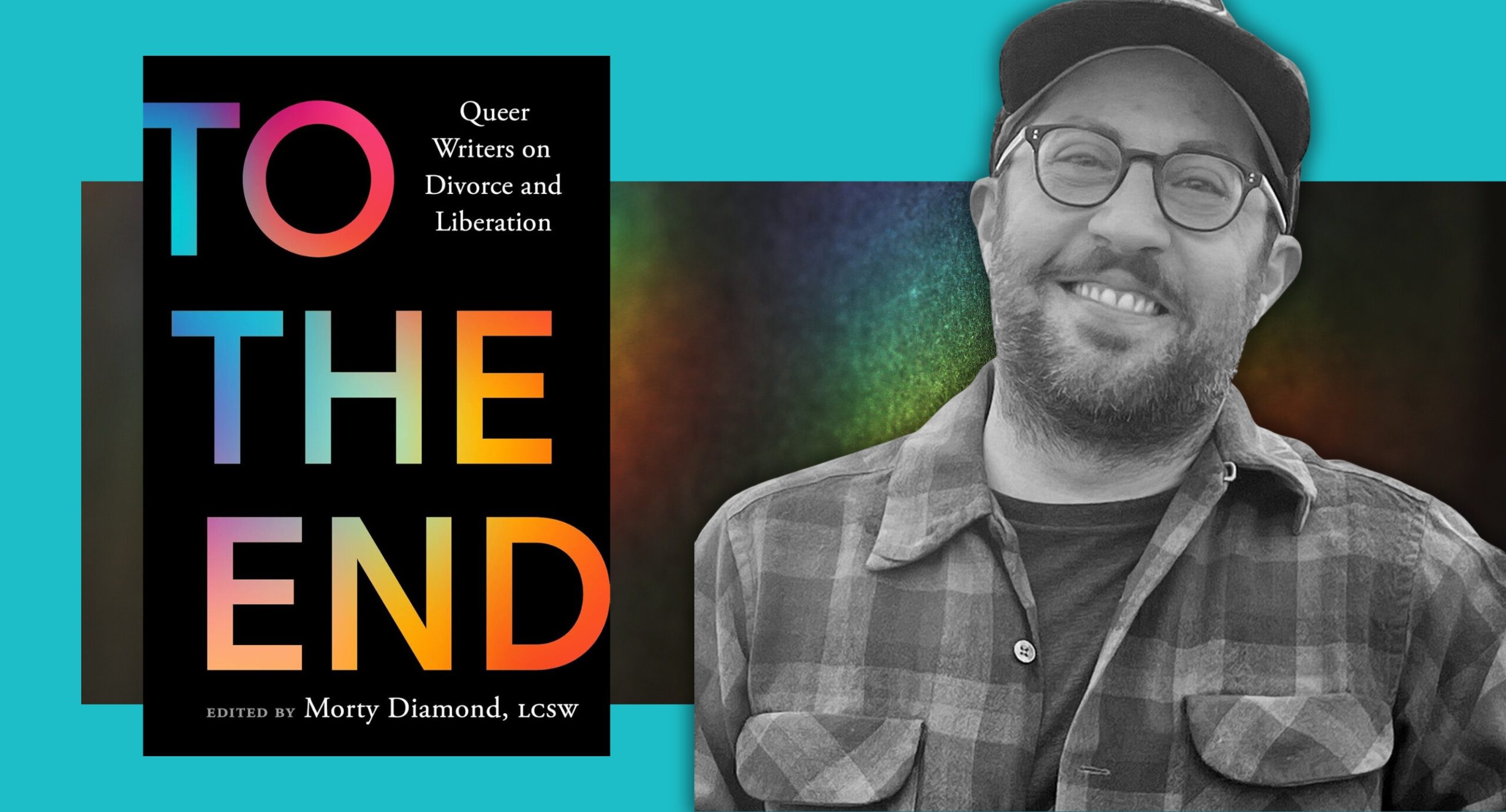
Morty Diamond’s friends call him the “Prince of Queer Divorce.” A queer and trans author and therapist who’s gone through a messy divorce of his own, Diamond isn’t afraid to approach a stranger at a party and ask them if they are divorced, as we learn in the introduction to his newest book.
I first met Diamond when I interviewed him for an Xtra article about queer divorce stories. Like Diamond, I was struck by the absence of popular narratives on queer divorce in an era when straight divorce memoirs were topping bestseller lists.
His willingness to take a social risk by bringing up breakups at parties reflects Diamond’s commitment to ending the silence on queer divorce. It’s also evidence of his drive to seek out others who’ve been through it. In 2023 he launched To the End Salon, a weekly virtual gathering where queer and trans people going through divorce and romantic breakups can share their stories with a community of supportive peers.
These conversations, along with the lack of resources on navigating the end of a marriage, were the inspiration for Diamond’s new anthology To the End: Queer Writers on Divorce and Liberation. The collection brings together 24 LGBTQ2S+ writers sharing their first-hand accounts of divorce, separation and transformation. It’s a book I wish I’d had a decade ago when I went through a queer divorce of my own.
I met with Diamond virtually to talk about why conversations about marriage should include divorce, how LGBTQ2S+ communities can get better at supporting people going through breakups and the freedom we can find on the other side of marriage.
To the End is a collection of queer and trans people’s divorce stories that is rooted in your own experiences with marriage and divorce. What motivated you to gather other people’s stories alongside your own?
I scoured the internet for resources on queer divorce and found little information concrete enough for someone going through it. What I did find was geared toward the cis white queer community, with a tiny margin of BIPOC or Latine writers. It wasn’t enough.
When I notice a lack of resources in one area, my first instinct isn’t to write a sole-authored book. It’s to bring together stories from all around the community. An anthology is a beautiful starting point to a subject. I’m hoping To the End will spark conversations: “Tell me about your divorce. What happened? How did it affect you? What did and didn’t you know?” Let’s invite that information in.
Some might assume that To the End is only for divorced people, but my sense is that you have a much broader readership in mind. Who is this book for, and what do you hope they’ll gain from reading it?
Divorce is a part of marriage. I want us to stop acting like it doesn’t happen to people. If I had read this book before I got married, it might have given me some pause. I want someone to show up on the doorstep of their newly married queer couple friends and say, “You should read this book. I’m not saying you’re going to get divorced, but I want you to see the full picture, and the full picture includes divorce.”
Divorce salon participants often talk about how the queer community doesn’t know how to support divorced people with care, concern, respect and honour. To the End is a catalyst for talking about these relational aspects of our communities and how we care for each other. As a psychotherapist, I also think it needs to be read by therapists and others working with the queer community who want to know about our relationships, including how they end.
To the End chronicles many of the legal, financial, social and emotional consequences of queer divorce. What’s different about queer divorce compared to heterosexual divorce?
Queer relationships have unique themes and contexts, so queer divorce will also be distinct in ways that are specific to our lived experiences. Straight people don’t have to worry that their divorce will be interpreted as a referendum on marriage.
Marriage can provide some people with a measure of refuge or protection from the huge, intersectional forces that impact queer life: homophobia, transphobia, family estrangement, legal vulnerability, healthcare access and housing instability, for example. And the highly formalized process of divorce puts many of us at the mercy of unvetted, more conservative [institutions and professionals]: lawyers, mediators, therapists, schools and courts.
I hear so many stories, including my own, about how easy it is to lose your power or for things to go very wrong in these systems.
What have you noticed about queer and trans narratives of romantic love, marriage and ideas of relationship “failure”?
There’s always pressure to stay together. Salon participants often say, “We were relationship goals. That’s what our friends would always tell us.” Marriage can be a survival tactic for a lot of people, including if their families of origin don’t talk to them anymore because they’re queer or trans. When our marriages fail, it can feel like we have no one to rely upon.
As queer and trans people, we live in a precarious world where we’re always pushing back on the idea that we are wrong or mentally unwell. When I was young, I accepted that I was queer and eventually trans. I also internalized the idea that I was a pariah. I always had this feeling that I wasn’t good enough.
We sometimes don’t realize how the narratives we were fed become unconscious in our choices. I never thought I would get married. When I did, my closest friends said, “This doesn’t make sense. Explain this to us.” I had never said one sentence about wanting to get married before my ex-wife came into my life. Marriage became a way of proving to myself that I was worthy of being loved.
Why can it be so hard for queer people to talk about what isn’t working in our marriages and what happens when they end?
There is a significant cultural silence around queer divorce. As queer people, we can feel pressure to be perceived as someone who has their shit together. Getting married looks so pretty on paper. We’re always told that it’s the next right thing to do, that it’s part of being a solid citizen.
Sometimes the silence comes from realizing you don’t actually abide by these cultural norms. A lot of people get divorced because of cheating or falling out of love, but it can also happen when you realize your marriage no longer serves you. Some of the stories in To the End are by trans people who realized they couldn’t be themselves if they stayed in their heterosexual marriages.
Another way To the End breaks silence is by helping people start talking about intimate partner violence and abuse in queer relationships. As a therapist who works with queer, trans and non-binary individuals, I’m well aware of the weight of this violence and abuse in our communities, but we don’t talk about this enough. [Advance] readers are already telling me how To the End is helping them realize we need to have more of these conversations.
You write in your introduction that some queer and trans community leaders have urged you not to share our divorce stories out of fear that they will be fodder for the far-right. What helps you stay anchored in your commitment to storytelling knowing our stories might be weaponized against us?
Thirty percent of the writers in this anthology are published under pen names because of what’s currently happening to queer and trans people in the United States. People would reach out to me while I was working on the book and say, “I have this really intense story, but I can’t put my name on it.” I would always respond with, “I completely understand.”
We need to be talking about how truly terrifying divorce can be. We always run the risk of our information being used against us, but I’m never going to stop talking about things that are absolutely necessary for queer people to talk about.
In your introduction to the book, you write, “I did not understand and would not allow myself to comprehend my faulty thinking on marriage.” What did getting divorced reveal to you about marriage? Has it shifted your thinking on the institution?
I’m not against queer marriage at all. I just want queer people to understand what the possibilities are.
I don’t personally think I’ll ever get married again. I learned about marriage through divorce, and I’m intentionally not married to my current partner. We live together and support each other and our families. We don’t need to be married.
What have divorce stories taught you about the freedom we can find after marriage?
I see a lot of possibilities in divorce. It’s a splitting open that forces us to reckon with everything—relationships, family, parenting, housing, finances, where we’re going to live. My own divorce gave me so much. It taught me to stand up for myself and be my own ally.
It can take people a while to get to the point where they’re on stable ground, but divorce is an opportunity to re-establish ourselves. A lot of what I hear is people coming into the salon saying, “I had to get so clear-eyed about what I want and how I want to live my life. What do I want my future to look like? Who do I want to be?”
In the anthology, writer Sassafras Patterdale shares their experiences of post-divorce “community aftercare.” What are your dreams and ideas for what community-based support might look like for queer and trans divorced people?
People want to be witnessed. They want to be heard. They want spaces where they’re not judged, and where they’re seen as their whole self in all the good, bad, ugly, everything. Maybe you’re all going to the park, or the library or hanging out on Zoom. We need to build more community-based arenas for listening and witnessing, whatever that looks like.
There’s so much to learn about relationships, including divorce. People in the divorce salon sometimes talk about how it took them six months to even figure out how to get an attorney. We need to build spaces where we share ideas, tools and information, where we can gather around and say, “This is how you survive this thing.”
This interview has been edited for length and clarity.

 Why you can trust Xtra