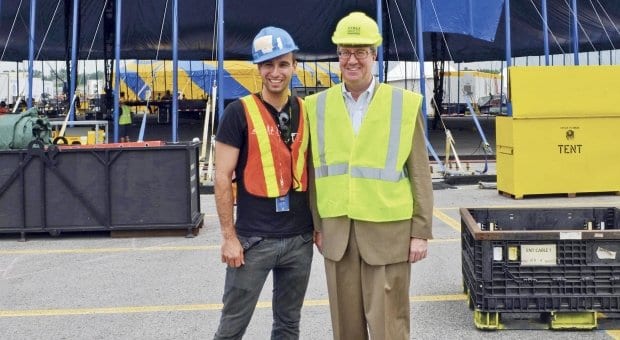
Cirque du Soleil’s Francis Jalbert with Mayor Jim Watson at the big-top raising, July 5. Credit: Bradley Turcotte
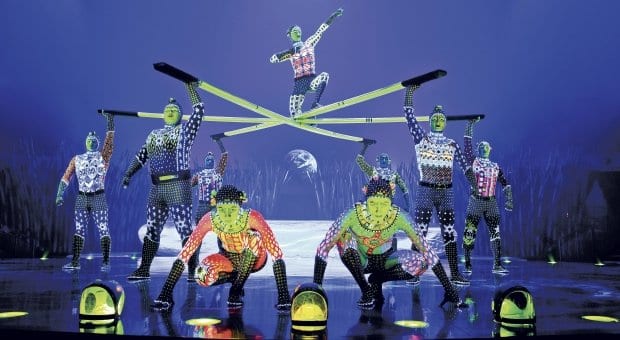
Initially conceived by a busker in 1984, Cirque du Soleil has blossomed into a multimillion-dollar empire with shows on every inhabited continent. The troupe has paid homage to everyone from the King of Pop to the Fab Four; with Totem, the Québécois collective tackles subject matter that everyone can relate to: the evolution of man.
Helmed by Robert Lepage, the Genie Award–winning director of Le Confessionnal, the big-top production traces the human journey “from the amphibian to the ape to the modern man, all the way to our quest into space,” says Totem publicist Francis Jalbert.
Lepage was handpicked to direct Totem, and Jalbert says the company gave the Quebec City native carte blanche for the show’s content.
“What really inspired him is what sets apart human beings from other species — that we always try to push farther our limits, prove ourselves and lift ourselves onwards and upwards. Who are better than acrobats to do that?” Jalbert asks. “All the acts in the show present the evolution of human civilization or the evolution of the human body.”
Every Cirque show features performers pushing the boundaries of physical possibility. In Totem, “we have five girls riding seven-foot-tall unicycles tossing metal balls from their feet to their head to the head of their partners. You have to see it to truly believe it,” Jalbert says. “The final act of the show is called Russian Bars, where you have those strong Russian men supporting a bamboo pole on which there’s a guy and you make him jump 30 feet in the air, and he lands on a six-inch-wide bar.”
The show’s title references the monumental sculptures built by West Coast indigenous cultures, and Cirque du Soleil specifically sought out Native American and Canadian hoop dancers and singers to perform in the show.
Jalbert adds that the big-top element offers an “intimate” atmosphere as attendees are seated close to the stage and “the artists are flying on top of you [and] walking next to you.”
On a sombre note, the company is still reeling from the death of Sarah Guillot-Guyard, who died during a performance of Ka on June 29. The mother of two fell more than 25 metres while performing a fight scene near the show’s climax in front of a live audience at Las Vegas’s MGM Grand Hotel. It is the company’s first stage casualty.
“Right now we are definitely heartbroken. We’re in mourning period,” Jalbert says.
Cirque du Soleil’s Totem
Thurs, July 11–Sun, Aug 4
Canadian Tire Centre, 1000 Palladium Dr
cirquedusoleil.com

 Why you can trust Xtra