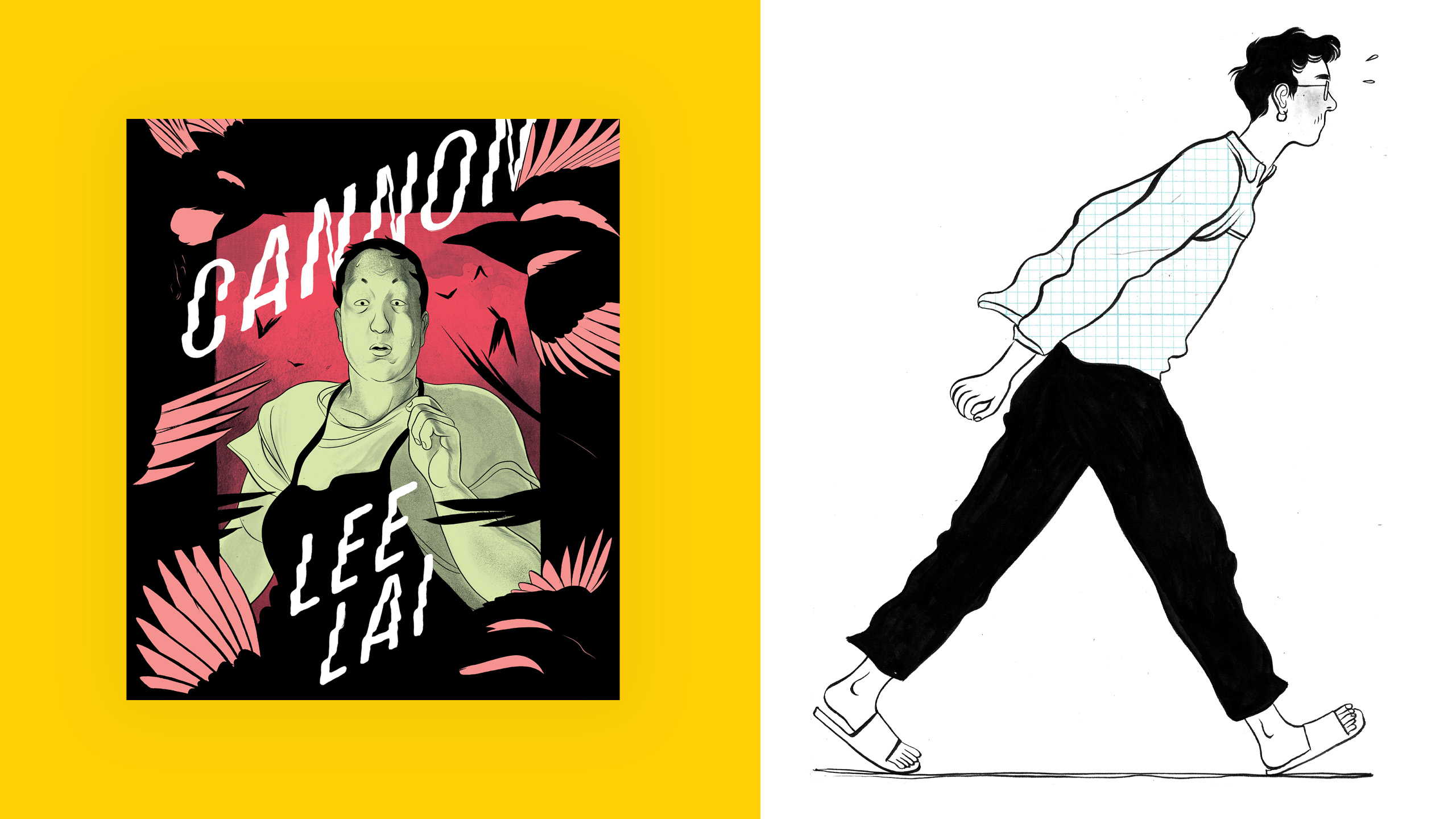
A good amount of Lee Lai’s new graphic novel Cannon, her follow-up to 2021’s much-acclaimed Stone Fruit, takes place in a fancy-schmancy Montreal restaurant. Not out in the dining area, where wealthy tourists in town for the Grand Prix come searching for a taste of small-plate, big-bill Montreal authenticity, but deep in the kitchen, amid the frenzied symphony of pans clanging, dirty dishes being pelted with water and bickering cooks vomiting unending streams of vicious Franglais at one another. It’s in the middle of this adrenal cacophony that the titular protagonist, Cannon, a late-20s Chinese lesbian from the Eastern Townships, can be found. Slowly slicing potatoes, emanating what those around her take to be serenity.
While reading Cannon’s story, I was struck by its resemblance to my own experiences. As a teenager, I spent time working as a dishwasher across a few different kitchens also powered by the creative potency of complete emotional dysregulation. (In a sense, this is the energy source behind much of the industry. Although The Bear is ridiculous, it’s not completely off the mark.) Like Cannon, I was a quiet, reserved worker, regarded as a reliable force in the otherwise chaotic kitchen. My stoicism was a mask for the anxiety that lay beneath, and that could not locate a way to express itself.
This is the position Cannon finds herself quite at home in: as a solid pillar that mediates the tumult of the kitchen, never expressing her own feelings, never letting loose her own chaos, never permitting herself to be messy. And why wouldn’t she feel comfortable in this position? It’s the perfect representation of the general scope of her life.
Cannon’s inability to assert herself is the novel’s central conflict. She’s dominated by her self-absorbed childhood friend Trish, made to shoulder the responsibility of caring for her abusive grandfather, used and lied to by a woman she considers a romantic prospect and exploited by her sleazy boss, Guy. Even her name is imposed upon her by others: it’s an ironic nickname referencing a “loose cannon,” given to her due to what others perceive to be her steady demeanour. On the page, her speech bubbles are constantly being overlapped by others’, the very words swallowed up. Cannon is, in a word, a pushover.
Cannon’s whole life has been leading her toward the point of no return when she will no longer be able to silently shoulder everything that she’s taken on, and this is the place we find her approaching at the beginning of the narrative. The novel could easily be seen as a cliché story about a nice person beaten down by society until they snap. (There’s a moment of humorous self-awareness late in the book where Cannon and Trish are seen watching the prom scene in Carrie.) But the book deviates from that stereotypical script because Cannon isn’t portrayed as a simple victim. She is clearly complicit in her treatment, never asking for what she needs, never giving any indication of her inner turmoil, careful not to show her anger in the slightest, doing her best to embody the strong, silent type that can handle it all. And, importantly, the book can also be read as outlining how Cannon is, if we put stake in the individualistic paradigms of mental health that permeate our everyday culture in the West, a supposedly aspirational model of self-regulation.
Cannon is, indeed, doing the work. She repeatedly listens to meditation podcasts, practising steady breathing and feeling at home in her body. She regularly goes for jogs, seeking them as a healthy release from stress. She never lashes out at people in anger, keeps herself from releasing harmful feelings like resentment and rage. She doesn’t drink the alcohol that’s offered to her at work, knowing that it might bring down her walls and allow extreme emotion to seep out. When she realizes that Trish has concocted a zany, dishonest way to exploit Cannon’s life story for material and reputational gain, Cannon holds back from confronting her friend, knowing she might become too angry. Cannon is aware that she has problems with anger, serious enough that she hallucinates flocks of black-and-white birds surrounding her whenever she begins to feel overwhelmed. That’s the kind of anger that could be dangerous to let loose. She tells herself it’s responsible to project calmness, to regulate her intense feelings on her own, to avoid subjecting those around her to them.
This is the core of our individualistic conceptions of mental health: that intense or abnormal feelings and experiences (rage, hallucinations) are unhealthy, and that it is our job to keep them under wraps, either through medical or therapeutic interventions or through self-regulation. These intense feelings are by nature disruptive—and perhaps even destructive—to our relationships, to the workplace, to the structure of the family. Particularly in the West, where the ability of a person to be self-sufficient is fetishized, there is a strong emphasis on practising self-control.
In recent years, an entire ecosystem of apps, podcasts and influencers has flourished around teaching the individual to regulate their emotions on their own. Given our communal fixation on emotional intelligence, many queer people are familiar with such tool kits to a painful degree. (The phrases “CBT” and “guided meditation” inspire Pavlovian reactions of vague guilt in me.) Cannon uses this ecosystem to cope—the soothing voice in her headphones reminds her to focus on breathing in order to turn her attention from her invasive emotions.
None of this is necessarily a bad thing. Not lashing out at people in anger is, obviously, good. But we are unfortunately human beings, and as such we don’t do well with perfection. We cannot be fixtures of flawless self-control; we must make space for messiness, for chaos, for reacting impulsively and being overcome with emotion. Cannon’s problem throughout the novel is that she’s afraid of what will happen when she finally does make space for these things. All of those strong emotions have built up inside her to the point where she’s scared to look at them, just like she’s scared of the birds she sees flocking around her.
When Cannon finally admits the birds’ presence toward the end of the book, Trish looks at her and says, evenly, without batting an eye, that they’re “probably just looking out for [her].” If we see our intensity as a thing that we need to by any means exercise self-control over, we begin to worship it, if only through fear. Sometimes our rage and resentment are just signs that something about our lives needs to be changed. And if it must be changed through letting ourselves channel a bit of chaos, so be it. Spoiler: Cannon eventually does blow up. But it’s through this moment of dysregulated messiness that she’s finally, gloriously, redeemed.

 Why you can trust Xtra