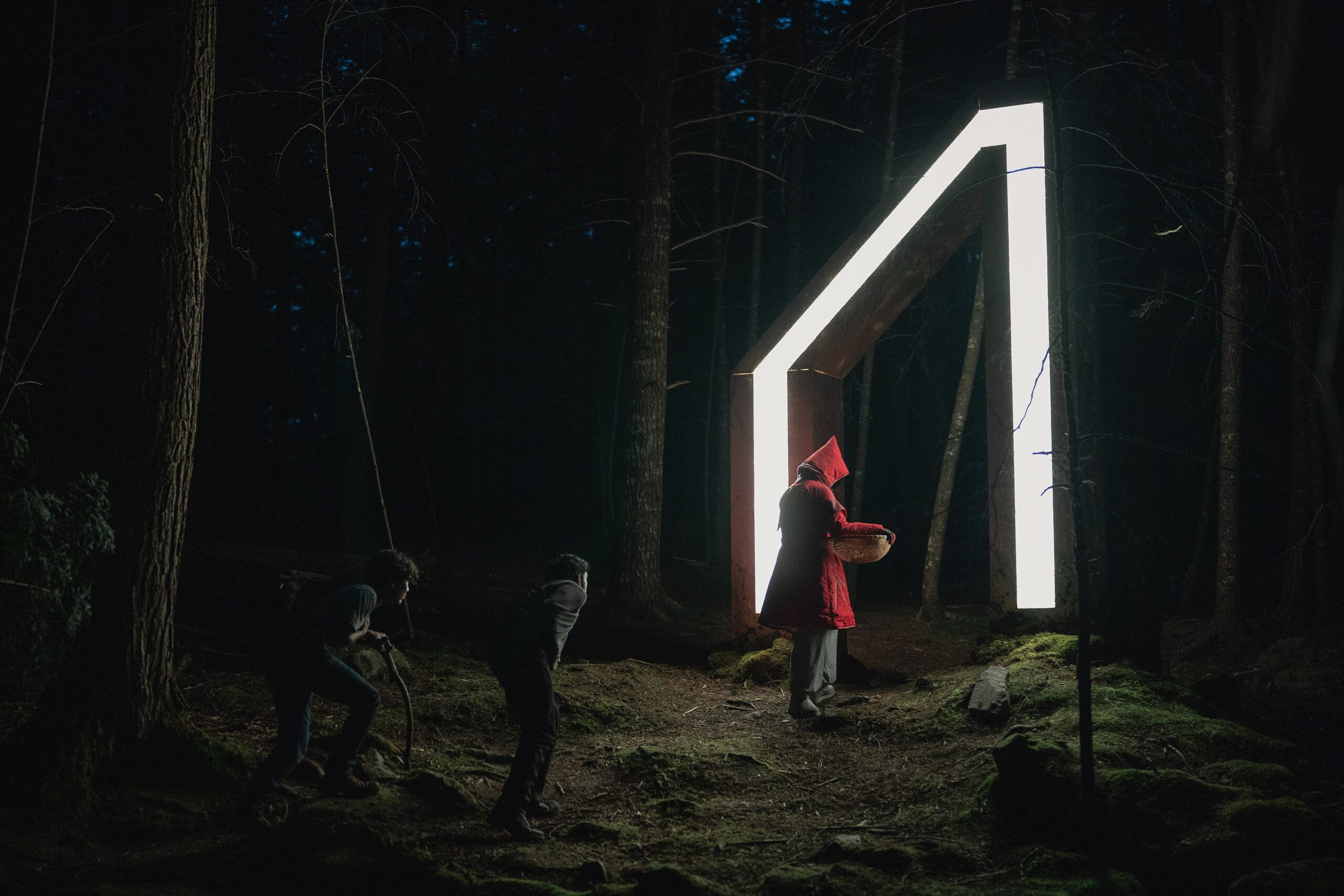
At the Place of Ghosts (Sk+te’kmujue’katik), the latest film by Two-Spirit L’nu filmmaker Bretten Hannam, is not just a tense and frightening ghost story. It also holds an intimate portrait of siblings confronting their past trauma, a meditative journey through the forest and a series of encounters that challenge settler conceptions of linear time.
Hannam’s film follows two siblings: Mise’l (Blake Alec Miranda), who has moved to the city, and their younger brother Antle (Forrest Goodluck), a single father still living in their home community. Early in the film, Mise’l is visited by a seemingly supernatural entity, whose appearance sparks Mise’l’s return to their community. Mise’l and Antle then venture into the forest, determined to prevent the mysterious figure from affecting the life of Antle’s daughter.
The movie unfolds in unexpected ways, seamlessly transgressing genres and generations; Hannam’s filmmaking allows viewers to experience both the story and its modes of storytelling in real-time. The journey through the forest also becomes a journey through time as the siblings encounter their younger selves, their ancestors and even colonial soldiers at different points in their voyage. These complexities in storytelling, though, are grounded in the relationship between the film’s central siblings, as they traverse guilt, pain and trauma in their trek toward healing.
Ahead of the movie’s theatrical release, Xtra spoke with Hannam about filmmaking, community and how Two-Spirit identity shapes Mise’l’s journey.
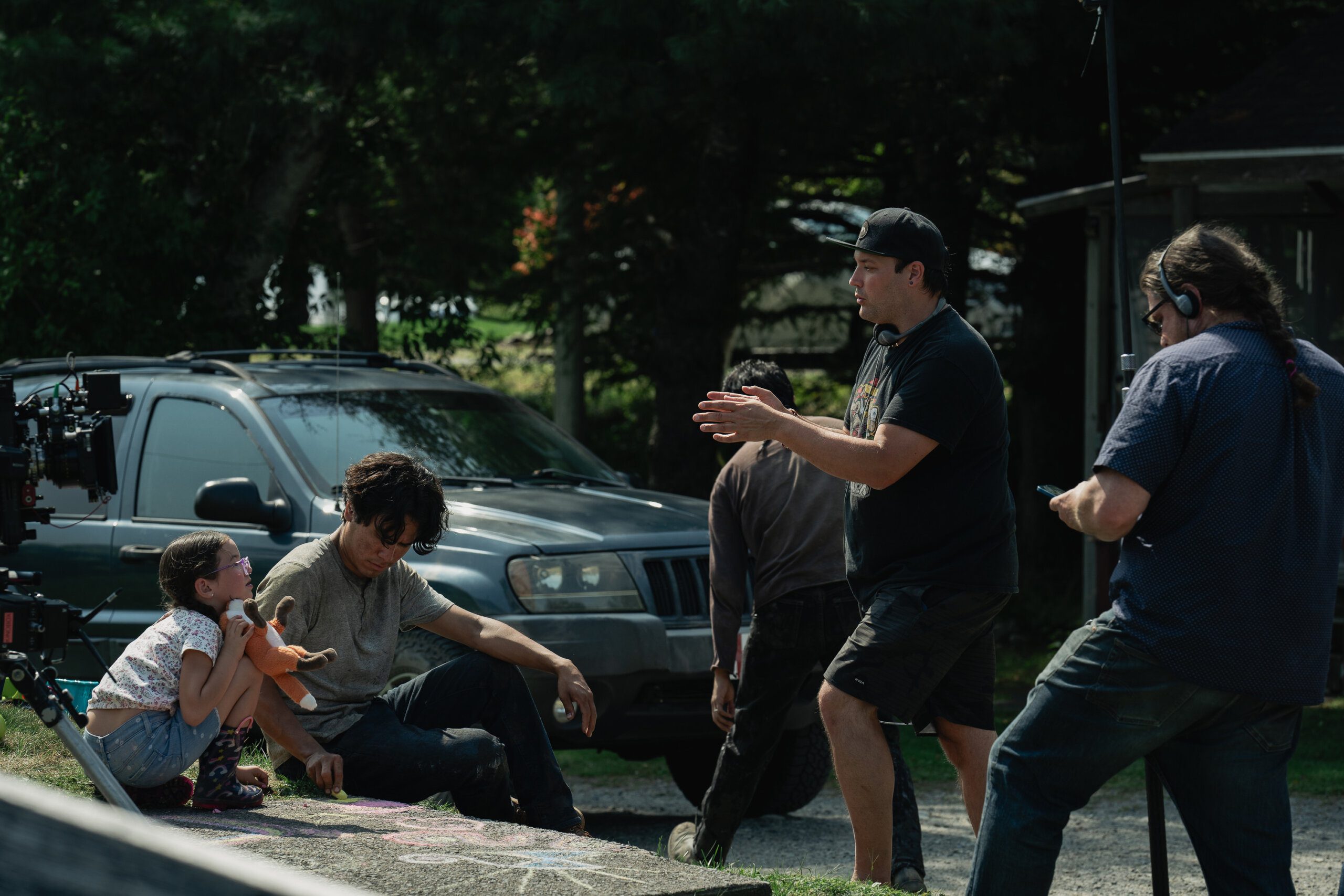
Bretten Hannam on the set of ‘At the Place of Ghosts’ Credit: Courtesy VVS Films
I’m wondering how you thought about approaching linearity and non-linearity in your storytelling, especially in relation to Indigeneity. The protagonists follow a linear journey as they follow a river that guides them. But the movie also depicts time as non-linear, with the characters encountering their younger selves and ancestors.
It’s sort of like a road movie, right? A road movie on foot and canoe in the forest. The idea of handling time comes from an oral storytelling tradition, understanding time like seasons or circles that overlap with each other, instead of a mainstream way of understanding time, which is past to present to future—if you change the past, you change the future. It’s very much like a river, actually—contained within that flexible idea of time is this visual representation of the linear journey you’re talking about.
What does it mean to you to have your characters be able to speak with their younger selves and ancestors? Where did that idea originate for you?
It comes from two places. When you’re in community, you hear a lot about speaking with ancestors, how you’re here because your ancestors are behind you. So part of that was “What if you could see that in front of you and talk to your ancestors, and see that they’re there and they’re Two-Spirit people?”
The other part of it comes from living a queer life or a Two-Spirit life. If I could talk to my younger self, what would I say? Lots of people have that thought, or it comes up in conversation: if I could say one thing to my younger self, give them encouragement—or maybe tell them not to do something stupid.
I was really struck by the moment where Mise’l says that their brother Antle “never got out,” referring to the fact that Mise’l moved to the city while Antle stayed home. What compelled you to address that tension between moving to the city versus staying home in this film, which has a return to home in a more primordial sense?
Mise’l has their own prejudices and preconceived notions. Growing up in their community, they didn’t find a place very naturally, so it wasn’t pleasant. There’s a lot of difficulty there. So they left, and they have a chip on their shoulder. They’re very judgmental to anyone that has remained. That’s just a real human quality, that we have our own biases. Justified or not, it’s there, and it causes a tension, certainly, between [Mise’l and their brother]. The younger sibling has other notions and biases, maybe the opposite way.
Antle, the younger sibling, is a single father. Why did you choose to have him be a single parent? How did that influence the film’s commentary on masculinity and fatherhood?
There were previous versions where Antle’s partner is mentioned, but we decided that it was adding too much to the mix. We’re using it as an example to show this young Indigenous dad who is stepping up and doing his best. He’s supported by his auntie as well, and presumably some extended family offscreen. It is something that is important to see.
I think it’s a great counterbalance to the narrative of the siblings’ own father, and everything that happens toward the end of the movie. The protagonists’ father is key to the film’s plot, but his face is mostly out of frame until quite late in the movie. Why did you decide to frame the father that way, and why did you choose that particular moment to reveal his face in full?
There are many films that do similar things; I find it intriguing, exciting. Here, the siblings are both going on a journey to confront this terrible thing that happened, and they have trouble facing it. Because they have trouble facing it, all the way up until they actually face it, we don’t see their father’s face. It’s only in that moment, at the heart of this trauma, where you see his face and you get the full weight of his presence. It builds up an intrigue and a weight that hopefully the viewers share with the characters. It puts them in that place.
The movie has a very lush and evocative soundscape that immerses the viewer in the story and setting. An element that adds to the tension later in the film is the use of country singer Porter Wagoner’s version of “Green, Green Grass of Home.” How did you develop that soundscape, integrating the score with the sounds of the forest? And why did you choose that country song to soundtrack a key scene in the film?
We did the sound in Belgium, which is half a world away from our home territory. But working with the sound designer and the mixer out there—they’re artists in their own right. So much care and research went into determining the animals and the birds and the sounds of the forest, because we really wanted to bring it to life. A lot of time went into very carefully going through each scene, and then playing them with the music to make sure they deepened the feeling of the forest as a presence or a spirit.
At the same time, we were working with composer Jeremy Dutcher, music producer Devon Bate and their team, who produced the score. They were doing tracks and sending them back, and we were listening to them in the mixing studio. We’d then give notes, and they’d respond directly. It was a very interwoven process.
The Porter Wagoner song—I was trying to find music that my dad would listen to, and [while] it’s adjacent to that, it’s not exactly that. The lyrics and the sentiment are relevant to the story, but it’s not too on the nose. I think that would draw too much attention to it. It’s one of those things where, when you’re a kid and this thing happens, and that song is playing in the background, it cements into your brain.
Is there anything else that you’d like to add?
It’s always worth mentioning that film, like all art, is collaborative. No art is made either alone or without an audience. This was something that we all did together, this team of people. I’m incredibly grateful for them and for the community, and I hope this movie creates some discussion.

 Why you can trust Xtra