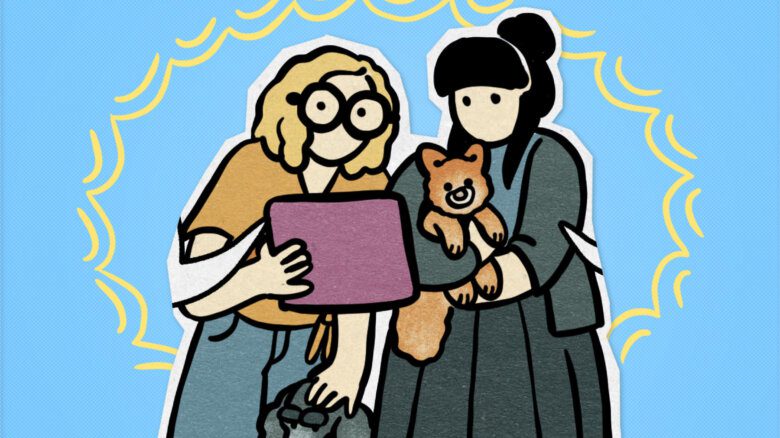
In downtown Edmonton, a recently divorced woman walks into the Book Boudoir seeking “Sapphic femme rage where the main character kills all the men.” Rather than raising eyebrows, staff eagerly help her find exactly what she needs. Interactions like this happen every day in the romance-only bookstore that has become more than just a retail space; it’s a model for meaningful community connection in a world where we’re increasingly reliant on screens.
After a successful one-year trial run, owner Kelsey Orlecki recently took the leap to establish a permanent location. The Book Boudoir, one of Canada’s few bookstores that only carry romance fiction, recently doubled its footprint to 2,000 square feet, moving from a temporary second-storey mezzanine to a ground-floor location with expanded space for events, workshops and gatherings. The growth reflects a hunger for physical spaces where authentic interactions can happen, particularly for those seeking judgment-free environments where they can open up about desires, dreams and fantasies.
For Orlecki, the journey to business owner began in the digital realm. With a strong following on BookTok before opening her brick-and-mortar store, she understood the power of online communities. She’d feature new books and authors, comment on the latest publications and build online book clubs. Yet she recognized that something essential was missing from purely digital connections.
“I come into the store and a weight is lifted off my shoulders,” says staff member Hedaya. “It’s not just being around the books, it’s about being around the people.”
Orlecki approaches her business with a philosophy that prioritizes human connection over commercial success. Building the Book Boudoir according to her values has given Orlecki a way to make a living she feels good about.
As both physical gathering spaces and online communities for marginalized groups face increasing challenges, the Book Boudoir offers a template for what successful “third places” can look like.
For staff member Percy, the environment is transformative. “I’ve never been a spectacle; I just get to exist here as a queer trans person,” he explains. Percy is acutely aware of the difference between authentic inclusion and rainbow capitalism: “With some businesses who put the rainbow flag on the door, you wonder, are they doing this because it’s a money-maker or because you actually care? I hate it when businesses monetize Pride.”
The proof is in the interactions. Hedaya recalls a group of older gay men who recently wandered in: “Seeing the joy on their faces when they asked if we had queer love books, they were so overjoyed.”
While the Book Boudoir welcomes the LGBTQ2S+ community, it positions itself more broadly as a sex-positive space where conversations about desire and pleasure can happen openly through the buffer of literature. This approach makes it accessible to anyone seeking a judgment-free zone, regardless of identity.
But what truly sets the Book Boudoir apart is their approach to connecting readers with books. Percy describes a process that mirrors safe kink discussions of consent: “What are you NOT into? What are your hard lines? What DO you like? How spicy?” he asks customers. “And then as I’m pulling things down from the shelves, I’m checking tropes and asking is this okay? Is this okay?”
This careful attention creates trust. Regular customer Sierra Wallace found her way back to books through romance novels. Her first request at the Book Boudoir? “I wanted the worst, most offensive, dark book there was in the store—where is the horrifying stuff?” The staff helped her find exactly that, without judgment.
“I feel important when I come in here,” Wallace says. “Every woman and queer person I know, I’ve encouraged to come here. I’m happy to bring a friend who is openly trans, and people who can’t necessarily straight-pass. It’s a really good selection of sex-positive, queer-positive, women-positive books.”
The store’s design makes a statement about accessibility and inclusion with ground-level entry, ramps and ADA-compliant washrooms. Floor-to-ceiling bookshelves equipped with a sliding ladder, reminiscent of the library in Disney’s Beauty and the Beast, invite exploration, while old oak tables on pedestals showcase carefully curated stacks of books.
It’s intentionally designed to be worth leaving home for. As Orlecki, a self-described homebody, puts it: “I have to make the place incredible to make people want to leave their house to come here. I don’t even want to leave my house, so I have to make it so I want to leave to come here.”
For those navigating an increasingly hostile world, the promise of spaces like the Book Boudoir is profound.
Though physical space is central to the Book Boudoir’s success, Orlecki maintains a vibrant presence on Instagram and TikTok: platforms she considers essential for nurturing her community. These digital channels don’t replace in-person interaction but rather complement it, creating multiple touchpoints for connection that bridge online engagement with real-world gatherings.
The recent expansion includes event space that’s already planned to be used for paint nights and readings, with potential for speakers and health topics. Regular book club meetings bring readers together to discuss shared literary experiences, while book launches celebrate both established and emerging authors. The calendar continues to grow with planned events focused on sexuality and women’s health topics that are often underserved in mainstream spaces.
The store’s boundaries are as clear as its inclusion. “If someone comes in with judgment, they are not welcome,” Hedaya states plainly. “It’s a safe space for everybody and the energy is the most important.” Staff are empowered to protect this atmosphere, even if it means making those with “icky vibes,” as Hedaya calls it, uncomfortable enough to leave.
For those navigating an increasingly hostile world, the promise of spaces like the Book Boudoir is profound. “The world is so dark and scary, so my nervous system is always dysregulated,” Hedaya admits. “Books are a healthy escape where I can just rest.”
Orlecki puts it succinctly: “Reading is a silent activity but it makes you feel heard.”
What makes the Book Boudoir’s approach so valuable as a blueprint for other communities? The answer lies in several key elements that could be replicated elsewhere.
First is the deliberate people-before-profit business model. “Find yourself an amazing team who think the way you do,” Orlecki advises. This focus on building a staff that embodies the values of inclusion creates an authentic environment that customers can sense immediately. Rather than treating diversity as a marketing strategy, the store integrates it into every business decision, from hiring to inventory to customer interactions.
The hybrid digital-physical approach offers another lesson. Orlecki’s pre-existing BookTok following provided a foundation, but she recognized that online connection alone wasn’t enough. Other businesses could similarly leverage digital platforms to build initial awareness while creating physical spaces that fulfill the deeper need for in-person community. This dual approach addresses the reality that while many communities start online, they often need tangible spaces to fully flourish.
The store’s space design itself provides practical guidance. Beyond meeting accessibility standards, the environment is intentionally created to feel special enough to draw people from their homes. The investment in event spaces allows for programming that transforms casual visitors into community members. From book clubs to health workshops, these activities provide multiple entry points for different comfort levels.
Perhaps most significant is how the Book Boudoir fills specific gaps in community infrastructure. By creating a space that isn’t centred around alcohol but still fosters social connection, it serves demographics often overlooked in traditional gathering spots. The judgment-free approach to conversations about desire and sexuality, framed through literature, creates a unique environment where vulnerability becomes possible.
In Edmonton, where winter temperatures frequently plunge below -20 C for months and darkness falls by mid-afternoon, the importance of welcoming indoor gathering spaces cannot be overstated. During these brutal winter months, residents often find themselves isolated, with the harsh weather making casual outings difficult and spontaneous social interactions rare.
In a political climate where queer existence is increasingly politicized, and in a digital landscape where social media no longer reliably connects communities, physical spaces like the Book Boudoir aren’t just nice to have, they’re necessary. “We have our found family here,” Orlecki says.

 Why you can trust Xtra