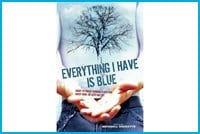
San Francisco writer and editor Wendell Ricketts had a mission. He saw a hole in the fabric of gay publishing and decided it had to be filled. Everything I Have Is Blue collects 18 stories by 18 gay and bi men from working-class backgrounds. In an intro, Ricketts reports that he had 57 rejections from publishers. It seems fitting that the aptly named Suspect Thoughts Press finally became the book’s home.
The first out of the gate is a knockout. C Bard Cole teaches English in Tuscaloosa, but his tale of New York City homeboys proves his familiarity with urban jive. Frankie and Raj are razzing each other on the stoop over a touchy issue. It seems Frankie is hanging with a boy whose reputation is a blot on the ‘hood. David is a little too pretty and arty to be a real brother. He works in Manhattan at a graphic design shop and gets off the F train with the laptop and leather portfolio to prove it. Raj is pressuring Frankie to come to his senses. “They say you down wit’ dat faggot, man…. They sayin’ you gay together.” Frankie fends off the charge with sarcasm.
Then we get inside David’s apartment — and Cole rises beautifully to the large implications. David and Frankie’s near-indefinable relationship makes for funny, sexy, touching and sometimes ominous storytelling. Gay man and straight man are in undeclared love, and it’s wonderful to watch. The dialogue communicates a labyrinth of cross-purposes, tenderness and denial that many a lesser writer would describe with clunky narration.
Marcel Devon’s story offers a Texas ma and pa just far enough from outright parody to be horribly convincing. Scotty is home from university with his bewildered boyfriend in tow. Ma is a Jesus freak nutbar terrorized by a 300-pound Pa whose sole pastimes are TV football, beer, kicking the dog and fingering the contents of his very deep navel. The dog abuse is a substitute for deeper fears: “You know, we oughta get rid of that faggot mutt.” As Scotty and Terry pull off each other’s pants later in his room, the spectre of Pa’s rage looms large. The story bounces between funny and ghastly. We learn in Ricketts’ end notes that Devon writes from solitary confinement. He’s been in a Texas prison for the last 13 of his 28 years.
Ricketts includes a story of his own, a disturbing tale of a man aroused by bloodshed, and his ex-lover who still can’t fathom why he loves films full of death and mangled flesh. “I want to see those things because they look like how I feel inside. Cut up, howling, disintegrated.” Ricketts explores violent fantasies and how they play out on the field of love, but offers us nothing about this scary guy’s background. How did he get so twisted?
One of two Canadians here, Toronto writer Ryan Kamstra grew up blue in Thunder Bay. His entry is convincing enough, but seems to have no point beyond its description of a druggy, gender-bendy night in streets and clubs, followed by an inconclusive erotic tease in a condo. The story feels like a cursory demonstration of talent without the redrafts that would give it focus.
Royston Tester, the other Toronto contributor, leaps beyond this. I happened to read another rendition of this story, Heaven, in Tester’s 2004 story collection, Summat Else. The version published here is the uncensored one, refusing to veil its (literally) climactic moment in tasteful innuendo. In Birmingham, England, Enoch is a delinquent choirboy who pinches wallets from the coats hung in the vestry men’s room. He’s caught by Mr Ketland, the “exemplary” church warden. The example he sets Enoch is to swoon over the lad’s dick at the urinals. Enoch’s woody is the bribe that buys Ketland’s silence.
An accomplished piece from prolific queer author Jim Grimsley is a reworked passage from Boulevard, his fifth novel, in which a small-town kid discovers gay life in New Orleans. Other highlights: Alfredo Ronci, a librarian in Rome, gives us an ominous love triangle that spurs one party to consider murder, while Christopher Lord offers a redemptive family Christmas at mom and pop’s (“first house past the trailer court”) in rural Oregon.
No review can do proper justice to 18 authors. That said, there are more than a handful of writers here who apparently remain unconvinced that good writing is mostly rewriting. A rambling, 30-page number from James Barr, first published in 1951, feels both unfocussed and a retro mismatch with the rest of the book, its narrator editorializing on nature versus nurture and underscoring his distaste for “effeminate idiosyncrasies.” Mostly though, Ricketts’ choices display a smorgasbord of arresting voices and sensual pleasures.
 Why you can trust Xtra