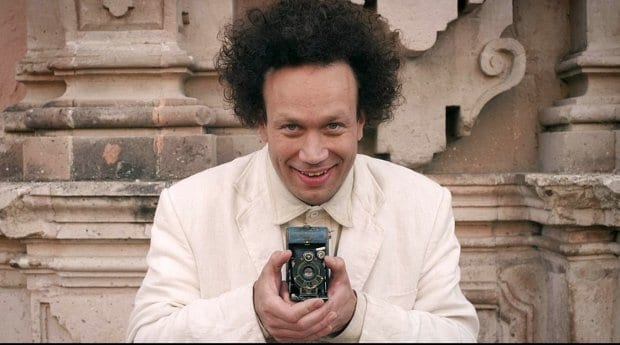
A politicized innovator from the silent film era, Sergei Eisenstein remains a household name (if the household in question contains Russians, film school students, or heavy duty film festival goers).
Otherwise, general knowledge of the man’s output between Strike (1925) and Ivan the Terrible (1945) might be summarized in a gif: a montage segment from the influential “Odessa Steps sequence” in The Battleship Potemkin (1925) during which an infant in a carriage rolls down stairs in the midst of a ferocious revolutionary battle.
After the worldwide success of those early Moscow-shot films, Eisenstein travelled to Europe, the US, and Mexico before returning to the Soviet Union. There, he married, taught, made a few more movies, and fell in and out of favour with Stalin. He died in 1948.
The strikingly attractive, perfectly composed beginning of Peter Greenaway’s Eisenstein in Guanajuato depicts three cars passing by cactus and agave on a dirt road.
It’s 1931 and Eisenstein is arriving in a beautiful Mexican town to shoot a new movie project with an unknown topic. On screen a few minutes later it’s dark. The drunk Russian director is vomiting in an alley and cleaning his ass and shoes at a water tap following a particularly explosive bout of traveller’s diarrhea. (From the artful symmetry of that scene to the fascination with taboo imagery — the director’s best-known film, The Cook, the Thief, His Wife, and Her Lover, concludes with cannibalism and death by gunshot — it’s clear that we’re in a wonderfully theatrical and artificial Greenaway world.)
From start to finish there’s plenty of impressive camerawork and pretty cinematography. They’ve been Greenaway signatures for decades. But even with a one-of-a-kind seduction and fucking scene between Eisenstein and Palomino Cañedo, his handsome local guide — which involves drizzled olive oil, piercing pain, and a worryingly large amount of blood — the film’s undeniably sumptuous visuals are weighted down by a indecisive script.
Broadly comic at times (as when he argues with “Señor Prick,” his underwhelming penis) and anguished or abstractly philosophical at others, Greenaway’s standard bio-pic approach struggles to build momentum.
A loud performance by Finnish actor Elmer Bäck, perhaps inspired by a script that has Eisenstein describing himself as “a child abroad” and “clownish,” doesn’t help either. He’s really committed to it, granted, but the over-the-top acting — veering between crazily overwrought bed-jumping buffoonery, raging political rhetoric, and wildly distraught heartache — repels and grates far more than it attracts.
If Greenaway is aiming to comment on the current policies of the Russian government by depicting a national hero as a crazy-in-love queer bottom, it’s not entirely clear what kind of point he’s trying to score.
Eisenstein labels himself “a boxer for the freedom of cinematic expression” at one point, and perhaps Eisenstein in Guanajuato’s 72-year-old director is reminding viewers that revolutionary government can occur without brutal repression.
Political messages aside, there’s no doubting Greenaway’s mastery of technique and his keen eye for beauty. In short, Eisenstein in Guanajuato is a joy to look at. Its seductive, colour-drenched images — churches, cemeteries, hotel rooms, cafes, desert landscapes — almost make up for the script’s occasional storytelling lapses.
Eisenstein in Guanajuato is the opening gala at the 2015 Vancouver Queer Film Festival, playing Thursday, Aug 13 at 7pm at the Vancouver Playhouse, 600 Hamilton St. A second screening will be presented on Saturday, Aug 22 at 4:30pm at International Village, 88 W Pender St. For tickets and a complete festival guide go to queerfilmfestival.ca.
 Why you can trust Xtra