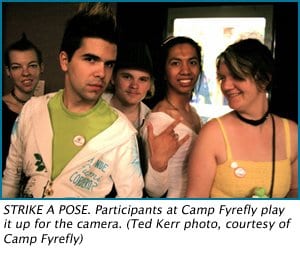
Camp Fyrefly, a summer leadership camp for queer youth in Edmonton, Alberta, is riding high on a string of successes. The camp will celebrate its fifth anniversary this July, and it’s all thanks to support from the local queer community, says Kris Wells, a driving force behind the program.
“Our fundraiser [Feb 2] sold out and snowballed into the ‘must have’ ticket in Edmonton that weekend,” says Wells, a researcher at the University of Alberta. Even Edmonton Mayor Stephen Mandel crashed the party.
“It has been phenomenal how individuals and businesses have rallied behind the camp; they intuitively understand it — send a kid to camp! Our donors often tell us that they wish they could have had the possibility of going to a Camp Fyrefly when they were growing up.”
“The bare bones costs for the camp now comes in at about $25,000, which is 100 percent paid for by fundraising dollars,” notes Wells. “Tallying up, I would say the Alberta community has raised over $100,000 since we started.”
Ironically, the grassroots nature of the camp’s financing was given its initial momentum by the provincial government.
“When we were launching the camp we put in a funding application to the Alberta Government — they had an anti-bullying initiative — and we were turned down. It was Edmonton Liberal [and opposition] MLA, Laurie Blakeman, who stood up in the Legislature and said ‘if this is not a group who needs protection from bullying in the province than I don’t know who is!’ So we used her comments as a rallying point to raise funds. If the government was not going to help then the community needed to come forward to support our youth.”
It worked. The camp has been gaining in profile and legitimacy ever since. Wells explains: “This is the only camp of its kind — that we are aware of — affiliated with a major research university. Parents put a lot of trust in us as educators. A mom who puts her 14-year-old daughter on a plane from Victoria, sending her to us because she knows she needs support, is a sign of trust.”
Demand for spots at camp far outstrip the supply. “We have youth here we cannot accommodate, but particularly since we went up on YouTube, we have been getting contacted by youth from all over the world wanting to be able to attend,” says Wells. “At this point we are only accepting Canadian youth, but the incredible demand has been a surprise for us.”
Fortunately spin-off Camp Fyreflies are now in the works. A team of researchers at the University of British Columbia is planning to host a camp in 2009, likely in rural BC. There has been interest in starting camps in Nova Scotia and Saskatchewan as well.
“I would like to see a camp in every province and territory in the country,” notes Wells. “Managing growth is something we are working on — we never anticipated that there would be this much community support. The generosity overwhelms us.”
 Why you can trust Xtra