Ecce Homo Theatre’s artistic director, Alistair Newton, is sick of people complaining about gay guys posting sexy pictures of themselves to websites and hook-up apps.
“It seems like every Sunday, The New York Times is full of articles saying ‘taking selfies makes you a narcissist’ and ‘all millennials are sociopaths,’” he says. “They position it like our generation invented exhibitionism. That we’ve gone mad with it and it’s evil.”

His view is that such pictures are often beautiful, and we need them because “beauty, and the appreciation of beauty, is a consolation and a defense against the brutalities of a homophobic world.”
By mid-2014, he was resolved to strike back. To create a little beauty and to give a bit of an artistic “fuck you” to the prudes, the self-appointed defender of beauty revived his interest in photography and started taking pictures of scantily clad, beautiful guys.
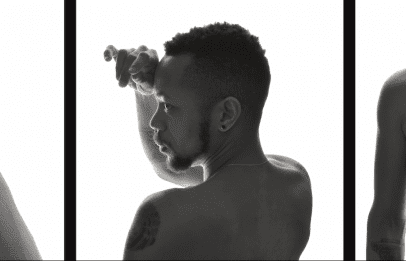
The result is a series of 50 triptychs, called Photographic Triptychs on Male Beauty. Because he’s a director — where his job is, in a sense, simply to see — he describes his series as a “voyeur’s defense of exhibitionism.”

It’s a bit of a who’s who of queer guys in Toronto — if you haven’t seen at least a few of them acting, stripping, singing, publishing or exhibiting, then you probably live in a cave. The triptychs will exhibit for one-night-only to celebrate Ecce Homo Theatre’s 10th anniversary.
“The aesthetic concept of it is pretty simple,” he says. “There’s a portrait in the centre, and the two side panels are something that speaks to that particular model. Sometimes they brought personal items with them for that. Sometimes they brought nothing.”
In other words, the side panels are where most of the heat and intrigue happens. You get a lot of tattoos and bare bums. Greg Wong has his camera, Michael Lyons has his notepad and Nathaniel Bacon has his penis — “it’s the only dick in the whole series, but it’s a really good one.”
Many of the pictures have great depth. In a particularly brave move, G Kyle Shields brought something he made using origami and a vacuum hose for his shoot. They represent both important moments in his past and ways he’s dealt with anxiety.

One of Yury Ruzhyev’s side panels is notable for its creativity, whimsy and shock value. “He asked me, ‘What about having disco balls?’” Newton says.“And I was like, ‘What do you mean?’” What he meant is not for the faint of heart.
(Photographic Triptychs on Male Beauty
Monday, Aug 10, 2015, 7pm
Videofag, 187 Augusta Ave, Toronto
eccehomotheatre.com)
(Photo credits: Panel 1, Chy Ryan Spain; Panel 2, Sze-Yang Ade-Lam; Panel 3, Yury Ruzhyev.)

 Why you can trust Xtra