Valentine’s Day is when athletic blond guys buy expensive gifts for tiny blonde girls in order to get sex. Or at least that’s the impression the soppy movies and tacky jewelry commercials that sprout up at this time of year tend to give.
Kayla Spag and her twin sister Jenna are sick of it. The pair, who host events under the name Feminist Twins, want to inject the holiday with a bit more meaning, and to include people usually left out of the occasion’s far-too-straight paraphernalia.
“[Occasionally Valentine’s cards] are from a man to a man, but not typically from a woman to a woman. There are no polyamorous ones or ones that say ‘to my partner’ or ‘partners,’” Kayla says. “And I’ve never seen a card that’s directed at genderqueer people or non-binary people.”
In 2015, they put together an event at Kind called the Non-Heteronormative Valentine’s Craft Night. People of all descriptions (including families with children) were welcome to come, socialize and make cards that conveyed messages they actually wanted to convey — messages not often featured on cards for sale in shops.
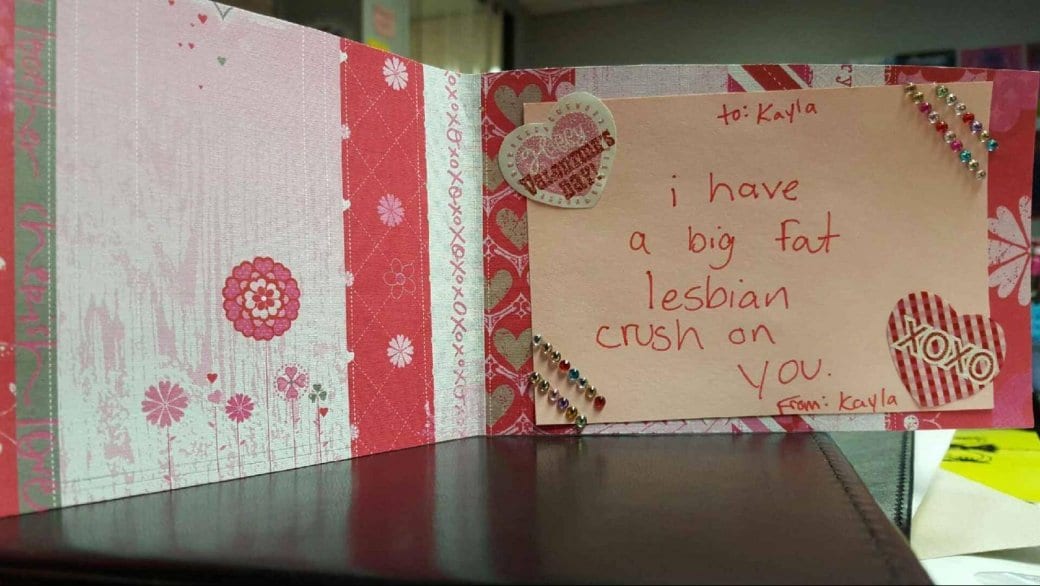
The messages could take into account a variety of gender identities, sexual orientations and relationship structures — whatever each attendee wanted. Kayla fondly remembers making a card for Kind’s executive director Carling Miller, which read, “I have a big fat lesbian crush on you.”
Kayla says that the crowd was large and enthusiastic, but response to the event was not uniformly positive. “Last year because of that event I actually got a lot of hate mail . . . an MRA from the States wrote a blog about me,” she says.
Undeterred, the Feminist Twins are set to host the second Annual Non-Heteronormative Valentine’s Craft Night. “You must be doing something right if people have a problem with what you’re doing,” she says. This time the event will be held at the café Pressed.
A variety of materials will be provided — card stock, beads, stickers, painting supplies and more — but attendees are encouraged to bring any extra materials they may have lying around.
She stresses that people can make any sort of meaningful gift they like — and that their skill allows — at the event. “It doesn’t necessarily have to be a card,” she says. “Last year I created a jar full of glitter and little messages of why I like my partner.”
With a primarily queer crowd, one thing is certain: everything will be festooned with cats, bow ties and angry slogans.
Non-Heteronormative Valentine’s Craft Night
Wednesday, Feb 10, 2016, 6:30pm
Pressed, 750 Gladstone Ave, Ottawa
For more info, visit Facebook.

 Why you can trust Xtra