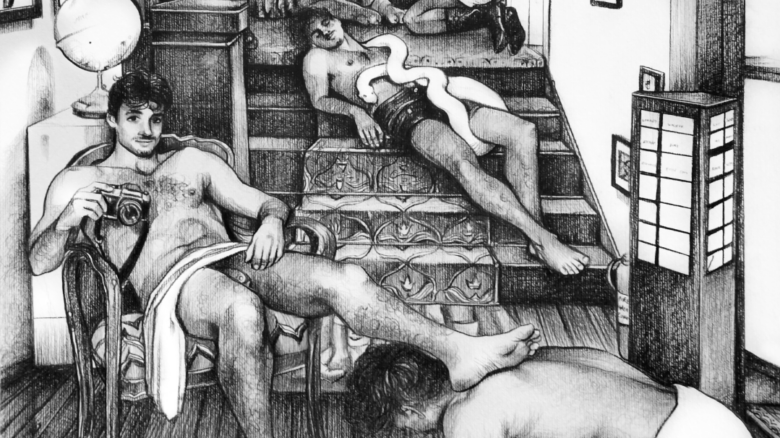
Meanwhile, in the African Union,
Under universal healthcare,
Where they all spoke Esperanto….
Think back to the first time you listened to Le Tigre. Admit it, you wished that Kathleen Hanna and co had prettier voices.
But their buoyant compositions, aerobic delivery and grad school–calibre observations won you over. And you’re glad they did.
Because you came to love the faults. You came to love the anyone-can-play-guitar punk philosophy. You came to recognize that loving average-sounding voices (as deceptive as that turned out to be) is, in a way, a kind of political statement.
As with Le Tigre, so with Tomboyfriend.
At turns slack, joyful, dark, scarred and sibilant, Ryan Kamstra’s less-than-virtuoso voice turns out to be one of Tomboyfriend’s strongest assets.
“Admittedly, it’s a bit of a connoisseur’s taste, but, I mean, those old blues recordings where people just sat down for two or three hours and cut an album…” says Kamstra. “It was a very rough, open delivery. I love those things. I love early punk recordings, too, which were terrible.”
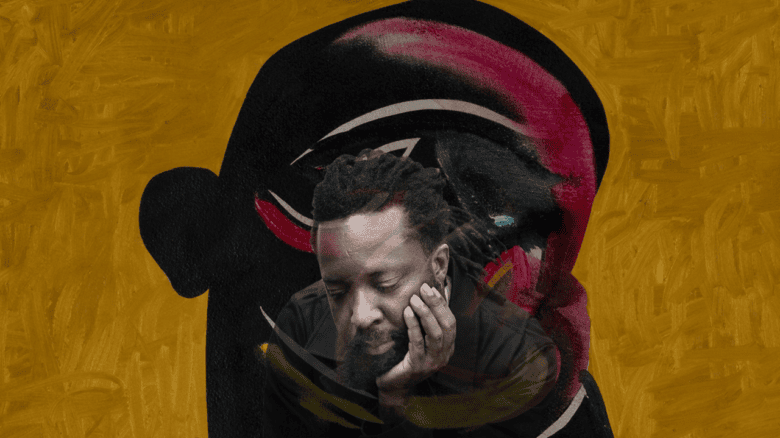
Kamstra will be familiar to some Xtra readers. The bisexual performer had two books of poems and two solo-ish albums under his belt before the Tomboyfriend project took root.
And Tomboyfriend is already, um, kind of a thing. Although its first album is set to launch mid-month, Tomboyfriend has been sharpening its songs against the iron file of live audiences for four years.
Those audiences have either turned into fans or, just as likely, been prone to text their friends a three-character assessment along the lines of “WTF.” And that’s not really surprising, since Tomboyfriend is, well, complicated. At their heart, the songs are both enthusiastic pop rock and coolly ironic commentary on themselves.
“It’s kind of a double irony appearance to the material, which is, on the one hand, gratuitously sincere and, on the other hand, plays up its emotionality. Its emotionality is both sincere and tongue-in-cheek,” says Kamstra.
It’s also a giant conceptual experiment — Don’t Go to School is a 12-track album featuring a large cast of non-professional musicians drawn from other creative disciplines, especially visual art.
“It was important for me to make a community band that was viable as music and still having artistic pretensions on top of that,” says Kamstra. “The songs mutated with the performers, which is what was supposed to happen. And as things mutated, I went back and rewrote the songs.”
The results? Kamstra calls it “baroque, over the top,” “sprawling and elaborate.” It is at turns ragged, lush, lovelorn and political.
Political, indeed. In fact, it sounds a little like Judy Rebick rewrote the book to Hedwig and the Angry Inch — other than the small matter of Auto-Tune, which dominates the mid-album thumper “Big in Afghanistan.”
Kamstra giggles before tackling the question.
“To play to my punk roots” — Kamstra begins the first of several attempts to explain his use of the synthy pitch-correcter made famous in Cher’s “Believe.”
“It’s taken as a given now that even those of us who have pretensions toward a higher culture, that we are all okay with pop culture,” he says next, then stops himself to recalibrate.
“The politics of the music business are transparent to us all, especially now as we’re watching the industry collapse. One of the things about the aesthetic of the big music industry is its over-engineering, its over-precision. I can’t quite shake off the fascist connotations of turning human voices, for example, into these things that are no longer human, basically a machine articulating it for you.”
And then one more try.
“I’m not writing off the surface pleasure; it’s still pleasurable, but…”
That’s exactly what Kamstra is after — holding simultaneously multiple understandings of the songs, ones that are by turns cultural critique, methodological innovation and, simply, pleasurable.
As Kamstra points out in “End of Poverty”:
From the galaxy of Gutenberg to the Videodrome, teens and tweens, they want to rock and roll.

 Why you can trust Xtra