Saturdays at 2am and Doll & Penny’s Café, at 1167 Davie St, would be hopping with club kids, drag queens, bar staff, sex workers and everyone in between.
The diner food was atrocious but the neighbourhood hub, known for its red Bonneville above the door, was a gay institution. The café enjoyed a brief, memorable run from the early 1980s to 1999, when the PumpJack Pub took over the space.
For Tony Correia and others who worked behind the counter, Doll & Penny’s was more than a late-night nacho spot — it was an oasis of belonging and sexual freedom.
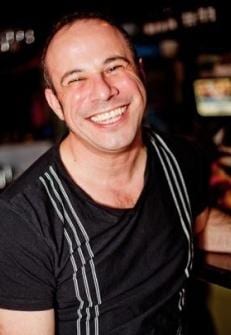
Now 43, Correia will chart Doll & Penny’s heyday in a new 19-part serial for Xtra, launching this issue.
The series, Foodsluts at Doll & Penny’s Café, will tell the café’s story through the eyes of those who frequented it. The first half of each chapter will run in Vancouver Xtra’s print edition, while the rest of the story will be published online.
The series is loosely based on letters Correia wrote about Doll & Penny’s and sent to Gord Shadrach, his friend in Toronto.
Years later, when Correia was living in San Francisco, Shadrach visited him for Christmas and gave him a book of letters and postcards Correia had penned from that time.
Correia returned to Vancouver’s West End in 2003, having already completed dozens of drafts of a memoir based on the letters. Shadrach was moved to tears when he heard their correspondence would become a serial.
Foodsluts is a love letter to a time and place, and an untold history of gay Vancouver. For Correia and others before him, Doll & Penny’s marked the beginning of new life as a gay man.
“I was a 20-year-old queer kid living in the shadow of my huge Portuguese-Catholic family,” he says. He was barely out of the closet.
“I needed to make my own decisions and find out who I was.”
He moved from Toronto to Vancouver in 1988. Within three days of arrival, he secured a one-bedroom apartment at the Holly Lodge on Davie and Jervis for $384 a month and a bartending job at Doll & Penny’s, which paid $4.95 an hour.
“That wasn’t my type of luck!” he says.
The circumstances were characteristic of a younger, more hospitable Vancouver, welcoming to newcomers and affordable for singles.
It was a great time to be out. The early 1990s meant the beginning of effective treatments for AIDS. “After this horrible decade of death and disease, we were starting to come through the fire again,” Correia says.
“Bill Clinton was campaigning and he was talking about gay people in the media, kd lang was coming out. There was a lot of pride.”
Correia hopes the series, illustrated by Xtra cartoonist Ken Boesem, will pay tribute to the strength of Vancouver’s gay community of the 1990s.
“What people are going to notice about the community 20 years ago is that they didn’t take shit from anybody,” Correia says. “They fought, tooth and nail, for everything. They didn’t give up. And they won.”
“Queer history didn’t just happen in New York and San Francisco,” Correia says. “It was happening all across North America.”
 Why you can trust Xtra