Depression and suicide are usually not welcome topics, which is exactly the stigma Olivier Ferlatte is trying to fight with the art exhibit still here.
“Sometimes when you have a topic that’s highly taboo, it’s very difficult to talk about,” he says.
Still here is part of Man-Up Against Suicide, a research project conducted through the University of British Columbia’s Men’s Health Research Program. Its aim is to de-stigmatize the issue of men’s depression and suicide.
The exhibit’s 29 subjects are gay and bisexual men who have been directly affected by suicide or suicidal ideation.

“We wanted to engage people, so we gave them cameras,” Ferlatte explains.
The participants were instructed to shoot anything that helped to describe their experience — things that triggered them, made them think about suicide, or helped them manage their suicidal thoughts — then bring the photos back as qualitative research.

“One of the great opportunities is we have all those images that are very powerful, so we want to show the photos to people to create a conversation,” Ferlatte says. “Art is often a very powerful way to talk about suicide.”
Suicide is the seventh leading cause of death among Canadian men, with gay and bisexual men being four times more likely than heterosexual men to attempt suicide, according to the research team.
Ferlatte joined the team last year to study queer men specifically.

“The problem is we don’t have a lot of people looking at this issue. So we actually know very little about why this is going on,” he says.
Common themes emerging from the research so far include experiencing homophobia and violence, poverty and social isolation.
“There’s not necessarily a single answer, but a complexity of factors. It’s feeling like you don’t belong, like you don’t have a place, and stories of trauma and violence, and a loss of hope,” he says.
“It’s not really talked about, it’s very hush-hush,” he says. “When people have those thoughts about suicide they feel they’re isolated, they think they’re the only person in the whole world who has experienced that pain or those thoughts.”

Ferlatte hopes the exhibit will help create awareness and lobby for prevention services for queer men in general, and then all queer people.
“I think people may think that it will be very depressing,” he says, “but it’s my experience that people felt very inspired by the strength and courage of the people who took the photos, and they felt empowered to talk about it.”
“It’s definitely affected me for the better,” says Jason Henrickson, who worked with visual artist Foster Eastman to create pieces based on his photos.
“When I first got involved in all of this, I didn’t think it was going to amount to what it has — I didn’t think it would reach so many people, so I’m very proud of it. It’s done a lot of positive things for me, my self esteem – it’s made me more artistic, too,” he says.
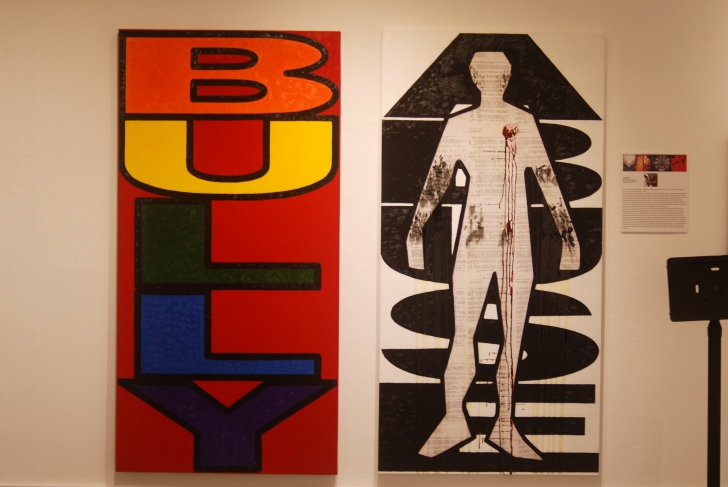
Henrickson’s photos highlight scars from self-harm and his struggles with anorexia. His art piece is a bold, multimedia diptych that he hopes will show people the lasting effects of bullying.
“I wanted to really vividly show how damaging that type of stuff is — I wanted it to be explicit and out there. Anorexia and cutting, those sort of things really dominated my life,” he says.
While the bulk of still here participants have faced suicide first-hand, there are also some like Adrian Pape, who lost a loved one to suicide. His video installation pays tribute to his father, who killed himself when Pape was 17 years old.
“It’s been a long time; every year that goes by it’s a little easier, of course, but also sad in a way that it’s becoming so distant. It was nice to dedicate some time and dig through that again and make something I can put forward as a tribute and then have this conversation, make it easier to have. Make an excuse for people to have it,” he says.
Pape hopes that by being open, he can help people breach a sensitive topic.
“Just being able to bring my community to this and have them know that I’m doing it —it’s become very important to me to become that beacon for people to talk them through.”
still here
Runs until Nov 13, 2016
Gallery gachet, 88 E Cordova St, Vancouver
menshealthresearch.ubc.ca
 Why you can trust Xtra