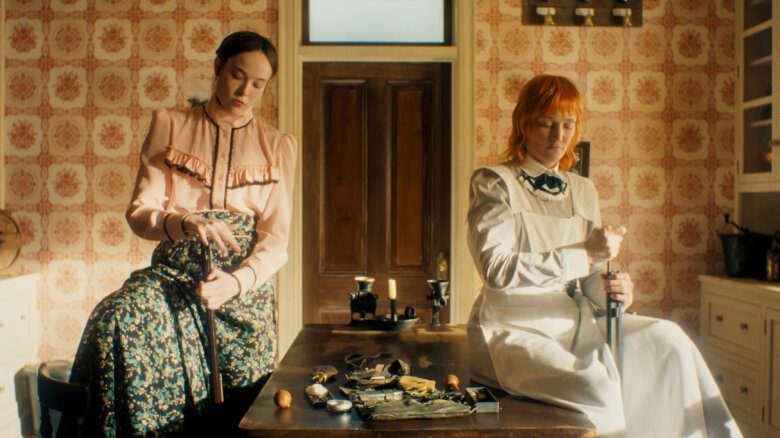
Some actors nail a particular character type that they end up playing over and over. But Kawa Ada’s calling card is his remarkable versatility. Whether he’s interpreting a Shakespearean king in a Bollywood-infused take on Much Ado About Nothing, a raving madman in Accidental Death of an Anarchist, or a douchey condo-flipper in Iceland, the Toronto-based artist manages complete metamorphosis each time.
For his current turn in Peter Hinton’s production of Bombay Black, Ada will once again sail uncharted waters, playing Apsara; a girl who lives with her mother, supporting them both by selling erotic dances to wealthy men. Penned by Anosh Irani in 2006, it’s part of Factory Theatre’s Naked Season, where Canadian classics are re-imagined with minimal production values.
“We haven’t changed the gender,” Ada says of his take on the role originated by actress Anita Majumdar. “I’m playing a woman. But it’s also not a camp or drag version of the character. It’s me trying to embody the female gender. Peter is really interested in the cross-sectionalities of gender and identity and what it means to have both the masculine and the feminine within us.”
While his training at the Boston Conservatory may partly account for his talent, one has to wonder whether Ada’s itinerant upbringing has anything to do with his chameleon-like abilities. Born in 1980 in Kabul, Afghanistan, to a politically prominent family, he fled with his parents when he was two at the onset of the Soviet invasion.
After moving between India, Pakistan and Switzerland over the next six years, the family landed in Scarborough; a place he felt somehow immediately at home.
“It was so perfect growing up there because it felt [like] the forgotten cousin of Toronto,” he says. “As I’ve grown older, I’ve felt the same way about Afghanistan. It’s thrown into the zeitgeist occasionally because of other people’s agendas, but then just recedes from popular consciousness again.”
A few years later he decided to attend Wexford Collegiate, the area’s only arts high school; a decision his parents did not initially support.
“It seems so cliché, but as immigrants they really wanted to see their kids have the potential for successful, fulfilling lives, which wasn’t something they thought was possible in the arts,” he says. “The arts were also being demonized by the Taliban at that point and so I think on some level they started to worry I might be ostracized by other Afghans. Now that they can see what I’ve accomplished though, it’s a different story.”
While they were able to accept his career choices, his sexuality was much more complex.
“This might be the political side of me, but as a community we’ve become so entrenched in shouting and making sure everyone supports us that we negate the developmental level of certain people who aren’t able to do that based on where they are at in that particular moment,” he says.
“When I saw my parents weren’t able to accept me initially, I went through all the facets of anger and self-loathing and deep sadness. But what I realized is that when someone is at the point of not being able to accept and you come back and acknowledge that’s okay, it actually opens lines of communication.”
Not pressing the issue seems to have worked. His parents have gradually come around, acknowledging he lives with a man and sending food home for his partner. While his many years of therapy and self-exploration aided his approach in dealing with them, a visit back to his country of birth as part of research for The Wanderers (his first full-length play which premiered at Buddies in 2014) also figured in by helping to crystallize how homosexuality is viewed in that culture.
“It’s not something that’s even spoken of,” he says. “I can’t really say there’s a movement even because it’s so oppressed. I don’t think it’s a conversation the culture is ready to have and I don’t think we can expect them to change any time soon.”
Bombay Black
Runs until Sunday, Dec 6, 2015
Factory Theatre, 125 Bathurst St, Toronto
factorytheatre.ca

 Why you can trust Xtra