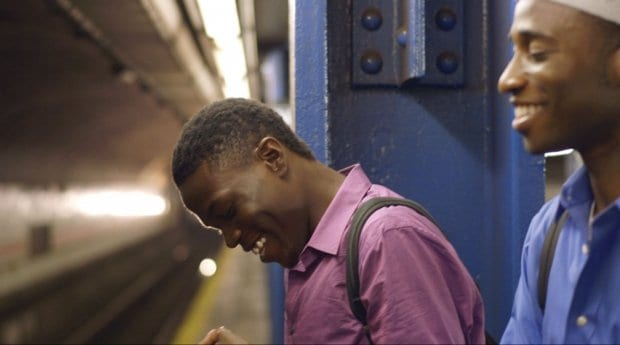
Brooklyn’s Bedford-Stuyvesant neighbourhood is the stage for the understated unfolding of a day in the lives of Naz and Maalik, two young Muslim men, who are exploring the beginnings of their closeted, mutual attraction while attracting the misguided interest of government authorities.
As the two lovers wander the streets — sneaking affectionate touches while peddling Christian saint cards, fragrant oils and lotto tickets — what’s striking is how familiar, natural and ordinary their everyday concerns and desires are. We are not used to seeing such an Average Joe portrayal of Muslims, accustomed as we are to fraught media coverage of automatic-weapon-toting ISIS and Boko Haram adherents, or terror-inducing attacks that inspire visceral speculation about their fundamentalist underpinnings.
Through the vehicle of their easy, sometimes-serious-sometimes-joking interactions, Naz and Maalik are humanized not objectified, revealing their anxiety about the state of the world, the creep of Manhattan-style gentrification into their neighbourhood, racial profiling, being outed to their families, and committing haram (sin).
Like many a proverbial good Catholic, or organized religion devotee, they feel some sense of duty to adhere to their faith’s tenets, even as they question whether their nascent relationship and street hustling are in keeping with Muhammad’s teachings, and argue over who will kill a chicken the halal way for a birthday celebration.
It’s surprising, almost out of place, that they are put under surveillance after they refuse an undercover cop’s amateurish bid to sell them a handgun. Enter a too-earnest FBI agent — and the film’s weakest character — Sarah Mickell, who is not so much a threatening presence as an annoying, petulant one, who lacks authority rather than commands it. Her prying and accusatory posture towards Naz, Maalik and their friend, Dan, as she roots about for any fundamentalist proclivities or terrorist links in the laidback neighbourhood appears contrived and unconvincing.
The contrast between the innocent teens’ city ramblings and the clumsiness of the security apparatus that turns its sights on the two is stark and laughable. “If you’re here with the NYPD, or you’re with the FBI, welcome. Sincerely. We expect you here; we hope that you will benefit and grow spiritually,” intones the imam — in a kind of theatrical aside — as he presides over the mosque that Naz and Maalik attend.
It’s when the teens interact with their families from whom they are hiding their relationship that the film’s tension palpably rises, heightening after Naz’s younger sister glimpses him in a liplock with Maalik and confronts him about his sin.
By the end of the film, the more tightly-wound Naz is in quiet torment, all but accused of being a national security threat while facing the prospect that his family might see him as a moral one.
Throughout, filmmaker Jay Dockendorf refrains from aggrandizing the boys’ predicaments and their reactions to them for dramatic effect, easy as it could have been to travel that route. Instead, the almost hushed, ground-level stroll we take with Naz and Maalik allows an effective glimpse into the farcical but insidious ways in which morality- and state-based fears of difference gradually and quietly chip away at a personal sense of self and security.
Naz and Maalik
Sunday, Aug 16, 2015, 7pm
SFU’s Goldcorp Centre for the Arts, 149 W Hastings St, Vancouver.
queerfilmfestival.ca

 Why you can trust Xtra