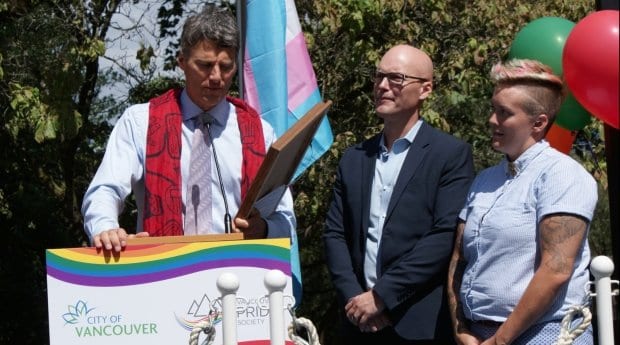
Vancouver’s queer community saw two firsts at City Hall July 27: a giant Pride flag was raised on the main flagpole for the first time and the trans flag was raised for the first time, nearby on the community mast.
Just before the banners were hoisted, Mayor Gregor Robertson paid homage to the Vancouver Pride Society for the Trans Equality Now pledge that all parade participants must sign this year. He too called on both the federal and provincial governments “to ensure all legislation protects trans rights and equality.”
Trans rights took centre stage as Vancouver’s municipal government kicked off Pride Week with seven trans and gender-variant activists and educators invited to sit in council chambers, in the seats usually reserved for elected city councillors. Drew Dennis, chair of the city’s LGBTQ2+ Advisory Committee, sat in the mayor’s chair.
The topic of invited guests’ discussion in the packed chambers was “Trans*Inclusion: What’s Next.”
“I am proud to be trans,” Dennis told the room.
Dennis says trans people face high levels of violence as well as barriers in housing and employment.
Trans youth often find themselves thrown out of their homes not knowing where to turn for support systems, adds Dennis, who identifies as non-binary and uses the pronoun they.
“Being out is not a safe or pragmatic reality,” they say. “We are not yet explicitly included in the human rights codes of Canada and British Columbia.”
Morgane Oger, chair of the Trans Alliance Society and an advisory committee member, says gender identity and gender presentation are protected by legal precedent — since some human rights decisions in BC have protected trans people — but trans rights are not explicitly protected by the BC Human Rights Code.
“We’re having difficulty getting two words and a comma added,” she says.
Getting emergency health care is also an issue, Oger explains. She says trans people often get poor service and face ridicule in emergency rooms. “In any other context, it’s called bigotry.”
Retired RCMP officer and advisory committee member Chase Willier says he is working with police to change attitudes and awareness toward trans people.
He called the Vancouver Police Department proactive and says he is working with the Justice Institute to instruct police cadets on diversity. “There will be lots of opportunities for open dialogue,“ he says.
Kai Scott, who co-chairs the Vancouver park board’s trans* and gender variant inclusion steering committee, pointed to the park board’s approval of 77 recommendations for trans inclusion in city parks in April 2014. “Community members have been treated as partners in change,” Scott says.
Psychologist Wallace Wong brought a list of suggestions to deal with barriers trans people face. He says trans youth face a lack of resources and need more support. “They worry about their future,” he says.
Schools, hospitals and health professionals need more resources and education, Wong says.
And, Wong says, Vancouver needs a surgical centre so trans people need not go to Montreal, far from their support systems, for major surgery.
Dora Ng, who sits with Scott on the park board steering committee, says she is often asked if there is something stopping the Chinese community from accepting queer and trans people, given the vocal opposition from some members of that community to the Vancouver School Board’s 2014 policy amendment to welcome trans people.
“My answer is ‘No,’” Ng says.
Ng says white people are never asked if there’s something blocking the white community from supporting gay people — “no matter how many Westboro Baptist churches or Tea Partys there are.”
“We need to have the right information out there that is culturally appropriate,” Ng says.
The special council session was followed by speeches and the double flag-raising on the steps of City Hall.
Editor’s note: This article was amended on July 28 to clarify that trans people are protected by legal precedent in BC but not explicitly included in the provincial Human Rights Code.
 Why you can trust Xtra