Credit: VQFF
The screening of this film has been cancelled. In its place, the Vancouver Queer Film Festival will feature a second screening of Sydney Freeland’s Drunktown’s Finest at the same venue and time slot.
— Natasha Barsotti
***
“I thought homosexuality was not normal, back then,” confides one of the five mothers interviewed in My Child, Can Candan’s heartwarming documentary about the complexities of raising lesbian, transgender and gay kids in Turkey.
Characteristic of the parents featured, this mother’s anxious initial responses were founded on the depressingly familiar perspectives she’d absorbed from social orthodoxy: that sexual minorities of all types are shameful, sinful or diseased, and that prayer, secrecy, denial and corrective measures (based on unhelpful advice from doctors, school counsellors and psychiatrists) are acceptable counter-measures.
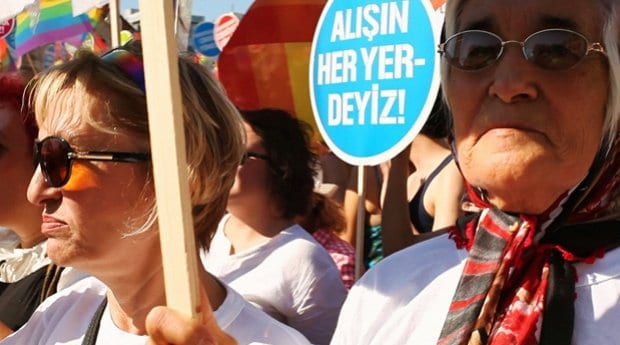
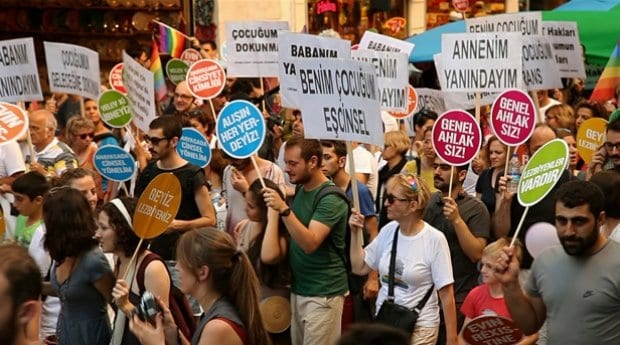
The arc of Candan’s story is hopeful, though. By the end, this mother not only has a close relationship with her son, but is handing out rainbow pamphlets with other parents, marching in Istanbul’s 20th Pride march and actively working to get an anti-discrimination statute passed by the Turkish parliament.
The first half of Candan’s film features seven parents speaking candidly to a camera. They’re from all walks of life and forthright about their expectations for their children and their lack of tools for handling their children’s differences. One mother admits to harassing her son to “behave more like a man.” Another parent prayed, “Please, God, make this right,” while another confesses her own suicidal thoughts stemming from the stigma of having a gay child.
“I thought he was psychotic,” one parent admits, while another says she now feels aghast that she avoided the topic for an entire decade.
It’s honest if painful viewing. Though specifically addressing Turkish parents, the story resonates because it’s so universal.
Gradually, the true bonds with their children make the parents realize that their choice — between their own children and the homophobic forces of social convention that ostracize and hurt — is no choice at all: love trumps everything.
The second part of the film opens with a meeting. Years after their initial missteps, the parents now belong to a vocal LGBT parents’ group. But society lags. Turkey’s minister of family affairs still regards homosexuality as “a sickness.” The parents know that as long as such beliefs exist, their children and others remain in danger of exclusion, discrimination and harm.
The parents have become full-fledged activists.
Despite its optimism, My Child doesn’t skip over the hard work of overcoming prejudice. And traumatic anecdotes passed between the parents about a brutal murder and a transgender friend abducted by angry men with weapons remind everyone of the work that still needs to be done.
My Child
Mon, Aug 18, 9pm
International Village, 88 W Pender St
 Why you can trust Xtra