Straight-looking and straight-acting I ain’t. Which is why I seldom get asked to play overtly straight roles, unless you count the mayor of Whoville.
Or the mostly straight married-with-children-and-a-dodgy-past man I was recently asked to play. (My success at pulling off that role depends on who you ask, which is why I’m very careful about who I ask.)
I’m no Meryl Streep; I’m simply better suited to play some characters. Characters closer to home — that home being located at the corner of Fabulous and Gay.
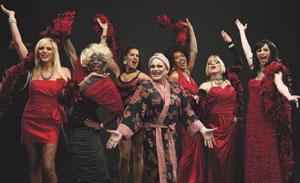
So I was thrilled when Vancouver’s Playhouse Theatre asked me to portray the fabulously gay Albin in its upcoming production of La Cage aux Folles.
Okay, they didn’t just ask me — I had to fight for it. And I fought hard.
For those of you who don’t use broadway.com as your homepage, La Cage (to paraphrase vancouverplayhouse.com) tells the tale of a family’s struggle to stay together, stay fabulous, and stay true to itself.
Georges owns a glitzy nightclub in St Tropez, and Albin, his partner in business and love, is the glamorous chanteuse, Zaza. When their son Jean-Michel brings his fiancée’s conservative parents home to meet the in-laws, family bonds are put to the test as the feather boas fly.
To say I really wanted this part would be a colossal understatement. In this business we call show, Albin is what we refer to as “the role of a lifetime.”
It’s also a role I’ve dreamed of playing since the play opened on Broadway in 1983.
It was my second year of theatre school and I was close to throwing in the thespian towel. I had just come out, and one of my less socially enlightened and more clinically paranoid theatre instructors was trying to beat the gay out of me. She was certain it would end my career before it started.
“If they know you’re gay, you’ll be typecast for the rest of your life,” she said.
Worse than her opinion was my willingness to believe it.
I’d spend my afternoons in scene study classes, failing miserably as Stanley Kowalski. Or Romeo. Even the role of Helen Keller’s father escaped me. No one believed I was capable of siring a child — not even a deaf, dumb and blind one.
After class, I would pull up my legwarmers, slouch into my torn sweatshirt and trudge home to comfort myself with original cast recordings blaring from my ghetto blaster, including La Cage. My nights would frequently end at JP’s, Windsor’s only gay bar, where I’d drown my sorrows in fuzzy navels and try not to think about what a bad actor I was turning out to be.
Then one night, my two worlds came crashing together with a synchronicity that changed my life.
I was spinning away my cares on the lit-from-below dancefloor when I heard familiar lyrics set to an unfamiliar disco rhythm.
Life’s not worth a damn till you can say, I am what I am.
It was the closing number from Act 1 of La Cage, a song that, thanks to Gloria Gaynor, was destined to become a gay anthem for a generation.
And I saw a glimmer of hope. A spark of light from the spinning disco ball convinced me not to change my major from drama to education, but to instead face down that one instructor whose opinion, in the great scheme of the fabulous universe, would amount to little.
Years later, in what was probably a collect call, I was telling my mother about yet another role that would require me to kiss a boy or wear a dress or both.
“I seem to play a lot of the same type of characters,” I demurred.
And with her stalwart southwestern Ontario wisdom, my mother replied, “Better typecast than not cast.”
It’s going to be the title of my memoir.
 Why you can trust Xtra