Arias, overtures and parlando. Yes, opera can be intimidating for a novice. But what better reason to learn? The Canadian Opera Company has some exciting new shows this season, and Xtra‘s opera maven, Lydia Perovic, provides a preview, as well as a few tips for those readers looking to impress a date.
Be sure to check back for more Opera 101 installments.
Peter Grimes (1945)
Benjamin Britten.
Libretto by Montagu Slater
Based on George Crabbe’s poem “The Borough.”
Conductor Johannes Debus, stage director Neil Armfield.
Revival director, Denni Sayers
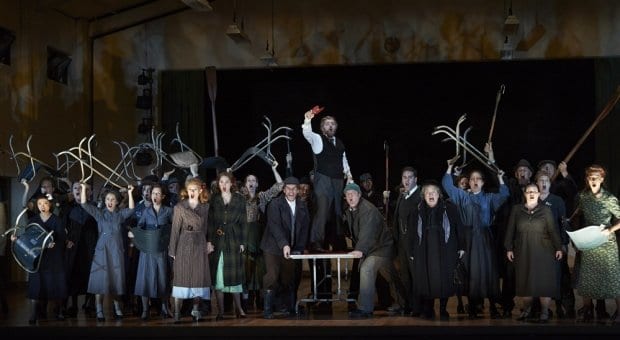
What happens? That is the question. On the most obvious level, residents of a small fishing town scapegoat and bully an outcast, who in turn bullies the only demographic that he can: his boy apprentices. By the final act, the violence from both sides escalates irreparably. But what is the original reason behind Peter Grimes’s outsider status? Does the Borough suspect something else in the nature of his relationships with boys? Why is Grimes violent and incapable of compassion — had he first endured violence himself? And is the scapegoat always necessary for the making of a community?
How much is the lead soprano tortured? We have a twist here, ladies and gents: it is the principal tenor who is given most torture air time: Peter Grimes. Britten liked his operas homosocial and created a number of roles, including Grimes, for his partner Peter Pears. The principal soprano can make a lot of the multilayered role of the widowed schoolmistress Ellen Orford, who shows sympathy for Grimes and is trying to understand and act amidst competing duties and affinities. Interesting characters can be created out of the many the smaller roles, too.
Why you should go. It will be up to you to decide what it is that you witnessed and whether Grimes is to be pitied or blamed. The undercurrent of homophobia and child-molestation panic is the work’s unspoken but very strong frequency. Grimes could be also a statement on post-war Britain. Now that the war is over, what is it that we are returning to — destitution, small-town mentality, self-chosen isolation, fear of the unfamiliar, the easy shunning rather than the difficult communication? Social psychologists and psychoanalysts will particularly be interested in this opera as it invites us to take a closer look at the so-called constitutive outside of the communal moments between humans. (By the way, when was the last time you felt immediately closer to somebody by a joint session of badmouthing a third party? Yeah, me too.)
What to look for in the music? The orchestral interludes — which feel like a melodic, lyrical suspension of the largely dissonant musical drama. I am partial to Ellen’s “Embroidery” aria and the slyly menacing way the church music is used in the sunny Sunday scene of Act 2. Those intimate moments when Grimes is alone and trying to become knowable to himself are also special, but equally — the social bullying via music and how the composer dramatized that. You will also notice a frustrating but meaningful blockage: the boy never says a word, spoken or sung.
What kind of date to bring? Not first-date material, this. Bring people who are into tenors — and you can discuss the type of characters this rarest of all operatic voices gets a lot of the time (to wit: heroes who get very flustered by the role given to them and make a dreadful mess). Anybody who’s seen or read Suddenly, Last Summer or The Children’s Hour, both films based on plays in which homosexuality is too horrible to be even conceived of in precise terms. People interested in war studies and post-war Europe. Anglophiles.
Conversation starter at the intermission: “Did you know that Britten first asked Christopher Isherwood to write the libretto? I wonder what this work would be like had he said yes.”
Peter Grimes
Sat, Oct, 5–Sat, Oct 26
Four Seasons Centre for the Performing Arts, 145 Queen St W
coc.ca
 Why you can trust Xtra